Best Cattle Feed for High Milk Production in India: A Complete Guide for Dairy Farmers
क्या आपकी गाय या भैंस उतना दूध नहीं दे रही जितना होना चाहिए? Most of the time, the answer isn’t a medical problem — it’s nutrition. The right cattle feed can increase milk yield by 15–30% without any other changes to your farming routine.
Why Feed Quality Directly Impacts Milk Production
Milk is made from nutrients absorbed from the bloodstream — and those nutrients come entirely from what your animal eats. A dairy cow producing 10 litres of milk per day needs:
- Crude Protein: 14–18% of dry matter intake
- Total Digestible Nutrients (TDN): 65–75%
- Calcium: 0.6–0.8%
- Phosphorus: 0.3–0.45%
- Dry Matter Intake: 3–3.5% of body weight daily
When these needs aren’t met through feed, the animal draws from its own body reserves — losing weight, reducing immunity, and dropping milk output.
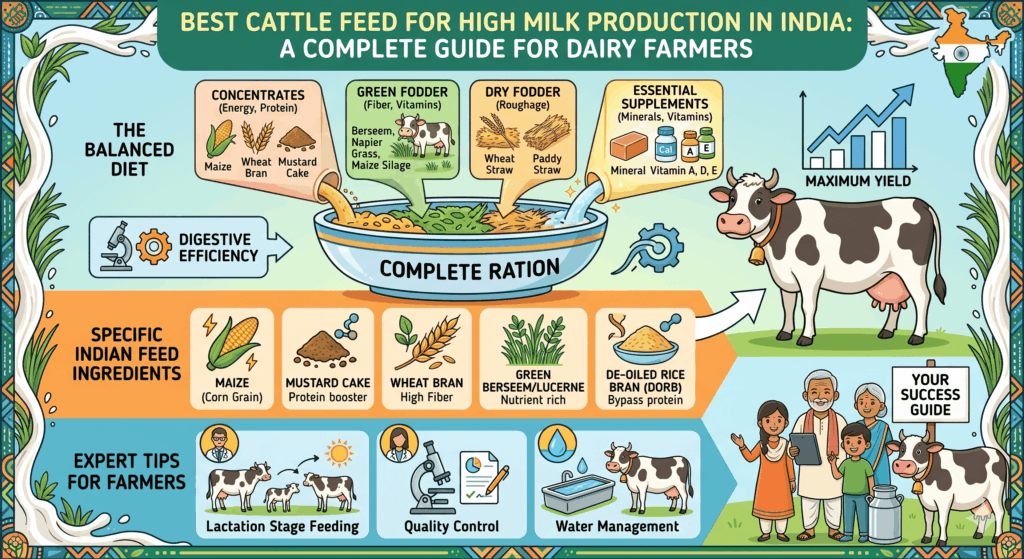
The 4 Key Components of High-Quality Cattle Feed
1. Concentrates (Daana / दाना)
Concentrates are energy-dense feeds that form the backbone of a milk-producing animal’s diet.
What to look for:
- Maize (corn), groundnut cake, cottonseed cake, soybean meal
- DDGS (Distillers Dried Grains with Solubles) — a cost-effective high-protein ingredient increasingly used by Indian dairy farmers. See our detailed guide: How Much DDGS to Include in Dairy Cattle Feed
- De-Oiled Rice Bran (DORB) — a widely available Indian byproduct that provides energy and digestible protein at low cost. Learn how it’s processed: How De-Oiled Rice Bran (DORB) Is Made
- Bypass protein sources that reach the small intestine without rumen degradation — these directly boost milk protein content
- A good concentrate mix should provide 18–22% crude protein for lactating animals
Pro tip: Locally blended concentrates are often cheaper but check for aflatoxin contamination, especially in groundnut-based mixes during monsoon season.
2. Roughage (Chara / चारा)
Roughage maintains rumen health and fat content in milk. Without adequate fiber, milk fat percentage drops — which directly affects your price if you sell to dairies.
Good roughage options:
- Green fodder: Napier grass, berseem, lucerne (alfalfa)
- Dry roughage: wheat straw (parali), paddy straw
- Silage: maize silage is increasingly popular for year-round green fodder availability
Ideal ratio: 60% roughage : 40% concentrate for high-producing animals (adjust based on milk yield)
3. Minerals and Vitamins
This is where most Indian farmers lose significant milk production without realising it.
Critical minerals for dairy animals:
- Calcium & Phosphorus — bone health, milk synthesis, prevents milk fever after calving
- Magnesium — rumen function, grass tetany prevention
- Zinc & Selenium — immunity, reproductive performance, udder health
- Iodine — thyroid function, affects milk yield indirectly
A good mineral mixture (Mineral Mixture / खनिज मिश्रण) should be fed at 50–80g per animal per day. Don’t skip this — it’s low cost, high impact. For a full breakdown of supplement options available in India, read: Animal Feed Supplements in India: Market Trends and Opportunities 2026
4. Water — The Most Overlooked Nutrient
A lactating cow or buffalo needs 50–80 litres of clean water per day. Even mild dehydration (5%) can reduce milk yield by up to 20%. Always ensure 24-hour access to clean water.
Feeding Schedule for Maximum Milk Production
| Time | What to Feed |
|---|---|
| Early Morning (5–6 AM) | Green fodder / silage + mineral mixture |
| After Morning Milking | Concentrate mix (based on milk yield) |
| Afternoon (1–2 PM) | Dry roughage + water |
| Evening | Green fodder + remaining concentrate |
| After Evening Milking | Small amount of concentrate as reward |
Rule of thumb: Feed 1 kg of concentrate for every 2.5 litres of milk produced above 5 litres. So a buffalo giving 12 litres needs roughly 1 kg base concentrate + 2.8 kg additional = ~3.8 kg total concentrate daily.
Common Feeding Mistakes That Reduce Milk Yield
❌ Feeding the Same Amount Regardless of Stage
Nutritional needs change through lactation. Peak lactation (weeks 4–8 after calving) needs maximum nutrition. Dry period needs different feed composition to prepare for the next lactation.
❌ Sudden Feed Changes
Changing feed abruptly disrupts rumen microbes and causes digestive upset, diarrhoea, and a sharp drop in milk. Always transition over 7–10 days.
❌ Ignoring Body Condition Score (BCS)
A thin animal (BCS below 2.5) cannot produce maximum milk no matter how much you feed — she’s using nutrients for survival first. Bring BCS to 3–3.5 before and during peak lactation.
❌ Poor Quality Roughage with No Supplementation
Paddy straw alone has very low nutritional value. If it’s your primary roughage, you must compensate heavily with concentrates and urea-molasses mineral blocks (UMMB). Adding De-Oiled Rice Bran (DORB) to the ration is a practical, low-cost way to boost energy density when green fodder is scarce.
❌ Skipping Mineral Mixture
This is India’s #1 feeding mistake. Mineral deficiency is widespread and causes: poor fertility, delayed conception, weak calves, mastitis, and 10–25% lower milk production.
Special Situations: What to Feed
Transition Period (3 weeks before and after calving)
This is the most critical phase. Feed requirements shift dramatically. Use:
- Anionic salts in the last 3 weeks of pregnancy to prevent milk fever
- Niacin supplementation to prevent fatty liver
- Gradually increase concentrates starting 2 weeks before calving
Summer Feeding (April–June)
Heat stress reduces feed intake by 10–20%. Counter this by:
- Feeding the bulk of concentrates in cooler hours (early morning, late evening)
- Adding electrolytes to water during peak heat
- Including sodium bicarbonate (baking soda) at 100–150g/day to buffer rumen pH
Monsoon Season
- Risk of mycotoxin contamination in stored feed increases
- Check all stored grains and cakes before feeding
- Reduce lush green fodder suddenly — introduce gradually to avoid bloat
How to Evaluate a Commercial Cattle Feed / Pellet
When buying packaged cattle feed (pellets or mash), check the label for:
| Parameter | Minimum Standard (Lactating) |
|---|---|
| Crude Protein | 18–22% |
| Total Digestible Nutrients | 70%+ |
| Crude Fibre | Less than 12% |
| Moisture | Less than 11% |
| Calcium | 0.6–1.0% |
| Phosphorus | 0.3–0.5% |
Also check: BIS certification (IS:2052) — this ensures the feed meets Indian quality standards. Avoid loose feed from unregulated sources.
Indigenous Breeds vs. Crossbreeds: Does Feed Differ?
Yes — significantly.
| Animal Type | Concentrate Requirement | Key Focus |
|---|---|---|
| HF / Jersey crossbreeds | High (4–6 kg/day for 15L+ milk) | High protein, bypass protein |
| Murrah Buffalo | Moderate-high (3–5 kg/day) | Energy-dense, high TDN |
| Gir / Sahiwal (desi breeds) | Lower (2–3 kg/day) | Focus on quality roughage |
| Local mixed breeds | Low-moderate | Roughage quality + minerals |
Desi breeds are more feed-efficient but have lower peak production. Crossbreeds need more precise nutrition to reach genetic potential.
The Economics: Does Better Feed Pay Off?
Let’s do a simple calculation:
Scenario: Buffalo giving 8 litres/day on basic feed
| Item | Basic Feeding | Improved Feeding |
|---|---|---|
| Milk per day | 8 litres | 11 litres |
| Milk price (₹) | ₹50/litre | ₹50/litre |
| Daily milk income | ₹400 | ₹550 |
| Extra feed cost | — | ₹50–70/day |
| Net gain | — | ₹80–100/day extra |
Over a 300-day lactation, that’s ₹24,000–30,000 additional income per animal — for a feed investment of ₹15,000–21,000. The ROI is clear.
Quick Summary: Top 5 Tips for More Milk
- Feed a balanced concentrate — don’t rely on roughage alone
- Never skip mineral mixture — 50–80g/day, every day
- Provide unlimited clean water — 24 hours a day
- Maintain Body Condition Score between 3.0–3.5 through lactation
- Transition feed changes slowly — 7–10 days minimum
About Brinda Foods
Brinda Foods manufactures high-quality animal feed products designed for Indian dairy and livestock farmers. Our formulations are developed with balanced protein, energy, and mineral profiles to help your animals reach their true production potential.