
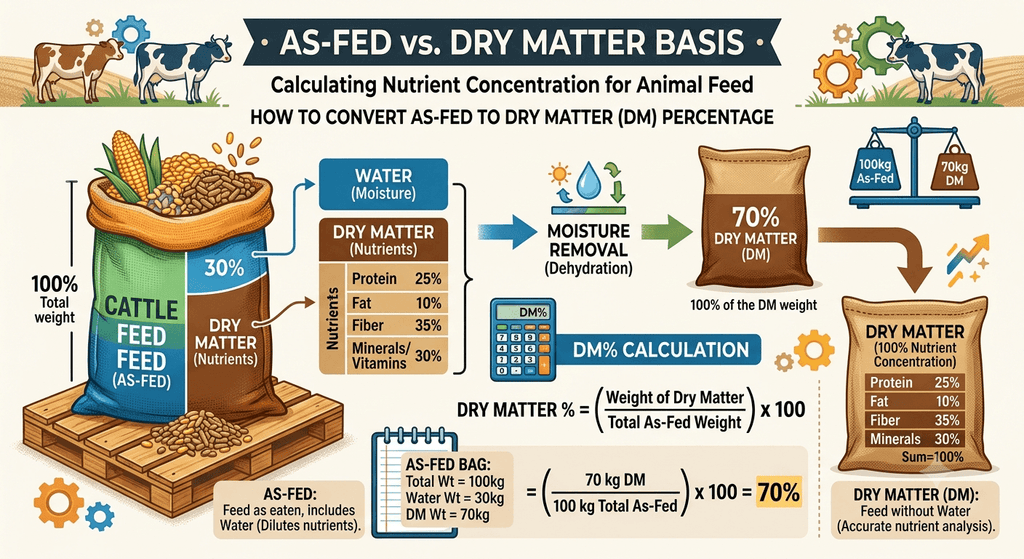
Quick answer: Knock the moisture off 100 to get dry matter. Then divide your as-fed number by that dry matter (as a fraction). DDGS at 10% moisture has 90% DM, so its 27% as-fed protein becomes 27 ÷ 0.90, which is 30% on DM. To come back, multiply by the same 0.90.
Say two Soya DOC offers come in on the same morning. One says 46% protein, the other 50%. Most buyers lean towards the 50% one. Then they spot “DM basis” written in small print under it.
Put both on the same basis and the 46% offer comes out ahead. It’s a common mix-up, and sorting it out takes nothing more than a calculator.
Below are worked numbers for DDGS, Soya DOC, DORB, maize silage and green berseem. There’s a conversion table and a sample ration near the end.
What is the difference between as-fed and dry matter basis?
As-fed is the feed as your godown receives it. Moisture and all. It’s the weight on the slip, the weight on the bill, the weight in the mixer.
DM basis pretends that moisture was never there. You can’t do that to the actual bag, obviously, so the lab does it with numbers instead.
Old reference books sometimes say “air-dry basis”. That one just assumes the feed is about 90% dry.
| Basis | Water counted? | Where you usually see it |
| As-fed / as-is | Yes, at actual moisture | Invoices, trade specs, mixer sheets, bag labels |
| Dry matter (DM) | No, water removed on paper | Lab reports, feeding standards, ration software |
| Air-dry | Fixed at about 10% | Older reference tables |
Water doesn’t feed the animal. More moisture in a lot means lower as-fed figures across the board, while the dry stuff inside stays exactly what it was.
What is the conversion formula?
All you need off the report is moisture. Subtract it from 100 and you have your dry matter percentage. To get a DM value, divide the as-fed value by that dry matter written as a fraction, so 90% becomes 0.90. To get back to as-fed, multiply by the same fraction.
Your DM number should come out bigger. If it’s smaller, you’ve multiplied where you meant to divide. Happens to everyone.
Protein, fat, fibre, ash, calcium, phosphorus, TDN, ME, trace minerals. Same working for all of them. Skip moisture though. On DM it’s zero anyway.
And use the moisture for that lot. Not last month’s. Not a rough guess.
How to convert a feed value, step by step?
- Moisture first. Read it off the report for this lot. Nothing else on the sheet matters until you’ve got it.
- Find the dry matter. 100 minus moisture. Soya DOC at 11.5% moisture leaves you 88.5.
- Do the sum. As-fed to DM, divide by 0.885. DM to as-fed, multiply by 0.885.
- Gut check. Did the number go up when you moved to DM? Good. For dry concentrates it rises a little. For fresh fodder it can shoot up five or six times, and that’s fine.
Why do lab reports and supplier specs use different bases?
Labs go with DM so samples can be compared. Two DORB lots at different moisture only line up properly once the water’s taken out of both. If you want each line of a proximate analysis explained, see our guide on how to read a feed lab report.
Quotes and contracts usually stay as-is, with a moisture cap. You’re billed on what the truck weighs.
Ration software works on DM. So do feeding standards. The cow needs a certain amount of dry feed, and the water isn’t part of that.
Trouble starts when a DM figure sits next to an as-is one. For the same material, a DM certificate can read two to five points higher. Our Certificate of Analysis guide shows where the basis usually gets mentioned.
How do you compare two suppliers quoted on different bases?
Same two Soya DOC offers. Prices are just examples, use your own.
| Detail | Supplier A | Supplier B |
| Protein as quoted | 46.0% (as-is) | 50.0% (DM basis) |
| Moisture | 11.5% | 12.0% |
| Dry matter | 88.5% | 88.0% |
| Price | ₹47 per kg | ₹46 per kg |
Bring B down to as-fed and it’s 50 times 0.88, so 44% crude protein. Take A up to DM and it’s 46 divided by 0.885, so 52%.
Either way, A is two points ahead. B was a 44% meal quoted on DM.
Now work out the cost of the protein itself. You pay for what’s delivered, so stay on as-fed. A costs ₹47 ÷ 0.46, which is about ₹102 per kg of protein. B costs ₹46 ÷ 0.44, about ₹104.5.
B saves you a rupee on the kilo and then charges over two rupees more on the protein. Over a 25 tonne order, that’s not small. You also get a little more water with B.
That’s why our Soya DOC specs always show moisture right beside protein. Converting then takes seconds.
Worked examples for concentrates: DDGS and DORB!
- Maize DDGS
Take a Maize DDGS lot with 10% moisture, 27% crude protein and 9% ether extract, as-fed. DM is 90%, so protein on DM comes to 30% and ether extract to 10%.
For concentrates the gap is only about a tenth. Easy to miss when the QC desk is rushed.
- De-Oiled Rice Bran (DORB)
A De-Oiled Rice Bran lot reads 9.5% moisture and 15.4% crude protein as-fed. With 90.5% DM, protein on DM is 17%.
Next truck, same bran, 12% moisture. As-fed protein now shows just 15%. The bran is identical. It’s only wetter.
How do you convert green fodder or silage values?
With wet feeds the mistake gets much bigger, since most of the weight is water.
- Maize silage
Good maize silage is usually near 30% DM. A report showing 2.4% crude protein as-fed means 8% on DM. Feed 20 kg and the cow gets 6 kg of dry matter.
- Green berseem
Berseem is the usual winter fodder in Haryana and Punjab. A normal cut might be 15% DM with 3% crude protein as-fed. On DM, that’s 20%.
So 30 kg of fresh berseem gives 4.5 kg of dry matter and 0.9 kg of crude protein.
On DM, that’s more protein than DORB has. Surprises most people the first time.
Berseem DM also moves from one cut to the next. A very green early cut can drop near 12% DM. Then those same 30 kg give only 3.6 kg of dry matter, around 20% less, and the scale won’t show any difference. Plenty of nutritionists run a quick oven or microwave DM test on fodder and silage every week or two for this reason.
Which basis should ration targets be written on?
DM for targets. As-fed for buying and mixing. Convert between them.
Our cattle feed formulation guide suggests 14 to 16% crude protein on DM for an average milking cow. A simple daily ration, checked against that:
| Feed | As-fed (kg) | DM % | DM (kg) | CP % of DM | CP (kg) |
| Green berseem | 30 | 15 | 4.5 | 20.0 | 0.90 |
| Wheat straw | 5 | 90 | 4.5 | 3.6 | 0.16 |
| Concentrate (20% CP as-fed) | 4 | 90 | 3.6 | 22.2 | 0.80 |
| Total | 39 | 12.6 | 14.8 | 1.86 |
That’s 1.86 kg of protein in 12.6 kg of dry matter, or 14.8% on DM. Inside the range.
Divide the same 1.86 by the 39 kg as-fed total and you get 4.8%. That looks far too low, so someone tips in more protein meal. The ration is now overfed and dearer, and nothing was actually wrong to begin with.
Feeding paddy straw instead of wheat straw? Same steps. Our paddy straw feeding guide has its values and feeding limits. For the concentrate side, read our article on concentrate feed for dairy cows.
Conversion table: Common Feed Ingredients!
Typical North Indian values, only as a guide. Formulate from your own lot report.
| Ingredient | Moisture % | DM % | CP as-fed % | CP on DM % |
| Maize DDGS | 10.0 | 90.0 | 27.0 | 30.0 |
| Rice DDGS | 10.0 | 90.0 | 45.0 | 50.0 |
| Soya DOC | 11.5 | 88.5 | 46.0 | 52.0 |
| Mustard DOC | 10.0 | 90.0 | 36.0 | 40.0 |
| DORB | 9.5 | 90.5 | 15.4 | 17.0 |
| Maize grain | 12.0 | 88.0 | 8.8 | 10.0 |
| Wheat straw | 10.0 | 90.0 | 3.2 | 3.6 |
| Maize silage | 70.0 | 30.0 | 2.4 | 8.0 |
| Green berseem | 85.0 | 15.0 | 3.0 | 20.0 |
Want specs for our Mustard DOC or Rice DDGS? Ask us. Moisture is listed beside protein on both.
Common conversion mistakes (and easy fixes)!
Mixing as-fed and DM values in the same software sheet. This one causes the most damage, and nobody notices until the ration looks odd. Keep everything on DM.
Reusing an old moisture figure. Stock picks up moisture in the monsoon. If a lot has gone from 10% to 13% moisture, every nutrient on the as-fed sheet is about three points lower. Our storage guide for DDGS, Soya DOC and DORB covers how to keep moisture down in storage.
Dividing a figure that’s already on DM. Feed tables often list DM values to begin with, so check the column header before you divide.
Handing over a DM sheet to the loader. He weighs as-fed, so the final mixing sheet needs to be converted back.
How we handle this at Brinda Foods?
Honestly, this is one of the simpler problems in feed buying, once someone points it out. On our specs you’ll find moisture sitting right next to protein, so your team never has to guess the basis. Ask and we’ll send the same figures on DM too, ready for your nutritionist’s sheet.
Comparing two quotes and not sure which one really gives more protein? Send us an enquiry with both, and we’ll work it out with you.
Frequently asked questions!
- What does ‘as-fed basis’ mean in animal feed?
Feed values worked out with the moisture still in. Your invoice, your weighbridge slip and your mixing sheet all use it. - How do you convert as-fed to dry matter basis?
100 minus moisture gives you DM%. Divide the as-fed figure by that DM% over 100. DDGS at 27% protein and 10% moisture: 27 ÷ 0.90, so 30% on DM. - How do you convert dry matter basis back to as-fed?
Multiply instead. 50% protein on DM, 12% moisture: 50 × 0.88 = 44% as-fed. - Is a dry matter value always higher than the as-fed value?
Every time. The wetter the feed, the wider the gap. With concentrates it’s small, with silage it’s huge. - Should ration targets be on as-fed or dry matter basis?
DM for targets. As-fed for the mixing sheet. Balance first, convert back at the end. - Why does green fodder look so low in protein?
It’s mostly water, often 80 to 88%. Berseem at 3% protein as-fed is roughly 20% once you take the water out. - Which nutrients need converting?
All except moisture. Protein, fat, fibre, ash, calcium, phosphorus, TDN, energy. Same formula for each.

[…] walks through every line. And if you’re comparing two lots with different moisture, read up on as-fed vs dry matter basis […]
[…] and when comparing protein from two suppliers, put both reports on the same basis first. The as-fed vs dry matter guide shows you […]
[…] at 8% moisture that only just meets the 24% mark will show about 22% protein as fed. Our note on converting as-fed and dry matter values explains the conversion if you need […]
[…] dry matter values and a few quote as fed, so if you’re holding two lab reports side by side, convert them first or you’ll be comparing apples with […]
[…] are on dry matter or as fed. I’ve seen buyers compare one of each and draw the wrong conclusion. Convert them to the same basis […]
[…] on dry matter will read about 20.7% protein on the bag. Not a typo, just maths. Our piece on as-fed vs dry matter basis shows how to convert one to the […]