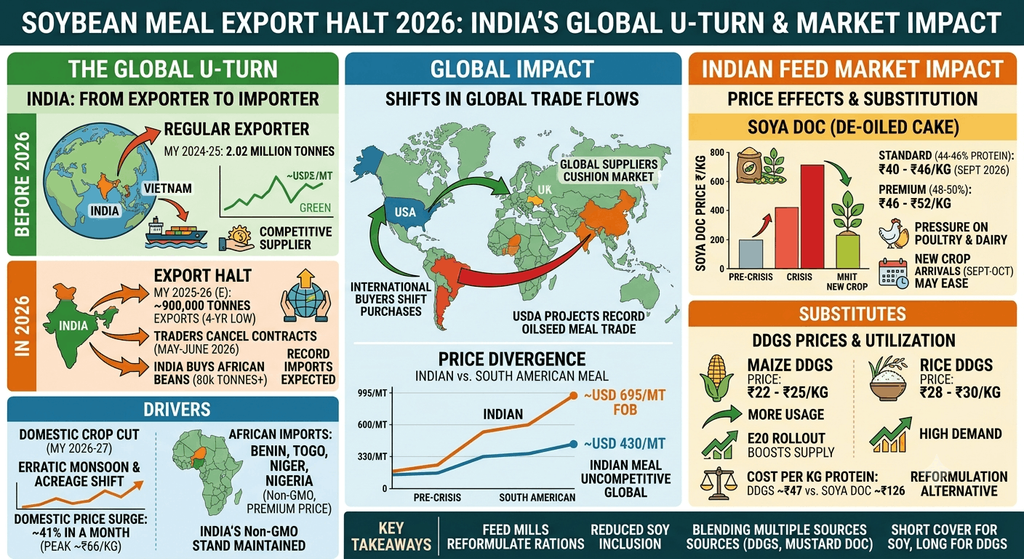
Quick answer: India has stopped selling soybean meal abroad this year. Nobody banned anything. Domestic rates simply outran what any overseas buyer was willing to pay, with export offers moving from about USD 475 per tonne to nearly USD 695 FOB inside a few weeks. Traders cancelled roughly 25,000 tonnes of contracts and started importing instead. What that means at your mill: every tonne of Indian meal now clears domestically. Soya DOC is at ₹40 to ₹46 per kg, Corn DDGS at ₹22 to ₹25, and Rice DDGS at ₹28 to ₹30 on bulk feed-grade lots.
Nobody banned anything!
Let us clear this up early, because the word keeps coming up on calls.
DGFT has not touched soybean meal. It sits where it always sat, freely exportable, with nothing gazetted, no restricted list, and no notification. The story going around is wrong, and the real version is a lot less dramatic.
Prices at home ran up around 41 per cent in a month and hit roughly USD 689 per tonne, the highest in four years. An exporter who had been quoting Vietnam at USD 475 was now quoting USD 695 FOB. Those buyers didn’t haggle. They picked up the phone to Argentina.
So the contracts got cancelled, because what else do you do? About 25,000 tonnes of May and June shipments were washed out, the biggest set of cancellations since 2021. Full-year exports for the marketing year ending this month are tracking near 900,000 tonnes. Last year they were 2.02 million.
Why does the wording matter to a buyer? Because a ban can be lifted on a Tuesday afternoon by a single circular. A price-driven halt lifts only when the crop lifts it. That puts your planning on the monsoon calendar rather than on Delhi’s.
From seller to buyer in one season!
For roughly twenty years India held a spot worth holding. Our meal was non-GM, and East Asian buyers paid a premium for that label on their supply chain. Gone in a season.
Alongside the cancellations, traders picked up around 80,000 tonnes of soybean imports out of West Africa. Since India allows non-GMO beans only, the shopping list is short: Benin, Niger, Togo, and Nigeria. Those origins carry a stiff premium, and cargoes were landing at USD 700 to USD 760 per tonne CIF through the middle of the year.
Want the whole reversal in one line? India’s soybean imports for the year to September 2026 are expected to touch a record 800,000 tonnes. The previous year, going by SOPA’s compilation, we brought in about 2,000 tonnes. Two thousand. That is the scale of what changed.
Upstream, the cause is plain enough. The 2025-26 crop landed near 12.7 million tonnes against 15.1 million the year before, a 17 per cent shortfall. Fewer beans through the crushers means less meal out the back, and DOC output is a fixed ratio of the crush. Processors cannot simply run harder. Meanwhile, poultry, dairy and aqua carried on wanting more protein, not less.
So where does Soya DOC actually sit?
Common sense says shutting the export tap should soften domestic rates.
It didn’t. It steadied them, which is not the same thing. The production gap is bigger than the tonnage that used to leave on ships, so the meal staying home got absorbed rather than piling up.
Standard 44 to 46 per cent protein Soya DOC is at ₹40 to ₹46 per kg on bulk feed-grade material as of September. Premium 48 to 50 per cent lots run ₹46 to ₹52. At Indore, India’s biggest crushing hub, ex-factory solvent-extracted soymeal touched ₹57,000 to ₹60,500 per MT through late July before easing to ₹57,000 to ₹57,500 by month end, going by SOPA market data. Soybean meal more broadly is trading ₹57 to ₹66 per kg, off the ₹65 to ₹66 peak but still high by any historical read.
Grade, region and order size all move your number. The full grade-wise table is in our Soya DOC price guide, and the background to the spike sits in our soybean meal crisis piece.
Everyone is now watching the same thing, which is a new crop. SOPA expects genuine relief once fresh beans reach crushing plants from September and October, with the fuller effect around November and December. Acreage data has been contradictory all season, with official numbers saying one thing and industry another, which we unpacked in our soybean sowing 2026 outlook.
There is also a policy card still face down. The Poultry Federation of India and others have asked for roughly 1.5 million tonnes of GM soybean meal imports to be cleared, on the argument that a measured opening would settle feed costs fast. Crushers and farmer bodies are pushing back, partly on bean prices, partly to protect the non-GM standing India spent two decades earning. Nothing large-scale has been approved yet. If it is, Soya DOC moves quickly, which is a fair reason to keep soy cover short rather than locked a year out.
The part that decides your ration cost!
Here is what gets far less attention than it deserves.
Expensive soy protein means everybody reformulates. Not gradually, and not one mill at a time. Demand piles into every workable alternative in the same fortnight, and those markets tighten right along with it. Which is exactly what the DDGS complex has done through the back half of this year.
| Raw material | Bulk feed-grade rate (₹/kg) | Crude protein | Notes for buyers |
| Soya DOC | 40 to 46 | 44 to 46% | Premium 48 to 50% lots run for ₹46 to ₹52 |
| Rice DDGS | 28 to 30 | 40 to 45% | Firmed on substitution demand |
| Corn (Maize) DDGS | 22 to 25 | 28 to 32% | Same product under both names |
| Mustard DOC | 19 to 25 | 35 to 40% | Inclusion capped by glucosinolates |
| DORB | 9 to 15 | Low | Energy side, not a protein substitute |
Indicative bulk rates. They shift with region, grade and volume, so confirm live pricing before costing a ration. Corn DDGS also attracts 5 per cent GST under HSN 2303 30 00, which belongs in your landed cost rather than as an afterthought.
Now run the comparison that actually matters, which is cost per kg of protein delivered rather than cost per kg of bag. Soybean meal at current rates works out near ₹126 per kg of protein. Corn DDGS lands closer to ₹47. That is not a rounding difference; it is a different league.
The caveat is real and worth stating plainly. Corn DDGS carries a weaker amino acid profile, lysine especially, so it is a partial replacement that usually needs synthetic supplementation rather than a straight swap. Build that cost into the comparison and it still wins comfortably.
There is a second force working on DDGS supply that has nothing to do with soy, and it is worth knowing about. India’s E20 ethanol rollout is pulling more maize into distilleries, which means more DDGS are coming out the other end over time. We covered what that does to availability in our piece on the E20 push and maize DDGS supply.
What mills are doing right now?
Four habits keep showing up among the millers we supply.
- They blend; they don’t swap. Nobody replaces soy one for one. The mills coping best have dropped soy inclusion a few points and rebuilt the gap from two or three sources at once, generally DDGS carrying both protein and energy with mustard DOC filling part of the balance. Each has its own ceiling, and amino acid balance is a job for your nutritionist, not a spreadsheet. Our guide to cutting feed cost through substitution sets out the sequence and the inclusion limits by species.
- They buy on spec rather than at the headline rate. Tight markets widen the gap between a good lot and a poor one and widen the temptation to quote sharply. Protein, moisture, aflatoxin, sand and silica, flowability. Every one of those changes your real cost per unit of protein. Saving ₹1 on the invoice means nothing if moisture is running three points high.
- They keep soy cover short and DDGS cover long. A new crop is arriving; the import decision may or may not land, so soy commitments stay tight while DDGS volumes get locked further out where supply is steadier and the discount is obvious.
- They tightened up the godown. More ingredients in the shed means more variation in how things behave in storage. FIFO discipline and moisture control are earning their keep this year in rupees, not just in audit files.
Three things to watch from here!
- New crop arrivals through September and October. The biggest single variable, and quality counts as much as tonnage.
- The GM import decision, which is the fastest-moving lever in the room. Clearance eases Soya DOC quickly. Continued deferral leaves things roughly where they are.
- Global meal prices, setting the outer boundary. USDA projects record oilseed meal trade in 2026-27, with soybean meal exports up around 5 per cent, so if domestic supply stays short, importing gets comparatively easier to justify.
About Brinda Foods!
Brinda Foods has supplied animal feed raw materials from Panipat, Haryana, since 1987. We provide bulk supply of Soya DOC, Maize (Corn) DDGS, Rice DDGS, De-Oiled Rice Bran (DORB) and Mustard DOC to mills and farms across India, with exports to 25+ countries. Every lot moves through source-level quality control, multi-level sampling, lab testing against nutritional specs, and FIFO storage. ISO 9001:2015 certified, GAFTA and FOSFA compliant.