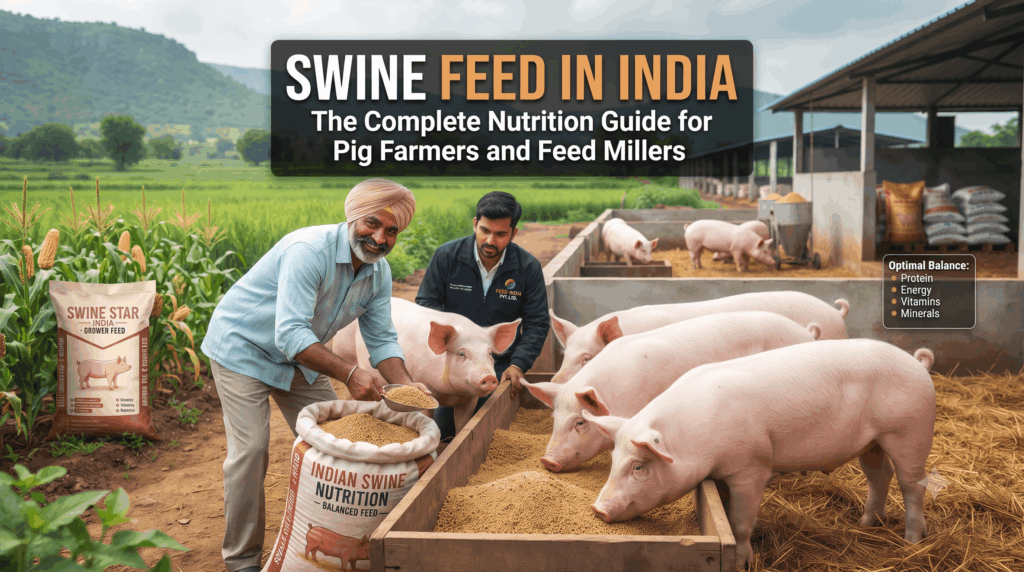
Pig farming in India runs on tighter margins than most people outside the industry realize. Feed accounts for 65–75% of total production cost—higher than in cattle or poultry—because pigs are single-stomached, fast-growing, and unforgiving of formulation mistakes. Get the phase transitions wrong, and you’re either overpaying for nutrients the pig can’t use yet or underfeeding a phase that determines the whole growth curve.
This guide walks through what swine feed actually needs at each life stage, which raw materials do the heaviest lifting in Indian formulations, and the mistakes that quietly erode feed conversion ratio (FCR) on farms that otherwise look well-run.
Why Swine Feed Formulation Is Less Forgiving Than Cattle or Poultry
Pigs are monogastric, like poultry, but grow faster and are pushed through more distinct nutritional phases in a shorter window — from a 5 kg weaner to a 110+ kg market hog in roughly five to six months. Unlike ruminants, pigs can’t rely on microbial fermentation to make up for a poorly balanced amino acid profile, and unlike layers, there’s no egg-production buffer that smooths out a bad week of feed.
Two things make swine nutrition uniquely sensitive:
- Gut development changes with age. A 5 kg weaner’s digestive system cannot handle the same fibre or protein complexity as a 50 kg grower. Diets have to be built around what the pig’s gut can actually process at each stage, not just what’s nutritionally “complete” on paper.
- Mycotoxin sensitivity is higher than in poultry or cattle. Pigs — especially breeding sows — are markedly more sensitive to vomitoxin (DON) and zearalenone than other livestock. A DDGS or maize lot that’s perfectly acceptable for cattle feed can still cause reproductive issues in sows at the same contamination level.
Swine Growth Phases and Nutrient Targets
| Phase | Body Weight | Daily Intake* | Crude Protein | Lysine | Digestible Energy |
|---|---|---|---|---|---|
| Nursery / Starter | 5–20 kg | 0.5–1.0 kg/day | 20–22% | 1.30–1.45% | 3,400–3,500 kcal/kg |
| Grower | 20–50 kg | 1.5–2.0 kg/day | 16–18% | 0.95–1.05% | 3,300–3,400 kcal/kg |
| Finisher | 50–110+ kg | 2.5–3.5 kg/day | 14–16% | 0.70–0.80% | 3,200–3,300 kcal/kg |
| Gestation (sows) | — | 2.0–2.5 kg/day | 13–14% | 0.55–0.60% | 3,000–3,100 kcal/kg |
| Lactation (sows) | — | 5.0–7.0+ kg/day | 17–18% | 0.90–1.00% | 3,300–3,400 kcal/kg |
*Intake figures reflect typical Indian farm practice across phases.
The pattern is the same one that governs layer and broiler feed: protein and amino acid density are highest early (nursery) and during lactation (milk synthesis demand), and lowest during finisher and gestation, where the priority shifts to controlled, cost-efficient growth or body-condition maintenance rather than rapid tissue building.
A common formulation mistake: running finisher-phase protein levels straight through to market weight “to be safe.” At 50 kg+, a pig’s lean growth rate is slowing and amino acid requirements per kg of feed drop accordingly — feeding grower-level protein through the whole finisher phase adds cost with no matching weight-gain return, and pushes up nitrogen excretion.
Key Raw Materials in Indian Swine Feed Formulation
Maize — The Energy Base
Maize is the dominant energy ingredient in nearly every Indian swine ration, typically 50–65% of the formula. It’s highly digestible for pigs, low in fibre relative to other cereals, and the benchmark against which every other energy source is compared on a cost-per-kcal basis. Moisture below 13% and low aflatoxin are non-negotiable — pigs, and breeding sows especially, tolerate aflatoxin contamination poorly compared to ruminants.
Maize DDGS — Energy and Moderate Protein
Maize DDGS works well in swine diets but with tighter inclusion limits than in cattle feed, because of its fibre content and the pig’s more limited hindgut fermentation capacity.
Recommended inclusion:
- Nursery: avoid or keep below 5% — young pigs handle fibre poorly
- Grower-finisher: 10–20%, commonly cited safe upper range in research is closer to 20–30% but Indian mills typically formulate conservatively at 10–15% for consistency
- Gestating sows: up to 20% — the added fibre supports satiety, which is genuinely useful in gestation (see below)
- Lactating sows: keep lower, 5–10%, since lactation diets prioritise energy density over fibre
Soya DOC — The Amino Acid Anchor
Soya DOC at 46–48% crude protein is the primary protein source in Indian swine formulations, for the same reason it dominates poultry diets: strong lysine content and a well-matched amino acid profile for monogastric animals.
Recommended inclusion: 15–25% in nursery and grower phases, tapering to 10–15% in finisher as overall protein requirement drops. Sows typically run 12–18% depending on gestation vs. lactation stage.
For more on Soya DOC’s amino acid profile and how it performs across species: Benefits of Soya DOC in Animal Feed
Rice Gluten — Concentrated Protein Support
Rice Gluten is a useful secondary protein concentrate in swine diets, valued for its protein density when formulators need to lift overall dietary protein without adding excessive bulk. It’s typically used at modest inclusion (3–6%) alongside Soya DOC rather than as a standalone protein source.
DORB — Fibre and Satiety, Especially for Sows
De-Oiled Rice Bran (DORB) plays a different role in swine diets than in cattle or poultry feed: fibre for satiety management, particularly in gestating sows. Gestation-phase sows are fed a restricted amount of energy to control body condition, which can leave them hungry and prone to stereotypic behaviour (bar-biting, excessive drinking). A moderate DORB inclusion — commonly 10–15% in gestation diets — adds bulk and fibre that improves satiety without adding excess energy.
In nursery and early grower diets, DORB should be minimised or excluded — young pigs’ digestive systems aren’t yet equipped to extract value from higher-fibre ingredients, and it can depress growth performance if overused at this stage.
For a deeper look at DORB’s role across species: What Is DORB and Its Uses in Livestock Feed?
Mustard DOC — A Cost Lever, Used Carefully
Mustard DOC can partially replace Soya DOC in swine diets, but glucosinolate sensitivity means it needs to be detoxified (heat-processed) material, used at moderate rates.
Recommended inclusion: approximately 15–20% in adult sow diets; lower rates in grower-finisher pigs, where amino acid precision matters more for lean growth.
Full detail on glucosinolate management, inclusion limits by species, and the economics of partial Soya DOC replacement: Mustard DOC in Animal Feed: The Complete Guide
Synthetic Amino Acids — Closing the Gap
As in poultry, a corn-soya swine diet is reliably short on lysine (the first-limiting amino acid), with methionine and threonine as secondary gaps. Synthetic L-lysine, DL-methionine, and L-threonine let formulators hit exact amino acid targets without over-supplying crude protein — which matters for cost control and for reducing nitrogen excretion in an industry facing growing environmental scrutiny.
Minerals and Additives
Limestone and dicalcium phosphate (DCP) supply calcium and phosphorus for skeletal development; salt maintains electrolyte balance. Phytase is increasingly standard in Indian swine diets — it releases phosphorus bound in phytate (found in maize and soya), reducing the need for supplemental inorganic phosphorus and lowering phosphorus excretion. Probiotics and organic acids support gut health, particularly valuable in the nursery phase when pigs are most vulnerable to digestive upset.
Gestation vs. Lactation: Two Very Different Feeding Jobs
It’s worth separating these because farms sometimes run one “sow feed” formula across both stages, which undersells performance in both directions.
Gestation is about controlled, economical maintenance — enough energy and protein to support foetal development without letting sows become overweight (which causes farrowing complications). Higher fibre inclusion (via DORB) is a genuine tool here, not just a cost-saving measure — it manages hunger and behaviour on a restricted-energy diet.
Lactation flips the priority entirely. A lactating sow nursing 10–12 piglets has enormous energy and protein demands for milk synthesis, and appetite — not restriction — becomes the challenge. Diets need to be energy-dense and highly palatable, because a sow that under-eats during lactation mobilises her own body reserves, which delays her return to oestrus after weaning and hurts the next reproductive cycle. This is why lactation diets generally run lower in bulky fibre sources like DORB and higher in energy-dense ingredients.
Common Mistakes That Hurt Swine FCR and Growth
1. Overfeeding fibre to young pigs DORB, wheat bran, and other fibrous by-products are useful in gestation and grower-finisher diets, but nursery pigs have limited capacity to digest fibre. Overuse here shows up as poor weight gain and looser stools, not immediate visible harm — which is why it often goes uncorrected for weeks.
2. Ignoring particle size Feed particle size has an outsized effect on swine FCR compared to other species — finer grinding (targeting roughly 600–700 microns for maize) measurably improves feed efficiency by increasing surface area for enzymatic digestion. Coarse, inconsistent grinding is a common and underrated source of poor FCR on Indian farms.
3. Running one formula across all phases Flat-rate feeding — using a single “grower” formula from weaning to market weight — is the swine equivalent of the layer-feed mistake of skipping the pre-lay phase. It over-supplies nutrients late and under-supplies them early, and the cost shows up in FCR, not obviously in animal health.
4. Underestimating mycotoxin risk in DDGS and maize Pigs, and gestating/lactating sows in particular, are far more sensitive to vomitoxin (DON) and zearalenone than cattle or poultry. Zearalenone specifically can cause reproductive issues (false heat, reduced litter size) in sows at contamination levels that wouldn’t register as a problem in a dairy herd. Request mycotoxin testing on DDGS and maize batches destined for breeding-sow diets specifically, not just growing-pig diets.
5. Skipping phytase Without phytase, a significant share of the phosphorus in maize and soya-based diets stays bound and unavailable, forcing higher (and costlier) inorganic phosphorus supplementation while also increasing phosphorus excretion — a growing regulatory and environmental concern for larger operations.
How to Check If Your Swine Feed Program Is Working
- FCR by phase: Nursery FCR should run 1.3–1.6; grower-finisher combined typically 2.6–3.0. Consistent drift above these ranges usually points to formulation or health issues, not genetics.
- Sow body condition at farrowing: Neither too thin (energy shortfall in gestation) nor over-conditioned (farrowing complications, reduced lactation appetite).
- Piglet weaning weight: A strong proxy for whether lactation-diet energy and protein are actually adequate — chronically low weaning weights across litters point back to sow nutrition, not just piglet management.
- Manure consistency: Loose stools in nursery pigs are an early, low-cost signal of excess fibre or protein before growth performance visibly suffers.
Frequently Asked Questions
What is the ideal protein percentage for swine feed in India? It depends entirely on phase: 20–22% crude protein for nursery pigs (5–20 kg), 16–18% for growers (20–50 kg), 14–16% for finishers (50 kg to market weight), and 13–18% for sows depending on whether they’re in gestation or lactation. Running one flat protein level across all phases either overfeeds early stages or underfeeds later ones.
Can DDGS be used in swine feed? Yes, with phase-specific limits. Avoid it in nursery diets (below 5%) due to young pigs’ limited fibre tolerance. In grower-finisher diets, 10–20% is a practical, conservative range for Indian formulations. In gestating sows, up to 20% inclusion is useful because the added fibre supports satiety on a restricted-energy diet.
Why do gestating sows need more fibre than other pigs? Gestating sows are deliberately fed a restricted amount of energy to control body condition and avoid farrowing complications. That restriction can leave sows hungry, leading to stereotypic behaviours like bar-biting. Adding a moderate fibre source like DORB (10–15% inclusion) increases satiety without adding excess energy, improving welfare and reducing restless behaviour.
Are pigs more sensitive to mycotoxins than cattle or poultry? Yes, particularly to vomitoxin (DON) and zearalenone. Breeding sows are the most sensitive category — zearalenone contamination that wouldn’t register as a problem in dairy cattle can cause reproductive issues like false heat and reduced litter size in sows. Mycotoxin testing on maize and DDGS batches is worth prioritising specifically for breeding-herd diets.
How much does feed particle size actually matter for pig growth? More than most farms assume. Grinding maize to a finer particle size (roughly 600–700 microns) meaningfully improves feed conversion by increasing the surface area available for enzymatic digestion. Coarse or inconsistent grinding is a common, easily-corrected source of underperforming FCR.
What raw materials make up a typical Indian swine feed formula? A standard formulation centres on maize (50–65% for energy), Soya DOC (15–25% for amino acid-balanced protein), with DORB, Rice Gluten, and Mustard DOC used in smaller, phase-specific amounts to manage fibre, protein density, and cost. Minerals (limestone, DCP, salt), synthetic amino acids (lysine, methionine), and additives like phytase and probiotics round out a complete diet.
Conclusion
Swine feed formulation rewards precision more than most other livestock categories — the growth window is short, the phase transitions are frequent, and pigs don’t have a ruminant’s buffering capacity or a layer’s production cushion to absorb formulation mistakes. Getting maize, Soya DOC, DORB, and Mustard DOC balanced correctly by phase — and getting basics like particle size and mycotoxin testing right — is what separates a feed program that hits FCR targets from one that quietly bleeds margin.
For feed millers and integrated pig farms, consistent raw material quality removes the single biggest source of formulation drift between batches.
Brinda Foods supplies certified-quality Maize, Maize DDGS, Soya DOC, Mustard DOC, De-Oiled Rice Bran (DORB), and Rice Gluten to swine feed manufacturers and integrated pig farms across India. Every batch is tested and comes with nutritional specification documentation, including mycotoxin analysis on request.
For bulk pricing and sourcing enquiries: Contact Us | Submit an Enquiry | Call: 9992500442 | Email: sales1@brindafoods.com