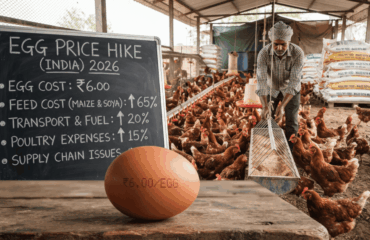
If you’re a feed miller, dairy farmer, or poultry producer in India right now, your raw material bill is telling a painful story. Soya DOC — the backbone of most Indian feed formulas — has surged from ₹35–38/kg in early 2025 to ₹43–44/kg as of mid-2026, a jump of nearly 25%. Maize has crossed ₹26/kg, well above its historical range of ₹20–22/kg. And soybean meal on international markets jumped from USD 0.59/kg in April 2026 to USD 0.74/kg by May — in a single month.
Feed cost constitutes 65–70% of total livestock production costs. When your two biggest input commodities move up simultaneously, profitability collapses fast — unless your formulation moves with them.
The good news: India has a rich, underutilised toolkit of alternative feed ingredients. Most large feed mills already use at least one. Many smaller operations don’t, either because of unfamiliarity with inclusion rates, concerns about quality, or simple inertia. This guide cuts through all of that.
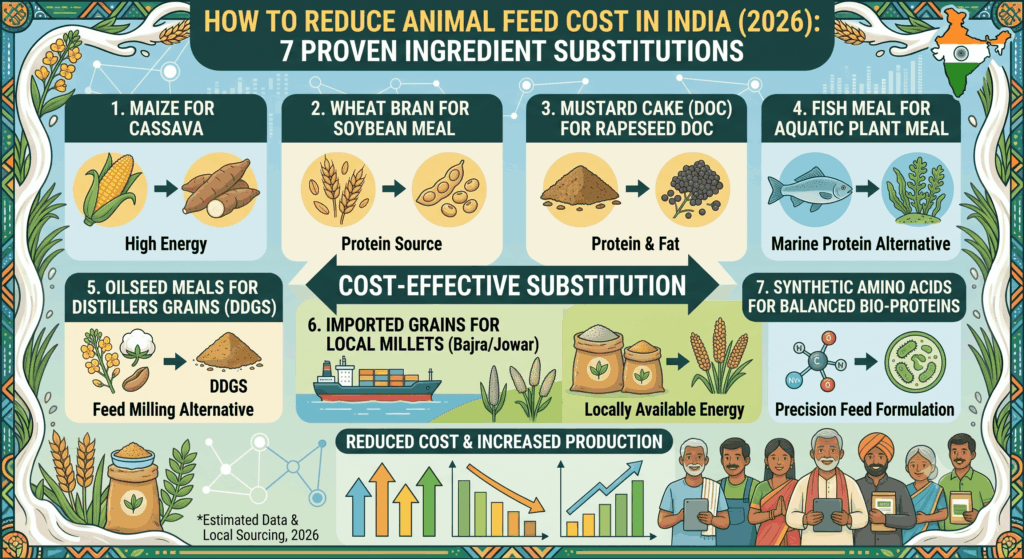
Here are 7 specific raw material substitutions — each backed by research, used in commercial Indian operations today — that can meaningfully reduce your feed cost without compromising animal performance.
Why 2026 Is the Year to Rethink Your Feed Formula
Before getting into the substitutions, it helps to understand what’s driving this cost environment.
The soybean shortfall is structural, not temporary. India’s domestic soybean production is estimated at 10.5–11 million tonnes for 2025–26 — significantly below the 13+ million tonne years of the early 2020s. The result is a tighter domestic supply of Soya DOC even as demand from the poultry, dairy, and aquaculture sectors continues to grow at 5–7% annually.
Maize costs are compounded by quality degradation. Procurement from major growing districts like Davanagere and Haveri has seen grain counts rise to 400+ per 100g (vs. the earlier norm of 350), indicating immature harvesting and lower nutrient density — meaning you’re paying more for less energy.
On top of this, the India-US interim trade agreement (February 2026) has introduced a quota of 5 lakh tonnes of US DDGS at zero import duty — a structural tailwind that will modestly ease supply, but not solve the fundamental cost equation for most millers.
All of this points in one direction: formulators who anchor their diets to Soya DOC and maize alone are paying a premium that their operations don’t have to absorb. Here’s how to change that.
Substitution 1: Mustard DOC → Replace 20–35% of Soya DOC in Ruminant Diets
Cost saving: ₹8–12/kg of protein vs. Soya DOC at current prices Best for: Cattle, buffalo, sheep, goat
Mustard DOC (De-Oiled Cake) is India’s most cost-effective locally produced protein source — and its most underused one. With crude protein ranging from 35–40%, it delivers meaningful protein at 20–35% lower cost per unit compared to Soya DOC at June 2026 prices.
The primary limitation is glucosinolate content, which can suppress thyroid function and reduce feed intake at high inclusion rates. But this is a managed variable, not a dealbreaker. For ruminant diets specifically, rumen microbes partially degrade glucosinolates, making inclusion rates of 10–15% in cattle and buffalo diets both safe and economically significant.
The amino acid gap (notably lower lysine than Soya DOC) matters far less in ruminants because the rumen microbiome synthesises amino acids, reducing direct dependence on dietary amino acid profiles.
Our detailed breakdown of nutritional values, glucosinolate management strategies, and species-specific inclusion rates is covered in the Complete Mustard DOC Guide for Feed Millers. For bulk pricing and availability, see our Mustard DOC product page.
Substitution 2: DDGS → Replace 15–20% of Diet DM in Dairy Cattle Rations
Cost saving: ₹12–14/kg protein vs. soybean meal at current prices Best for: Lactating dairy cows, dry cows, buffalo
Distillers Dried Grains with Solubles (DDGS) is the single highest-impact substitution available in India right now — and the India-US trade deal has just made it easier to access.
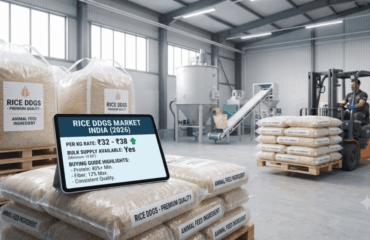
At ₹30/kg for Rice DDGS (42% protein) vs. ₹43–44/kg for Soya DOC (46% protein), the economics are compelling. The key differentiator is rumen bypass protein (RUP) — the fermentation process increases rumen undegradable protein to 40–55% of total protein, making DDGS highly efficient for lactating cows where metabolizable protein supply is the production constraint.
The standard recommendation for lactating dairy cows is 15–20% of total diet dry matter, well established across Indian commercial dairy operations. The practical ceiling is around 20% due to sulfur content; exceeding this raises the risk of polioencephalomalacia in cattle.
For the complete inclusion rate guide by animal class — dry cows, heifers, transition cows — read How Much DDGS to Include in Dairy Cattle Feed.
One formulation note: corn DDGS has faced quality challenges in India, particularly around mycotoxin contamination in some lots. Rice DDGS, available domestically from Indian ethanol plants, avoids this issue entirely and offers comparable protein at similar price points.
Substitution 3: DORB → Replace 10–20% of Maize in Energy Formulas
Cost saving: ₹4–7/kg vs. maize at current prices Best for: Cattle, buffalo, broilers (controlled inclusion), layer hens
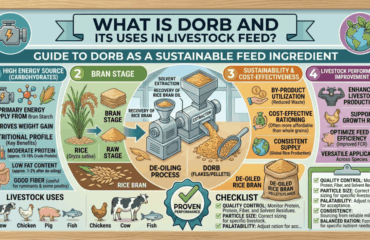
De-Oiled Rice Bran (DORB) is the residue after oil extraction from rice bran — widely produced across India’s rice mill belt and available in high volumes, particularly in Punjab, Haryana, UP, and West Bengal.
With maize above ₹26/kg and DORB typically priced at ₹19–22/kg, DORB offers a meaningful energy cost reduction when used as a partial maize replacer. At 10–15% inclusion in cattle diets and 5–10% in broiler finisher diets, performance impact is minimal to none when managed within specification.
The key quality variable to monitor is oil content (should be 1–2% post-extraction) and free fatty acid (FFA) level — high FFA DORB (above 3%) can depress palatability and cause digestive issues. Sourcing from verified solvent-extraction facilities with consistent grading is essential.
The full manufacturing process and quality grading criteria are covered in detail in How De-Oiled Rice Bran (DORB) Is Made. See the De-Oiled Rice Bran product page for current specifications and bulk availability.
Substitution 4: Rice DDGS → Replace 10–15% of Soya DOC in Poultry Diets
Cost saving: ₹10–14/kg protein vs. soya DOC Best for: Broilers, layer hens
Rice DDGS from Indian ethanol plants carries 38–42% crude protein and typically prices at ₹28–32/kg — a significant discount to Soya DOC’s current ₹43–44/kg.
For poultry diets, inclusion is more conservative than in ruminants, typically 8–12% in broiler grower/finisher diets and 10–15% in layer mash, due to:
- Fibre content: Higher NDF than Soya DOC reduces energy density; compensate with fat supplementation if needed
- Phosphorus: DDGS provides moderately available phosphorus — adjust inorganic phosphorus downward to avoid over-supplementation
- Amino acid profile: Lysine is limiting; ensure synthetic lysine (L-Lysine HCl) maintains minimum dietary levels
The economic benefit is most compelling in the broiler finisher phase, where protein requirements drop and the cost differential can be captured without risking early-phase growth targets. For a complete breakdown of broiler protein requirements by phase and how to position DDGS within your formula, see the Best Protein Supplement for Broiler Feed India guide.
Substitution 5: Guar Meal / Rapeseed Meal → Secondary Protein Diversification
Cost saving: Variable; typically ₹5–8/kg protein vs. Soya DOC Best for: Ruminants, mature poultry, swine
Guar meal (from guar gum processing) and rapeseed meal (mustard’s close cousin in the Brassica family) are two additional domestically available protein sources that are gaining traction as Soya DOC costs remain elevated.
Guar meal contains 50–55% crude protein — higher than Soya DOC — but is limited by high tannin content that significantly reduces protein digestibility. Heat treatment or chemical processing markedly improves digestibility, and treated guar meal at 5–10% inclusion in ruminant diets shows minimal performance impact with a meaningful cost reduction.
Rapeseed meal (a close relative of mustard DOC, also produced from Brassica oil extraction) carries 34–38% crude protein and a glucosinolate profile similar to mustard DOC. Inclusion guidelines are essentially parallel: up to 10–15% in cattle and buffalo, 5–8% in poultry with careful monitoring.
The practical recommendation: treat these as tertiary diversifiers rather than primary substitutions. A diet anchored on 40% Soya DOC → 25% DDGS → 10% Mustard DOC → 5% Guar Meal achieves both risk diversification and meaningful cost reduction across the protein matrix.
Substitution 6: Enzyme Supplementation → Unlock 5–8% More Value from Existing Ingredients
Cost saving: ₹80–150/tonne of finished feed (indirect) Best for: Broilers, layers, monogastrics generally
This substitution is different in nature — it doesn’t replace an ingredient, it makes existing cheaper ingredients work harder.
Phytase is the most impactful enzyme for Indian feed formulations. Most plant proteins (including DDGS, DORB, Mustard DOC, and soya DOC) carry phosphorus in the phytate form, which monogastrics cannot digest. Adding exogenous phytase (500–1,000 FTU/kg) releases this phosphorus, allowing you to reduce inorganic dicalcium phosphate (DCP) in the formula — typically saving ₹40–80/tonne of feed on phosphorus alone.
NSP (Non-Starch Polysaccharide) enzymes — xylanase, beta-glucanase — are the second priority. As you increase DDGS and DORB inclusion (which carry more fibre than Soya DOC), NSP enzymes maintain gut transit and nutrient absorption. They’re also enabling higher inclusion rates of alternative ingredients by reducing their viscosity effect on digesta in the gut.
Enzyme use is growing fast across Indian poultry operations. The Animal Feed Supplements India 2026 market analysis covers enzyme adoption rates, key Indian and international brands, and inclusion economics in detail.
Substitution 7: Diet Reformulation by Phase → Stop Overfeeding Protein in Late Phases
Cost saving: ₹200–400/tonne of finished feed (system-level) Best for: All livestock and poultry — universal
This is the highest-leverage change most smaller operations can make, because it requires no new ingredients — only better formulation discipline.
The default approach in many Indian feed operations is to run one or two diet phases across a production cycle. The science, and the economics, support a minimum of three phases for broilers and four for layers, because protein requirements drop significantly as animals mature.
For layers, the difference between phase-appropriate feeding and a single-formula approach is stark. A layer at 40 weeks of production needs roughly 15–16% crude protein. Feeding her a 19% CP pre-lay formula wastes 3+ percentage points of your most expensive nutrient every day for 30+ weeks. Multiply that by 100,000 birds and you’re looking at substantial avoidable cost.
The complete layer feeding phase breakdown — with nutrient targets for each phase, calcium management strategy, and phase transition timing — is covered in the Layer Feed India Complete Nutrition Guide. The Broiler Feed product page includes our recommended starter-grower-finisher specifications as a formulation reference.
Building Your Cost Reduction Strategy: A Practical Checklist
Applying all seven substitutions at once isn’t the goal — it’s understanding which ones apply to your specific livestock segment, sourcing infrastructure, and current formula. Here’s a decision framework:
If you’re formulating cattle/buffalo rations:
- Priority 1: DDGS at 15–20% DM inclusion (highest cost impact)
- Priority 2: Mustard DOC replacing 20–30% of Soya DOC
- Priority 3: DORB as partial maize replacer at 10–15%
- Enable: Phytase supplementation to release dietary phosphorus
If you’re formulating broiler feed:
- Priority 1: Rice DDGS at 8–12% in grower/finisher phases
- Priority 2: DORB at 5–8% in finisher phase
- Priority 3: Phase-specific formulation (minimum 3 phases)
- Enable: Phytase + xylanase to handle increased fibre load
If you’re formulating layer feed:
- Priority 1: Phase-appropriate CP reduction in late lay
- Priority 2: Rice DDGS at 10–12% in lay phases
- Priority 3: Mustard DOC or rapeseed meal at 5–8% for protein diversification
- Enable: Phase transition management, enzyme support
What to Watch in H2 2026
Three developments will shape feed formulation economics through the rest of 2026:
US DDGS import quota rollout: The 5 lakh tonne zero-duty quota announced in the India-US interim trade deal (February 2026) will provide modest relief to DDGS supply, particularly corn DDGS. Watch for pricing differentials between domestic Rice DDGS and imported corn DDGS — there may be a window where corn DDGS at port is competitive.
Kharif soybean crop: India’s 2026 kharif season will be the key supply determinant for Soya DOC prices in Q3–Q4. Current estimates suggest acreage is recovering, but yield uncertainty remains. Having alternative protein sources locked in before harvest removes your exposure to this swing.
Maize quality improvement: Post-harvest procurement teams should resume more aggressive quality grading as the new season’s maize comes to market. Rejecting high grain-count (>380/100g) lots reduces hidden dilution of your energy matrix and justifies DORB as a more cost-stable alternative.
Summary: The Case for Feed Cost Diversification in 2026
The core message of this guide is simple: Indian feed formulation has been over-indexed on Soya DOC and maize for years. When those two commodities were cheap and abundant, the formulation was fine. In 2026, both are expensive, one is facing quality degradation, and domestic alternatives are plentiful and well-validated.
The seven substitutions above — Mustard DOC, DDGS (Rice and Corn), DORB, Guar/Rapeseed Meal, Enzymes, and Phase-based reformulation — are not experimental. They are in active commercial use in Indian operations today. The performance data supports them. The cost case is stronger right now than it has been in years.
The question isn’t whether to diversify your raw material mix. It’s how fast.
About Brinda Foods
Brinda Foods has supplied animal feed raw materials from Panipat, Haryana since 1987. We provide bulk supply of Maize DDGS, Rice DDGS, Soya DOC, Mustard DOC, De-Oiled Rice Bran (DORB), and other feed ingredients to mills and farms across North and Central India. ISO 9001:2015 certified.
Get a bulk quote: brindafoods.com | Call: [your phone number]