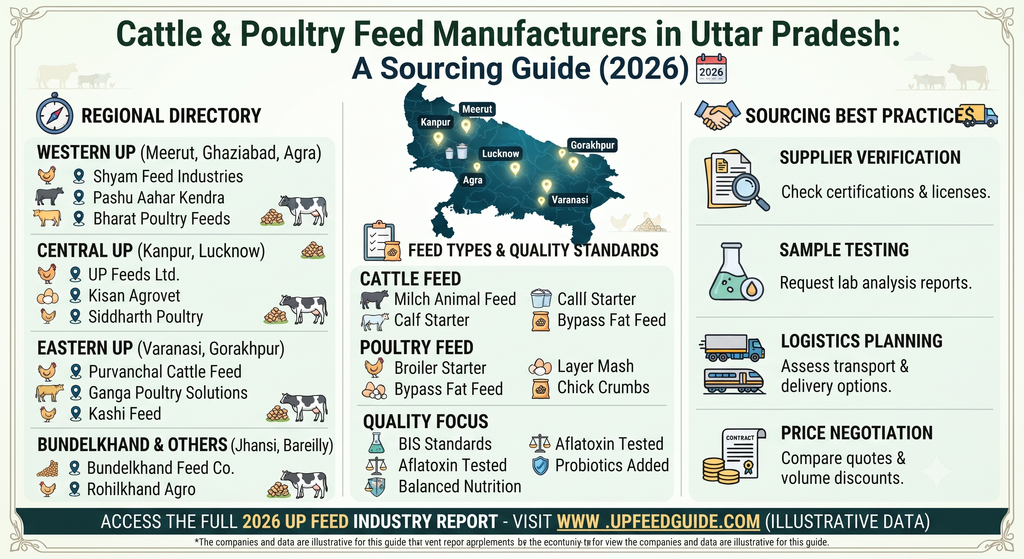
Uttar Pradesh just became India’s largest milk-producing state — and that shift, combined with a large and growing poultry sector, makes it one of the biggest structural demand centers for cattle and poultry feed raw material in the country. If you’re a feed miller, dairy cooperative, or poultry integrator in UP sourcing DDGS, DOC, or DORB, this guide covers what’s driving that demand, what the nutrition needs to look like, and what to check before committing to a bulk raw material supplier.
Why Uttar Pradesh Is a Growing Structural Demand Center for Feed Raw Material
UP’s position in India’s dairy and feed economy isn’t a marginal statistic — it’s a genuinely current, headline-level shift:
- Per the Basic Animal Husbandry Statistics (BAHS) 2025 release, Uttar Pradesh overtook Rajasthan to become India’s largest milk-producing state in 2024-25, accounting for roughly 15.66% of India’s total milk production — ahead of Rajasthan (14.82%), Madhya Pradesh (9.12%), Gujarat (7.78%), and Maharashtra (6.71%). Together these five states produce over half of India’s total milk.
- India itself remains the world’s largest milk-producing nation, contributing roughly 25% of global milk production — meaning UP alone now accounts for a meaningful slice of the entire world’s milk supply.
- The Centre’s White Revolution 2.0 initiative, launched by the Ministry of Cooperation and the Department of Animal Husbandry and Dairying, is actively scaling dairy cooperative infrastructure nationally: as of its most recent progress update, the program has established 24,097 new Dairy Cooperative Societies and strengthened 31,394 existing ones, backed by ₹66.95 crore disbursed so far through the National Programme for Dairy Development. The target is 75,000 new cooperatives and milk procurement reaching roughly 1,007 lakh kg/day by 2028-29 — a 50% increase — with underserved dairy-belt states like UP squarely in scope.
- UP is also among the country’s largest poultry-producing states, adding a second, parallel line of compound feed demand alongside its dairy sector.
Put together: a state that just became India’s #1 milk producer, sitting inside a national cooperative-dairy expansion program actively scaling procurement and processing capacity, is a state where raw material sourcing demand is set to keep climbing — not a one-time spike.
What Cattle and Poultry Rations in UP Actually Need Nutritionally
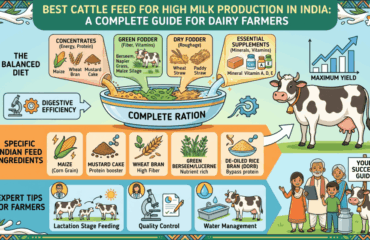
UP’s dairy base spans everything from cooperative-scale procurement to individual and smallholder herds, alongside a substantial broiler and layer sector. Across both, the same core raw material categories do most of the formulation work:
| Raw material | Crude protein | Role in the ration | Where it fits |
|---|---|---|---|
| Maize DDGS | 28–32% | Protein-energy supplement with a consistent, bypass-protein-rich amino acid profile | Dairy cattle rations targeting higher milk yield |
| Soya DOC | 44–48% | Primary plant protein source | Both dairy cattle and poultry (broiler/layer) rations |
| De-Oiled Rice Bran (DORB) | Moderate protein, high energy/fibre | Cost-effective bulking and energy component | Managing overall ration cost, especially given UP’s own large rice-milling base |
| Mustard DOC | High protein, strong regional availability | Alternative/blended protein source | Cost-competitive protein blending, particularly in western UP near mustard-growing belts |
If Rice DDGS specifically is your focus, our dedicated Rice DDGS supply guide for Uttar Pradesh covers sourcing logistics for that ingredient in more depth — this guide covers the fuller raw material picture across a mixed cattle-and-poultry operation.
For dairy formulations specifically, DDGS’s naturally higher rumen undegradable protein (RUP) fraction — protein that bypasses the rumen and is absorbed directly in the small intestine — is a key reason it has become standard in higher-yield rations rather than a niche substitute, since rumen-degraded protein alone can’t keep pace with peak lactation’s amino acid demand. Typical inclusion runs 15–25% of the ration for dairy cattle, though the right figure depends on your specific yield targets and existing base ration — see our cattle feed formulation guide for ration-balancing detail.
What UP’s Feed Manufacturers Should Look For in a Raw Material Supplier
Whether you’re a cooperative-linked dairy feed plant, an independent mill, or a poultry integrator, the evaluation criteria are consistent:
- Consistent, scalable supply capability — a supplier who can grow alongside expanding cooperative procurement volumes, not just fulfill one-off orders.
- Certificate of Analysis (COA) on every batch, not only at onboarding — protein and moisture consistency compounds in importance the more farmer households or flocks a formulation ultimately reaches.
- Certifications suited to formal, large-scale procurement — ISO 9001:2015, HACCP, and CLFMA membership matter more as buyers move from informal to cooperative- or integrator-scale purchasing.
- Mycotoxin-controlled processing and storage — particularly relevant given UP’s monsoon exposure and the aflatoxin sensitivity of both dairy cattle and poultry. See our monsoon mycotoxin risk guide for detail.
- Reliable logistics into UP — UP’s dairy and poultry belts (western UP districts like Meerut, Baghpat, and Bulandshahr in particular) are well within reach of North India’s grain-processing corridor, which should mean predictable transit times from an established supplier.
- Transparent, commodity-linked pricing that tracks visibly against the underlying DDGS/DOC market.
More detail on supplier evaluation is in Cattle Feed Ingredients & Quality Standards and How to Choose a Feed Raw Material Supplier in India.
Brinda Foods: Raw Material Supply Into Uttar Pradesh
Brinda Foods (Brinda Feeds Private Limited) is based in Panipat, Haryana — directly adjacent to western UP and well within North India’s core grain-processing corridor — and supplies feed millers, dairy operations, and poultry integrators across the region, including UP, Haryana, Punjab, and Delhi-NCR. Core raw materials supplied include:
- Maize DDGS — 28–32% crude protein, COA-confirmed on every batch, suited to higher-yield dairy rations
- Soya DOC — 44–48% crude protein, primary plant protein for both cattle and poultry feed
- Rice DDGS — cost-effective protein-energy alternative
- De-Oiled Rice Bran (DORB) — energy and bulking component
- Mustard DOC — regional protein source, cost-competitive for western UP buyers
As a veterinarian with an MVSc in Animal Nutrition from NDRI Karnal, I’ve built our quality frameworks around a simple principle: feed performance is decided at the raw material stage, before it ever reaches the mixer — a standard that matters just as much whether the order is feeding a large cooperative-linked dairy operation or an independent poultry mill. Learn more on our About Us page, review our certifications, or connect via my author page.
How Bulk Supply Into UP Works
- Specification alignment — confirming protein, fibre, and moisture targets against your dairy or poultry formulation.
- Sample and COA review — verifying batch quality before committing to volume.
- Bulk order and freight coordination — Panipat sits directly on the road/rail corridor into western and central UP, keeping transit times short and predictable.
- Standing supply agreement — most regular-volume buyers move to a scheduled or standing order once quality is verified across a few shipments.
Frequently Asked Questions
Is Uttar Pradesh really India’s largest milk-producing state now? Yes. Per Basic Animal Husbandry Statistics (BAHS) 2025 data, Uttar Pradesh overtook Rajasthan in 2024-25 to become India’s largest milk-producing state, accounting for roughly 15.66% of national milk production against Rajasthan’s 14.82%.
What is White Revolution 2.0 and how does it affect feed demand? White Revolution 2.0 is a central government initiative to expand India’s dairy cooperative network — targeting 75,000 new cooperative societies and a 50% increase in cooperative milk procurement by 2028-29. As dairy cooperative infrastructure and procurement scale up in states like UP, so does the underlying demand for cattle feed raw material.
Does Brinda Foods supply raw material to feed manufacturers in Uttar Pradesh? Yes. Based in Panipat, Haryana — directly adjacent to UP — Brinda Foods supplies bulk Maize DDGS, Rice DDGS, Soya DOC, Mustard DOC, and DORB to feed millers, dairy operations, and poultry integrators across Uttar Pradesh.
How much DDGS or DOC should go into a UP dairy ration? As a general starting range, Maize DDGS typically runs 15–25% of a dairy cattle ration, with Soya DOC inclusion set by the protein density your target milk yield requires. Validate against your specific base ration and formulation software before applying at scale.
What certifications should a UP feed manufacturer look for in a supplier? ISO 9001:2015, HACCP certification, CLFMA membership, and a documented batch-level Certificate of Analysis process — the baseline expectations for formal, scaled procurement. See our certifications page.
How do I request pricing for bulk feed raw material delivered to UP? Request a quote or contact our team with your required product, specification, and delivery location.
Sourcing cattle or poultry feed raw material for an operation in Uttar Pradesh? Request a quote from Brinda Foods today.