
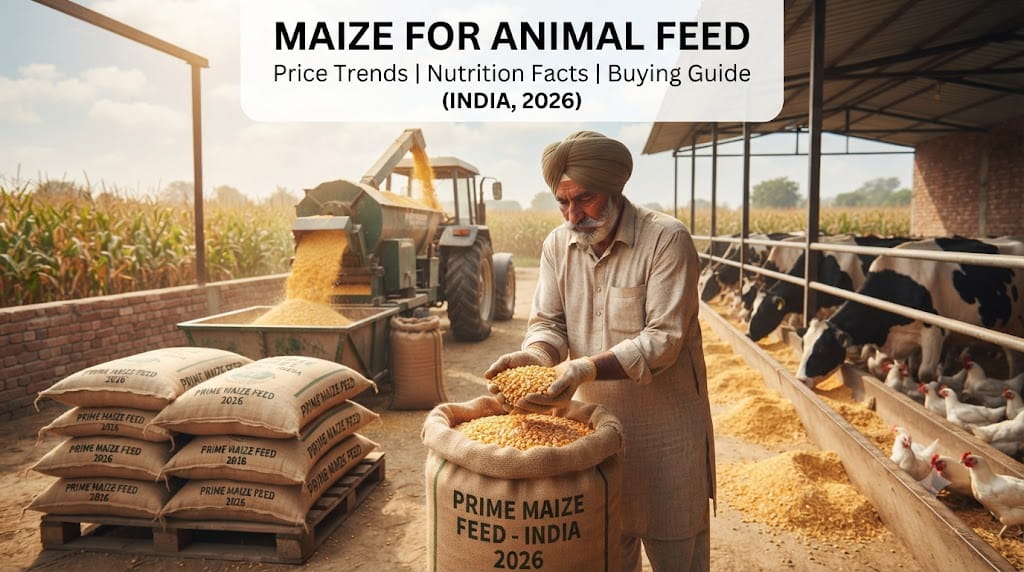
Every conversation about feed cost in India eventually comes back to one ingredient: maize. It’s not the most expensive line item in a formulation sheet, and it rarely makes headlines the way soybean meal or DDGS prices do — but it’s the single largest ingredient by weight in most poultry and swine rations, and a major energy contributor in dairy cattle concentrate. A ₹1/kg move in maize price changes the economics of a feed mill’s entire product line faster than almost any other raw material.
This guide covers what feed millers, poultry integrators, and livestock farmers need to know about sourcing maize for feed: current price behaviour, nutritional composition, inclusion rates by species, quality checks that actually matter, and how maize compares to its own by-products — DDGS, maize gluten, and maize DOC — which are frequently confused with it.
What Is Maize as a Feed Ingredient?
In feed formulation, “maize” almost always means the whole, dried corn kernel — cracked, ground, or coarsely milled — used as the primary energy source in compound feed. This is distinct from maize’s processed by-products, which show up in feed under different names:
- Maize DDGS (Dried Distillers Grains with Solubles) — the residue left after starch is fermented out for ethanol production
- Maize Gluten — the protein-concentrated by-product of wet milling (starch extraction)
- Maize DOC — de-oiled maize germ cake, a lower-volume by-product
Whole maize itself is prized for one thing above all: starch-based metabolizable energy. Nothing else in the standard Indian feed basket delivers energy as efficiently or as predictably.
For Brinda Foods’ Maize specifications and bulk availability, our team supplies feed-grade maize to compound feed manufacturers and integrators across North India.
Maize Nutritional Profile
| Nutrient | Typical Range (feed-grade maize) |
|---|---|
| Crude Protein (CP) | 8–9% |
| Crude Fat (Ether Extract) | 3.5–4.5% |
| Crude Fibre (CF) | 2–2.5% |
| Starch | 68–72% |
| Total Ash | 1.2–1.5% |
| Moisture (acceptance limit) | ≤14% |
| Metabolizable Energy (Poultry) | ~3,300–3,400 kcal/kg |
| Metabolizable Energy (Swine) | ~3,300–3,450 kcal/kg |
| Metabolizable Energy (Cattle) | ~3,000–3,100 kcal/kg |
| Lysine | 0.25–0.30% |
| Methionine | 0.18–0.20% |
Maize’s protein content is unremarkable — this is not why it’s used. Its value is almost entirely energy density and digestibility. Compare its ~3,300+ kcal/kg poultry ME against Maize DDGS (~2,600–2,700 kcal/kg) or Mustard DOC (~1,800–2,000 kcal/kg): nothing in a typical formulation matches maize on energy per kilogram, which is exactly why it anchors 55–60% of most poultry rations by weight.
Maize Price in India (2026): What’s Driving It
Feed-grade maize pricing in India tracks a few distinct pressure points, and understanding them helps procurement teams time purchases rather than react to them:
1. Ethanol blending demand. India’s ethanol blending programme has pulled a meaningfully larger share of the national maize crop into fuel-grade ethanol production over the past few seasons. This diverts supply away from the feed and starch industries and has been one of the most consistent upward pressures on feed-grade maize prices — the same underlying dynamic behind the Maize DDGS supply story, since DDGS is the co-product of that same ethanol process.
2. Kharif harvest timing and quality. Maize is predominantly a kharif crop in India, harvested September–October, with a smaller rabi crop in parts of Bihar and the South harvested around February–March. Prices are typically softest just after the kharif harvest floods the market and firm up progressively through the lean months (July–September) as old-crop stock tightens ahead of the new harvest — which is exactly the window this guide is being published in.
3. Poultry sector demand growth. Broiler and layer production in India has grown steadily, and since maize is the base energy ingredient in essentially every compound poultry feed, sustained growth in poultry output translates directly into sustained maize demand.
4. Export and international price linkage. While India is largely self-sufficient in maize, prices are not fully insulated from global corn markets, particularly when domestic supply is tight and traders weigh import economics against MSP and mandi rates.
Typical indicative price range (feed-grade maize, ex-mill/mandi, North India, mid-2026): ₹22–₹26/kg, with regional and quality-grade variation. Prices firm meaningfully in the pre-harvest lean season (July–September) compared to the post-harvest months (October–December). Always confirm current rates directly with your supplier — this market moves week to week, not just season to season.
For the broader cost-pressure picture across protein and energy ingredients this year, see: Soybean Meal Crisis in India (2026) and How to Reduce Animal Feed Cost in India.
Inclusion Rates by Species
Poultry — Broiler and Layer
Maize is the backbone of Indian poultry formulation.
Recommended inclusion rate: 55–60% of total diet (broiler starter/grower/finisher and layer diets alike)
At this level, maize supplies the bulk of dietary energy, with protein sourced separately from Soya DOC and supplementary sources like Mustard DOC. Because maize contributes so much of total diet volume, even small quality defects — elevated moisture, aflatoxin contamination, excessive broken kernels — have an outsized effect on flock performance and feed conversion.
For phase-by-phase layer nutrition where maize inclusion is broken down by production stage, see our Layer Feed Guide for Indian Poultry Farmers.
Swine
Recommended inclusion rate: 50–65% of total diet, varying by growth stage — higher in grower-finisher diets where energy demand for weight gain is highest, moderated in gestating sow diets to manage body condition.
For Brinda Foods’ Swine Feed, maize forms the primary energy base of the formulation, balanced against protein sources for amino acid adequacy.
Dairy Cattle and Buffalo
Maize plays a smaller relative role here than in poultry or swine, since ruminants derive much of their energy from roughage and fibre digestion. In the concentrate portion of the ration, though, it’s still significant.
Recommended inclusion rate: 25–35% of the concentrate mix
Ground or cracked maize improves starch availability for rumen microbial fermentation, supporting milk yield and body condition — particularly useful for high-yielding animals whose energy requirements outpace what roughage alone can supply.
For a full breakdown of how energy and protein sources are balanced in dairy concentrate formulation, read: The Complete Guide to Cattle Feed: Raw Materials, Quality, and Formulation
Quality Checks Before You Buy
Maize is a commodity, but not a uniform one. These are the parameters worth verifying on every batch, not just the first one:
- Moisture: Should not exceed 14% at acceptance. Higher moisture accelerates fungal growth in storage and directly increases mycotoxin risk — particularly aflatoxin, which is a serious concern in maize specifically. See our detailed guide: Monsoon Mycotoxin Risk in Animal Feed.
- Test weight: A proxy for kernel density and starch content. Lower test weight generally correlates with lower energy value.
- Foreign matter and broken kernels: Excessive dust, stones, or broken/damaged kernels reduce effective nutrient density and increase spoilage risk in storage.
- Aflatoxin testing: Request lab-verified aflatoxin B1 levels, particularly for maize sourced during or after the monsoon months, or from regions with known storage/handling gaps.
- Colour and kernel uniformity: A visual proxy for variety consistency and freedom from insect damage, but should never replace lab testing for critical parameters.
Maize vs Its Own By-Products: A Quick Comparison
Buyers new to feed procurement sometimes assume maize, Maize DDGS, and Maize Gluten are interchangeable or substitutable at similar rates. They aren’t — each serves a different formulation purpose.
| Parameter | Whole Maize | Maize DDGS | Maize Gluten |
|---|---|---|---|
| Primary role | Energy | Protein + residual energy | Concentrated protein + pigment |
| Crude Protein | 8–9% | 26–29% | 60%+ (gluten meal) |
| ME (Poultry) | ~3,300–3,400 kcal/kg | ~2,600–2,700 kcal/kg | Varies by grade |
| Typical inclusion — Poultry | 55–60% | 5–10% | 2–5% |
| Fibre content | Low | Moderate–high | Low |
| Best for | Base energy in every formula | Protein/energy blend, cost offset vs soya | Pigment (egg yolk/broiler skin colour) + protein density |
The practical takeaway: maize is the volume ingredient that anchors the formula; DDGS and gluten are the by-products layered in for protein economics and specific functional benefits. None of them replace maize’s core role as the primary energy source.
For the DDGS side of this comparison in detail: Maize DDGS Price in India (2026)
Storage and Handling
- Moisture control is the single most important factor. Store at or below 14% moisture in dry, ventilated conditions. Above this threshold, mould growth and aflatoxin risk rise sharply, especially in humid North Indian summers and the monsoon window.
- Shelf life: 3–4 months under proper dry storage; shorter in high-humidity conditions without adequate ventilation or aeration.
- Pest management: Whole and cracked maize are attractive to storage pests (weevils, grain borers). Regular monitoring and, where needed, approved fumigation protect stored volume.
- First-in, first-out rotation: Given seasonal price swings, mills often buy in bulk post-harvest — rotate stock to avoid holding old-crop maize into the next harvest cycle, when quality risk rises fastest.
FAQs: Maize for Animal Feed
What percentage of maize is used in poultry feed? Maize typically makes up 55–60% of broiler and layer diets by weight, making it the single largest ingredient in most Indian poultry formulations. It supplies the majority of dietary metabolizable energy.
Why is maize price rising in India? Several factors compound together: growing diversion of maize toward ethanol production under India’s blending programme, seasonal tightening ahead of the kharif harvest, and steady demand growth from the poultry sector. Prices are typically firmest in the July–September lean season and soften after the October harvest.
What is the difference between maize and Maize DDGS? Whole maize is the raw grain used primarily as an energy source (8–9% CP, high starch). Maize DDGS is a by-product of ethanol production — the residual solids after starch is fermented out — and delivers concentrated protein (26–29% CP) rather than being an energy ingredient. They serve different roles in a formula and aren’t directly substitutable at the same inclusion rate.
How much moisture should feed-grade maize have? Feed-grade maize should be accepted at 14% moisture or below. Higher moisture significantly raises the risk of mould growth and aflatoxin contamination during storage, particularly in humid conditions.
Can maize be fed to dairy cattle? Yes. Ground or cracked maize is a common component of dairy concentrate mixes, typically at 25–35% of the concentrate portion, where it supplies fermentable starch that supports rumen microbial activity, milk yield, and body condition — especially in higher-yielding animals.
Is Indian maize price linked to global corn prices? Partially. India is largely self-sufficient in maize, so domestic supply-demand dynamics (harvest size, ethanol diversion, poultry demand) dominate pricing. But when domestic stock tightens, global corn price levels influence the economics of any import consideration, creating an indirect linkage.
Conclusion
Maize doesn’t get the same attention as protein ingredients in feed cost conversations, but it’s the ingredient with the largest impact on total formulation cost simply by virtue of volume. A feed mill running 55–60% maize inclusion in poultry feed is more exposed to maize price movement than to almost any single protein source.
The practical approach that works for most Indian feed operations: track the seasonal pattern (soft post-harvest, firm pre-harvest), buy in volume when the market is favourable and storage capacity allows, verify moisture and aflatoxin risk on every batch — not just the first one — and treat maize, DDGS, and gluten as three distinct tools in the formulation kit rather than interchangeable options.
For procurement teams building out a full raw-material sourcing strategy rather than buying ingredient-by-ingredient, our guide on choosing a feed raw material supplier covers what to evaluate beyond price alone.
Brinda Foods supplies feed-grade Maize, Maize DDGS, Soya DOC, Mustard DOC, and other raw materials to compound feed manufacturers and livestock farms across India. Every batch is tested and comes with nutritional specification documentation.
For bulk pricing and sourcing enquiries: Contact Us | Submit an Enquiry | Call: 9992500442 | Email: sales1@brindafoods.com

[…] Price India 2026Soya Doc Price India 2026Maize DDGS Price India 2026Mustard Doc Price India 2026Maize Animal Feed Price Nutrition Guide India 2026Rice DDGS Price India […]