Quick answer: Maize gluten meal is the protein one. Roughly 60% CP, golden yellow, and poultry mills buy it partly because it deepens yolk colour. Gluten feed is the bulky, fibrous cousin. It’s bran mixed back with steep water and spent germ, and it usually tests around 18 to 22% protein. Cattle do well on it. Birds? Not so much. Both leave the same starch factory gate, and honestly that’s where all the confusion starts.
Now, why does this even need a blog? Because on the phone, nobody says “meal” or “feed”. They say “maize gluten, kitna rate?” and leave the rest to luck. It’s not unusual for a “60%” invoice to arrive with a load that tests far lower. Sometimes it’s an honest labelling slip, sometimes it isn’t. Either way, the formula that batch went into was off by a mile. Let’s start inside the plant, because once you see where each one comes from, the rest falls into place pretty quickly.
Where Do the Two Come From in a Wet Mill?
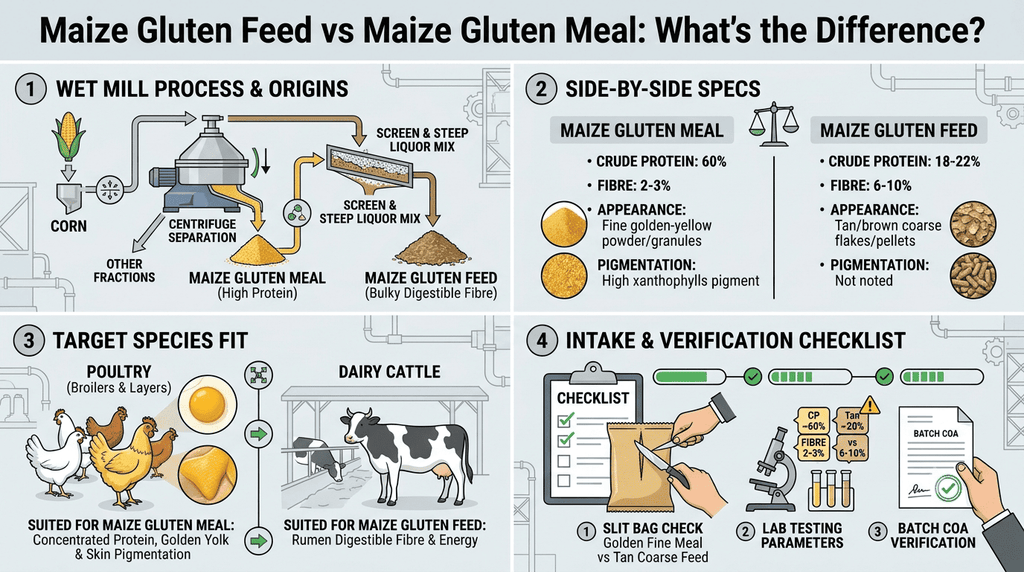
Both come out of a maize wet mill, the same plant that makes corn starch. They just get collected at different points on the line. Never been inside one? It’s a factory that takes corn kernels to bits and then sells every bit separately.
It starts with soaking. Warm water, a pinch of sulphur dioxide, and the maize just sits in it for a day, maybe two. Kernels come out soft. The water doesn’t get thrown away either; it’s full of dissolved goodies by now, and the plant drains it off as “steep liquor” to use later. Then a rough grind. The germ, which holds the oil, pops free and goes off for crushing. Then a finer grind, and screens catch the bran and hull. What slips past the screens is starch and protein, still mixed. A centrifuge sorts that out, since protein and starch don’t weigh the same.
Dry the protein that comes off the centrifuge and that’s your maize gluten meal. Very little fibre left in it by then, not much starch either.
Maize gluten feed is a different animal (pun not intended). The plant collects the bran off the screens, mixes the steep liquor back in, often adds spent germ meal, and dries it or sells it wet. Middling protein. Loads of digestible fibre. Some starch hanging on.
Easy way to keep them straight? The plant runs for the meal. The feed is what it makes so nothing goes to waste.
How Much Protein Is in Each? The Spec Sheets Side by Side
Three times the protein on one side. Several times the fibre on the other. Here’s the rest:
| Parameter | Maize Gluten Meal | Maize Gluten Feed (dried) |
| Crude protein | About 60% (Brinda Foods spec) | About 18-22% |
| Crude fibre | 2-3% | Roughly 6-10% |
| Fat | 2-3% | Usually under 4% |
| Residual starch | Low | Moderate, varies widely by plant |
| Moisture | Below 10% | Around 10-12% for dried material |
| Natural pigment (xanthophylls) | High | Low |
| Rumen behaviour of the protein | Largely bypass (escapes the rumen) | Largely degradable in the rumen |
| Look | Free-flowing golden-yellow powder or granules | Light tan to brown, coarser and flakier, often pelleted |
| Main role | Concentrated protein and pigment | Digestible fibre, energy and moderate protein |
The feed column is fuzzier, and that’s not sloppy data. Every plant blends its own leftovers its own way. Two trucks of gluten feed from two plants? Don’t expect them to match. Trust the batch certificate over the bag label, every time. (Numbers drawn from Feedipedia (FAO), NDSU Extension and our own meal spec.)
Which One Goes to Cattle and Which to Poultry?
Feed for cattle, meal for birds. Most nutritionists would put it that bluntly, and fibre is why.
Start with the cow. Her rumen is basically a fermentation tank full of microbes, and bran fibre is food to them. Gluten feed hands her energy plus a bit of protein, without the starch rush you’d get from piling on grain. Small problem: those same microbes eat most of its protein before the animal sees it. That’s why a bypass protein usually rides along in the ration. Our complete guide to cattle feed raw materials goes through that balancing act.
Chickens are another matter. Fibre does very little for them. Hand them a 60% protein ingredient with next to no fibre and you’ve matched what they need. Most broiler and layer formulas use gluten meal at 2 to 5%, usually as a protein top-up sitting beside Soya DOC. Colour comes along for free, which we’ll get to. Watch lysine, though; the meal is short on it, even if methionine looks great. Could a dairy ration use gluten meal as bypass protein? Sure. Most mills just don’t want to spend 60% material there.
Swapping them is where things go wrong. Gluten feed in a broiler formula meant for meal? Protein falls, fibre climbs, both in one shot. Flip it, meal in a cattle ration where feed should be, and you’ve paid protein money for something that was only ever supposed to supply energy and roughage.
Why Does Gluten Meal Turn Yolks Golden?
Short version: the meal ends up holding most of the maize’s yellow pigment, and hens pass that pigment straight into the yolk. We’re talking about two xanthophylls mainly, lutein and zeaxanthin, both found naturally in yellow corn. A hen can’t make either. She just passes on whatever her feed gives her, into the yolk, and broilers do the same with their skin.
Inside the wet mill, these pigments cling to the protein. Starch doesn’t hold them and bran doesn’t either. End result, the meal carries most of the kernel’s colour and the feed gets scraps. Back in the 1960s a Cereal Chemistry paper measured it: several times more carotenoids in the meal than the feed, same plant, same maize (AACC). Add all the gluten feed you like to a layer diet. Yolks won’t budge much.
Why should a mill care? Plenty of egg and broiler buyers in India still judge quality by that golden shade. One ingredient giving you protein and colour together is handy. Pigment fades in badly dried or badly stored stock, and that’s why an even golden colour through the whole lot is worth noticing. Our layer feed nutrition guide has more on pigment across laying phases.
Which Gives More Protein for the Money?
Per kilo of protein, real gluten meal tends to come out a little cheaper than gluten feed. Surprised? Most buyers are, because on a rate list the feed looks like a steal. The real money leak is something else entirely: paying a meal price for a feed delivery.
Grab a calculator. Rate per kg, divided by protein %. We’ve used the indicative August 2026 numbers from our maize gluten meal price guide here:
| Material and price paid | Crude protein | Cost per kg of protein |
| Maize gluten meal at ₹40/kg | 60% | About ₹67 |
| Maize gluten feed at ₹15/kg | 20% | About ₹75 |
| Soya DOC at ₹43/kg (for reference) | 45% | About ₹96 |
| Gluten feed wrongly sold as gluten meal at ₹40/kg | 20% | About ₹200 |
Look at the bottom row for a second. ₹200 for every kilo of protein, three times over, and the formula still comes up short.
In fairness to gluten feed, cattle buyers shouldn’t judge it on protein alone. Half the reason you’d buy it is the fibre and energy a cow can actually digest. So the honest comparison is with whatever it’s pushing out of the ration, maybe grain, maybe bran. Oh, and these rates shift whenever maize or soya does. Use this week’s numbers, not ours.
How Do You Avoid Getting One Sold as the Other?
Easiest protection? Get the lab report and skip straight to two lines: crude protein, crude fibre. Real meal? Somewhere near 60 and 2 or 3. Feed comes back closer to 20 on protein, and the fibre number jumps a lot. Those two numbers settle most arguments.
Lab results take a day or two. Meanwhile, slit open a bag. Meal is a clean, bright gold the whole way through. Feed? Duller, browner, clearly coarser. Pinch some and rub it. Meal feels fine and pours easily; flakes and bran bits mean you’re holding feed, or meal that’s been cut with it. Quotes at 40 or 50% protein usually point to a lower grade or a blend. Fine to buy, honestly, just not at a 60% rate.
One scoop off the top of a 20-tonne truck tells you about that one scoop. That’s it. Our truckload sampling procedure explains how to get a sample that speaks for the full load. And cutting expensive material with cheaper stuff happens in lots of feed ingredients, gluten’s no exception. We’ve put quick gate tests for several of them in our guide to detecting adulteration in feed raw materials.
Your quote checklist!
Screenshot this bit. Before you sign off on a maize gluten meal quote, it should cover:
- The exact product name: maize gluten meal, with the grade (for example 60% CP)
- Guaranteed minimum crude protein
- Maximum crude fibre
- Maximum moisture (below 10% is a sound target)
- Fat range
- Aflatoxin B1 limit, tested on the batch
- Physical form and colour (golden yellow powder or granules)
- A batch-specific Certificate of Analysis, plus a sample before bulk dispatch
- Price per kg and the price per kg of protein, on the same delivery basis (ex-works or delivered, bag size, freight)
Buying gluten feed? Same list. Just expect the protein line to say something like 18 to 22%, and don’t accept a quote without a fibre figure. If a supplier gets cagey about any of these, that tells you something too.
Questions Buyers Usually Ask Us
- Is maize gluten meal the same as corn gluten meal? Yep. Maize, corn, same crop. Both names mean the 60% protein meal, and corn gluten feed is just another name for maize gluten feed.
- Is maize gluten feed the same as maize DDGS? No, different process altogether. Gluten feed comes from a starch plant. DDGS is what remains once maize has been fermented for ethanol and then dried, usually somewhere around 26 to 30% protein, with more fat in it. Our piece on DDGS in animal feed explains it properly.
- Does maize gluten contain gluten like wheat? Not the bakery kind, no. Feed traders use “gluten” loosely for the protein that’s been separated from the starch. In maize that protein is mostly zein, which doesn’t act anything like wheat gluten.
- Can maize gluten feed be used in poultry feed? In small amounts. Push it too far and the fibre starts working against you. It won’t do much for yolk colour either. That’s why you’ll rarely see it high up a broiler formula.
- Any storage tips? Dried meal and dried feed are both easy: dry, airy godown, moisture kept low. Wet gluten feed is trickier. If it isn’t sealed it can spoil in a few days, so it’s usually used near the plant that made it.
- Which maize gluten grade does Brinda Foods supply? We stock the meal, the 60% one. Fat and fibre come in somewhere between 2 and 3%, and we keep moisture below 10. Each batch ships with its Certificate of Analysis.
To Wrap Up!
So, one name, one factory, two jobs. If you run a poultry line, you probably want the meal, for protein and colour both. Cattle mill? The feed will likely serve you better, and cost less doing it. Whatever you buy, test protein and fibre on each lot. It costs little and saves a lot.
Curious how the rice version compares? Our Rice Gluten page has its profile. If you’re rethinking suppliers altogether, have a look at our guide on choosing a feed raw material supplier. Price is only one of the things it covers.
About Brinda Foods
Family business, Panipat, since 1987. That’s us. Feed mills and manufacturers all over India buy Maize Gluten, Rice Gluten, Maize DDGS, Rice DDGS, Soya DOC, Mustard DOC, DORB and Maize from us by the truckload. Each batch is lab-tested before it leaves and goes out with its own Certificate of Analysis. ISO 9001:2015 certified, too.
Looking for real 60% maize gluten meal? Send an enquiry | Call: 9992500442 | Email: sales1@brindafoods.com