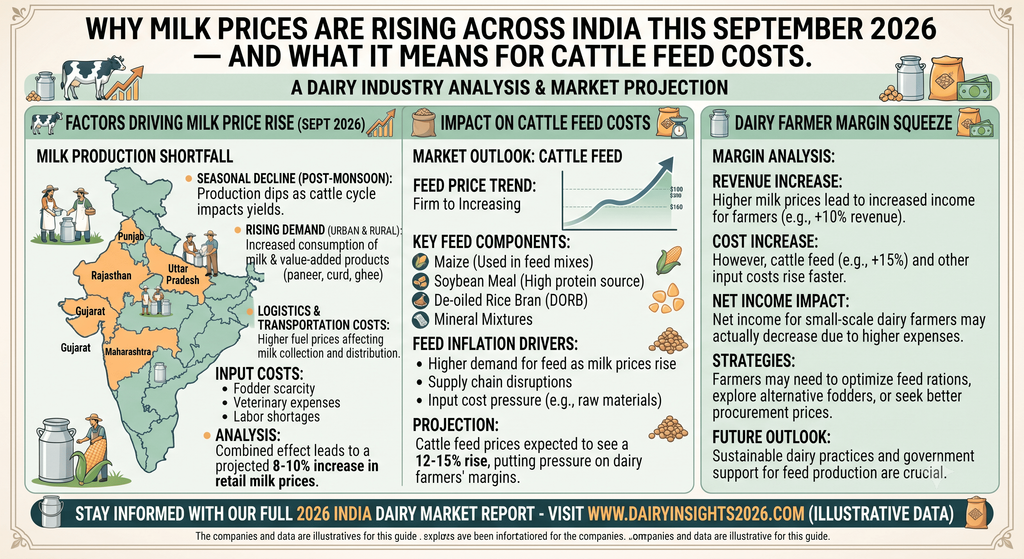
Quick summary: September 1, 2026 brought two milk price stories that made national headlines for very different reasons. In Mumbai, the Mumbai Milk Producers’ Welfare Association raised its wholesale buffalo milk rate by ₹9 per litre to ₹102/litre — the steepest single hike in the association’s 70-year history. On the same day, Tamil Nadu’s government raised its procurement price by ₹6 per litre to ₹44/litre, benefiting over 3.16 lakh dairy farmers. Both announcements point to the same underlying cause: a sharp rise in cattle feed costs. For anyone buying or selling feed raw materials, that’s the real story behind the headlines — and it’s worth understanding in detail heading into India’s peak festive dairy season.
Two Milk Price Hikes, One Shared Cause
Mumbai: The Mumbai Milk Producers’ Welfare Association (MMPA) raised its loose/wholesale buffalo milk rate from ₹93 to ₹102 per litre effective September 1, 2026 — up from ₹91 as recently as February 2026. Retail prices are expected to follow, with estimates ranging ₹115–125/litre or higher depending on locality. The association called it the steepest increase in its 70-year history, and cited three factors directly: milch animal costs up 60–70%, feed expenses (“dana,” tuvar, chuni, chana-chuni) up roughly 25%, and rising fodder (grass and hay) costs.
Tamil Nadu: The state government raised its milk procurement price by ₹6/litre to ₹44/litre, effective the same date, for six months through February 28, 2027 — a decision benefiting more than 3.16 lakh registered milk producers. The stated justification: “the rising cost of producing milk,” with officials specifically pointing to farmers “spending more on cattle feed and other needs.”
Two different mechanisms — a wholesale trade association’s rate revision in Maharashtra, a state government’s procurement price order in Tamil Nadu — arriving on the exact same date, citing the exact same root cause. That’s not a coincidence; it’s a genuine national cost cycle showing up in two different price-setting systems at once.
The Timing Isn’t an Accident Either
Both price actions land at the start of India’s peak dairy demand window. Milk consumption typically rises 35–40% through the run of festivals ahead — Ganesh Chaturthi, Navratri, Diwali, Christmas, and Ramzan — plus wedding season, when milk-based sweets drive heavy institutional and household demand. Dairies and producer associations routinely time price resets to this window, but this year’s increase is unusually steep because it’s layering festive demand on top of a genuine input-cost shock rather than adjusting for demand alone.
What’s Actually Driving the 25% Feed Cost Jump
“Dana” (grain-based concentrate), tuvar chuni, and chana chuni are pulses-processing byproducts — pigeon pea and chickpea husk/broken fractions — that form a meaningful share of low-cost cattle ration formulations across Maharashtra and neighbouring states, alongside the maize, oilseed cakes (DOC), and DDGS that anchor most compound feed. When any of these inputs move 25% in a matter of months, it shows up in a dairy farmer’s cost sheet almost immediately, since feed typically accounts for 60–70% of total milk production cost.
This tracks with what we’re already seeing across Brinda Foods’ own raw material price ranges through August–September 2026:
| Ingredient | Approx. price range (Sep 2026) | Trend note |
|---|---|---|
| Maize | ₹22–26/kg | Firming — kharif 2026 sowing ran ~4% below last year, and ethanol demand (now ~35% of India’s ethanol feedstock) is adding structural pull; see our kharif sowing update and E20 ethanol demand piece |
| Soya DOC | ₹40–52/kg | Elevated after a shorter 2025–26 soybean crop; see our soybean meal crisis coverage |
| Mustard DOC | ₹20–27/kg | Regionally variable |
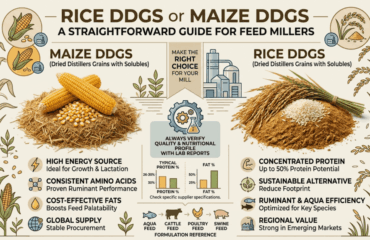
| Maize/Rice DDGS | See our Maize DDGS and Rice DDGS price guides | Co-product supply tracking ethanol/distillery throughput |
| DORB | ₹9–15/kg | Low-cost energy filler, price-sensitive to rice-milling volumes |
Ranges are indicative and move weekly — always confirm current pricing directly with your supplier before budgeting a purchase.
The maize and Soya DOC pressure points line up closely with what MMPA and Tamil Nadu officials described in their own words: this isn’t an isolated Mumbai or Tamil Nadu phenomenon, it’s the same raw-material cost cycle that’s been building across our maize, DDGS, and Soya DOC coverage through the second half of 2026, now visible in consumer-facing milk prices.
What This Means If You Buy or Sell Cattle Feed
For dairy farmers and gaushalas: A milk price increase helps offset rising costs, but the sequencing matters — feed cost increases typically arrive before, not after, a price revision reaches you. Locking in raw material supply (or a compound feed source) at a known cost, rather than buying reactively in spot markets as prices climb further into the festive season, protects margin during exactly this kind of cycle. Our cattle feed formulation and ration-balancing guide covers how to substitute among maize, DOC, and DDGS as relative prices shift.
For feed mills and compound feed manufacturers: Rising retail milk prices generally translate into farmers being willing to spend more on feed quality to protect yield — see our best cattle feed for high milk production guide — but your own input costs are moving at the same time. This is the window to review bulk sourcing agreements rather than buying ingredient-by-ingredient as spot prices firm through September and October.
For anyone budgeting cattle feed costs into Q4 2026: Treat this as confirmation that the raw material cost pressure flagged across our maize sowing, ethanol demand, and soybean coverage this year is now showing up downstream in real consumer and procurement prices — not a one-off Mumbai or Tamil Nadu story. See our full guide to reducing animal feed cost in India for practical levers beyond just absorbing the increase.
Quick Price Check:
Maize Kharif Sowing 2026 Ddgs Price Outlook
DDGS Price in India
Layer Feed Price in India
Broiler Feed Price India
Cattle Feed Price in India
Maize Price Per Kg India 2026
Feed Raw Material Price Comparison India
Corn DDGS Price India 2026
Rice Gluten Meal Price India 2026
Dorb Price In India 2026
Maize Gluten Meal Price India 2026
Soya Doc Price India 2026
Maize DDGS Price India 2026
Mustard Doc Price India 2026
Maize Animal Feed Price Nutrition Guide India 2026
Rice Ddgs Price India 2026
Frequently Asked Questions
Why did milk prices rise in India in September 2026? Multiple dairy-price actions — including Mumbai’s steepest-ever wholesale hike and Tamil Nadu’s state procurement price increase — took effect September 1, 2026, both citing rising cattle feed costs (roughly 25% higher for key ingredients) as the primary driver, compounded by rising milch animal and fodder costs.
Is this a Mumbai-only or Tamil Nadu-only issue? No — while the specific price actions are regional, the underlying cause (rising maize, DOC, and pulses-byproduct feed costs) is a broader national trend that’s been building through 2026, visible in our maize, DDGS, and soybean price coverage over recent months.
Will cattle feed prices keep rising through the rest of 2026? Several structural factors — a below-normal maize sowing year, growing ethanol-linked maize demand, and elevated Soya DOC pricing after a shorter soybean crop — point toward continued cost pressure through the festive season, though actual movement depends on harvest outcomes and monsoon-linked supply through September–October.
How can dairy farmers and feed mills manage rising feed costs? Locking in bulk raw material supply ahead of further spot-price increases, reviewing ration formulations for cost-effective ingredient substitution, and sourcing directly from raw material suppliers rather than only branded compound feed are the main practical levers — covered in detail in our feed cost reduction guide.
Where can I get current bulk pricing for cattle feed raw materials? Request a quote from Brinda Foods for Maize, Soya DOC, Mustard DOC, Maize/Rice DDGS, or DORB — our team can also advise on securing supply ahead of further seasonal price movement.
About Brinda Foods
Brinda Foods has supplied animal feed raw materials from Panipat, Haryana since 1987. We provide bulk supply of Maize, Soya DOC, Mustard DOC, Maize DDGS, Rice DDGS, and De-Oiled Rice Bran (DORB) to dairies, feed mills, and farms across India. ISO 9001:2015 certified.
Get today’s bulk quote: Submit an enquiry or contact our team.