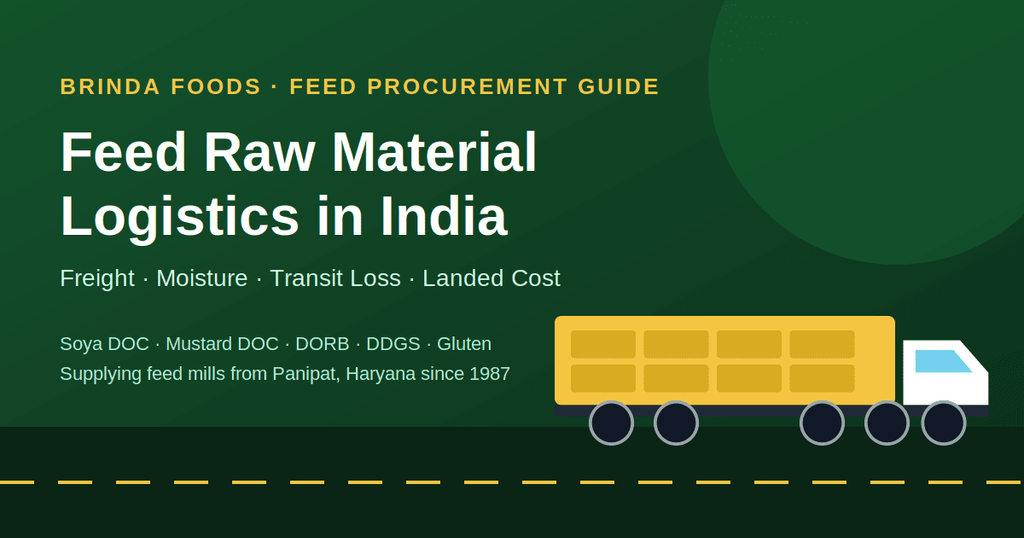
Quick answer: Most bulk feed raw materials in India move by road in 50 kg bags on 10, 12 and 14 wheel trucks. Rail rakes handle a share of the long hauls. Your real cost depends on much more than the freight rate per tonne. It also depends on how far the material travels, how light it is (DDGS and DORB fill a truck by volume well before they reach its weight limit), how much moisture it picks up on the road, weighbridge differences between loading and unloading, and the season you book in. The buyers who get the best value compare delivered cost per kg of nutrient, agree a transit loss tolerance in writing, and plan their orders around monsoon and harvest season.
Ask a purchase manager at any feed mill about their last bad consignment, and the story is rarely about price. It’s the truck that turned up two days late. The tarpaulin with a tear in it. The 400 kg that went missing somewhere between the supplier’s weighbridge and theirs.
Price gets all the attention in procurement meetings. Logistics quietly decides whether that price holds up by the time the material is sitting in your godown. So let’s talk about the part of buying feed raw materials that doesn’t show up on the quotation.
Why Logistics Belongs in Your Procurement Decision
Feed already accounts for 65 to 70% of livestock production costs in most operations. Within that, freight is a bigger slice than many buyers realise, especially for lower-value materials.
Here’s a simple way to see it. Say freight to your mill works out to ₹2 per kg. On a protein meal priced around ₹42/kg, that’s roughly 5% on top. On a lower-priced material like DORB, the same ₹2 can be a much larger share of what you actually pay. Same truck, same route, very different impact.
That’s why two suppliers quoting ₹1/kg apart ex-works can end up almost level once the material reaches your gate. Sometimes the “expensive” quote wins.
| How DoMode | How it’s typically loaded | Best suited for | What to watch |
| Road, bagged (10 to 14 wheel trucks) | 50 kg PP bags, stacked and covered | Most mill orders, short and medium distances | Tarpaulin quality, stacking, days on road |
| Road, bulk or jumbo bags | Loose load or 500 kg to 1 tonne bags | Large mills with bulk intake systems | Contamination from previous load, spillage |
| Rail rake | Wagon loads, thousands of tonnes per rake | Long hauls between states, very large buyers | Last mile trucking, siding delays, rake availability |
| Container | Bagged, sealed | Export and some coastal movement | Condensation inside the container |
How Feed Raw Materials Actually Move Across India?For most feed mills in North and Central India, road freight is the everyday reality. It’s flexible, it goes door to door, and a single truck matches a typical weekly or fortnightly intake. Rail makes sense when volumes are very large and distances are long, though you’ll still need trucks at both ends.
The Light Material Problem: Why Some Loads Cost More Per Tonne!
This one surprises new buyers. Trucks have a weight limit, but they also have a volume limit. Denser meals hit the weight limit first. Lighter, fluffier materials fill the truck body before they get anywhere near it.
| Material | How it loads | What that means for freight |
| Soya DOC and Mustard DOC | Fairly dense, loads close to the truck’s weight capacity | Freight per tonne stays efficient |
| Maize DDGS and Rice DDGS | Lighter, bulkier | Fewer tonnes per truck, higher freight per tonne |
| De-Oiled Rice Bran (DORB) | Among the lightest common feed materials | Truck often fills by volume, so plan for lower tonnage per load |
What to do about it? Ask your supplier how many tonnes of that specific material a truck realistically carries on your route. Then compare freight per tonne delivered, not freight per truck. A truck rate that looks cheap can turn out costly if it only carries two thirds of the tonnage you assumed.
Moisture, Monsoon, and Quality in Transit!
Every feed buyer knows moisture is money. A lot that left the plant at 10% moisture can pick up more on a long, humid journey, and that changes both the nutrient value per kg you paid for and how well it stores.
A few simple habits make a big difference:
- Insist on proper covering. Double tarpaulin during monsoon, with the floor of the truck body dry and clean before loading. A single torn sheet over a 20 tonne load is a risk you don’t need to take.
Keep days on road short. The longer material sits in a closed, humid truck, the more condensation builds up, even without rain. Nearer sourcing helps here.
Avoid mixed loads. Feed ingredients should not share a truck with wet goods, chemicals, or fertiliser. Ask what the truck carried last.
Unload promptly and use FIFO. A truck parked outside the gate overnight in July is still in transit, as far as moisture is concerned. Material that arrives first should go into production first.
Test on arrival, not just at dispatch. Your supplier’s certificate of analysis tells you how the batch left. A quick moisture check at your gate tells you how it arrived.
Weighbridge, Paperwork, and Transit Loss!
Small weight gaps between the loading and unloading weighbridges are normal. Some moisture loss or gain, a torn bag, a slightly different calibration. The trouble starts when nobody agreed in advance what “normal” means.
- Agree a transit loss tolerance in writing. Many buyers and suppliers settle on a small percentage, often around half a percent, beyond which the shortfall is claimed. Whatever figure you choose, put it on the purchase order.
- Weigh at both ends on the same day. Keep the loading weighbridge slip and your own receiving slip together.
- Check that the right documents travel with the truck. This usually means the tax invoice, the lorry receipt (builty), the loading weighbridge slip, the batch test certificate, and an e-way bill where applicable. Your accountant can confirm the e-way bill rules for your specific materials and routes.
- Photograph the load on arrival. Covering, bag condition, any wet patches. It takes two minutes and settles most disputes before they begin.
Plan Around the Seasons That Tighten Truck Supply!
Truck availability in India follows a rhythm, and a little planning keeps your mill running smoothly through it.
- Monsoon (roughly July to September): Slower roads, higher moisture risk, and occasional route disruptions. Build a few extra days of buffer stock.
- Kharif harvest (October to November): Paddy in Punjab and Haryana and soybean in Madhya Pradesh all need trucks at the same time. Freight rates often firm up and availability gets tighter.
- Festive season: Drivers go home for Diwali and the weeks around it. Book early and confirm vehicles in advance.
- Winter fog (December to January): Night movement across North India slows down, which can stretch transit times on longer routes.
Buyers who lock in supply and dispatch schedules ahead of these windows usually get steadier deliveries and fewer rush orders at spot rates.
Ex-Works vs Delivered: How to Compare Quotes Fairly
| Quote type | What it covers | What you still need to add |
| Ex-works (ex-factory) | Material loaded at the supplier’s plant | Freight, transit loss, unloading, your own time arranging trucks |
| FOR destination (delivered) | Material delivered to your mill | Unloading, and any claims for shortfall beyond the agreed tolerance |
To compare two quotes properly, bring them to the same basis:
Landed cost per kg = material price + freight per kg + loading and unloading per kg + expected transit loss
Then take it one step further and divide by the nutrient you’re buying the material for. A 48% protein Soya DOC delivered from a nearby supplier can work out cheaper per kg of protein than a lower priced 44% lot travelling twice the distance. Our feed raw material price comparison and guide to reducing feed cost walk through this kind of maths in more detail.
Why Sourcing Distance Matters More Than It Looks?
Distance affects your freight rate, and it also shapes everything else in this article: days on road, moisture exposure, the number of weighbridges and handlers involved, and how quickly a replacement load can reach you if something goes wrong.
For mills in Haryana, Punjab, Delhi NCR, western Uttar Pradesh, and Rajasthan, sourcing from within the region often means next-day or two-day delivery instead of four or five. That shorter cycle also lets you hold less stock and still feel secure. We explain more about regional sourcing in our Rice DDGS supplier in Haryana guide.
A Quick Checklist Before You Book Your Next Load
1. Compare delivered cost per kg of nutrient, not ex-works price per kg.
2. Ask for realistic tonnage per truck for that specific material on your route.
3. Put the transit loss tolerance on the purchase order and agree how shortfalls get settled.
4. Confirm covering standards, especially between July and September.
5. Get the batch test certificate with every load, and run your own moisture check on arrival.
6. Book ahead of harvest and festive season so trucks are confirmed before rates firm up.
7. Choose consistency over the cheapest quote. A supplier who delivers the same grade on time every time saves you reformulation, storage headaches and rush orders. Our article on what raw materials go into quality cattle feed and why sourcing matters covers this in more depth.
Frequently Asked Questions
- How are feed raw materials usually transported in India?
Mostly by road, in 50 kg bags on 10 to 14 wheel trucks. Rail rakes are used for long distance, high volume movement, and large mills with bulk intake systems sometimes take loose or jumbo bag loads.
- Why does DDGS or DORB cost more to transport per tonne than Soya DOC?
They are lighter materials, so a truck fills up by volume before it reaches its weight limit. You get fewer tonnes per truck, which pushes the freight cost per tonne higher.
- What transit loss is normal for feed raw materials?
It depends on the material, distance and season, but many buyers and suppliers agree a small tolerance, often around half a percent, and write it into the purchase order. Anything beyond that is handled as a claim.
- How can I protect raw materials from moisture during the monsoon?
Use double tarpaulins, make sure the truck bed is dry and clean, avoid mixed loads, keep transit time short, and unload promptly. Test moisture on arrival and use older stock first.
- Should I buy ex-works or delivered?
Either can work well. What matters is comparing both on a landed cost basis. Delivered pricing is simpler to budget, while ex-works gives you more control if you already have reliable transporters.
About Brinda Foods!
Brinda Foods has supplied animal feed raw materials from Panipat, Haryana since 1987. Located on the GT Road corridor, we supply Soya DOC, Mustard DOC, De-Oiled Rice Bran (DORB), Maize DDGS, Rice DDGS, Maize Gluten and Rice Gluten to feed mills and manufacturers across North and Central India. Every batch is lab tested and comes with specification documentation. ISO 9001:2015 certified.
Planning your next bulk order? Send us an enquiry or call 9992500442 to discuss grades, quantities and delivery to your location.