
Quick answer: Feed ingredient rates in India go up and down with the crops they come from. New kharif maize and soybean hit the mandis from October, so October through January is when maize and Soya DOC are easiest on the pocket. DORB picks up in winter, once the rice mills are in full swing. Mustard DOC is best bought after the March to May crush. DDGS is the odd one out; it follows the ethanol plants more than any harvest. Buy when the crop is in, hold back in the lean months, and your yearly average cost tends to come down.
Every year, somewhere around the middle of September, we get the same call.
“Bhaiya, two trucks of Soya DOC, just to get us through Diwali.”
We send them, of course. But those two trucks are usually the costliest material that mill will buy all year, and most of the time it could have been avoided with a bit of planning back in December.
The crop seasons aren’t a secret. Ask any purchase manager and they’ll roughly know when maize lands or when mustard gets crushed. What’s hard to find is all five ingredients laid out against all twelve months, in one place, so you can plan a quarter ahead instead of firefighting week to week.
That’s the idea behind this calendar. For live rates, our Soya DOC price tracker and the other price posts on the blog are kept updated. This piece only deals with when to buy.
Why Do Feed Raw Material Prices Follow the Crop Calendar?
Simple supply and demand, really.
Almost every line on your formulation sheet came from a crop, or from what was left after a crop was processed. At harvest there’s more material around than buyers can lift, so sellers soften. Give it a few months and the stock runs down. Now buyers are the ones running after sellers.
Three cycles decide the rhythm for Indian feed mills. Kharif harvest, roughly September to November, brings maize, soybean and paddy almost together. Rabi harvest, February to May, gives you mustard and Bihar’s rabi maize. And underneath both sits the processing cycle: crushing, rice milling, solvent extraction and distilling. That last one decides when the by-products actually turn up at your gate.
People forget the processing lag all the time. Paddy is cut in October, sure. DORB doesn’t really start moving until the mills and solvent plants have been running on that paddy for a few weeks. Track only the harvest and you’ll be early.
Trade and policy can also lift or drop the whole curve. You can see it this year with the soybean meal export situation. The seasonal shape stays; only the starting level moves.
What Does the Month-by-Month Buying Calendar Look Like?
Below is how a normal year usually plays out from our end. “Buy” means arrivals are good and offers are on the softer side. “Steady” is a regular month. “Tight” means lean season, better to use what’s already in your godown.
| Month | Maize | Soya DOC | Mustard DOC | DORB | DDGS |
| January | Buy | Buy | Tight | Buy | Steady |
| February | Steady | Steady | Tight | Buy | Steady |
| March | Steady | Steady | Steady (crush starting) | Buy | Steady |
| April | Steady (rabi maize) | Steady | Buy | Steady | Steady |
| May | Buy (rabi maize) | Steady | Buy | Steady | Steady |
| June | Steady | Tight | Buy | Steady | Steady |
| July | Tight | Tight | Steady | Tight | Watch quality |
| August | Tight | Tight | Steady | Tight | Watch quality |
| September | Tight | Tight | Steady | Tight | Steady |
| October | Buy (kharif arrivals) | Steady (crush starting) | Tight | Steady | Steady |
| November | Buy | Buy | Tight | Buy | Steady |
| December | Buy | Buy | Tight | Buy | Steady |
November, December and January give you maize, Soya DOC and DORB all at good levels together. If your planning cycle is quarterly, that one quarter can take care of a large part of the year.
Mustard DOC moves on a separate track. It comes good in April to June, right around the time soy starts climbing, which suits cattle feed plants nicely.
Then there’s July to September. Nearly everything is tight. Walk into July with stock in hand.
DDGS barely changes through the year, so it’s useful to have in the mix when other things get costly.
Keep some margin for weather. A delayed monsoon or late sowing can shift these windows by two to four weeks either way, so cross-check mandi and supplier rates before you commit volumes.
When Does New-Crop Kharif Maize Reach Mandis?
Late September, in small lots first. October and November are when it really comes in, from Karnataka, MP, Rajasthan, Maharashtra and Telangana. For most mills it’s the most relaxed time of the year to buy maize.
There’s a second window many buyers in the north overlook. Bihar grows a large rabi maize crop, and along with some from Andhra and Telangana, it starts arriving around April and runs into June. Good for a top-up before the summer squeeze.
Careful with the very first October lots. New maize often comes in with high moisture, and nobody wants to pay grain rates for water. Mid-October onwards usually gives a better mix of price and dryness.
Ethanol has also shifted the maize market a fair bit. Distilleries now compete with feed mills for the same grain, so harvest-time dips aren’t as deep as they used to be. There’s more on this in our post on the E20 push and maize supply.
August and September are normally the tightest months. If you want grades, inclusion and quality checks in detail, our maize buying guide covers it. We also supply feed-grade maize in bulk from Panipat.
When Does Soybean Crushing Start, and When Is New-Crop Soya DOC Available?
The soybean harvest in MP, Maharashtra and Rajasthan runs from late September into October. Plants start crushing seriously in October. By November, new-crop Soya DOC is moving well, and it stays that way till about January.
Summer is the painful part. June to early October, old beans are scarce, plants run below capacity, and rates climb. That’s the pre-Diwali rush we talked about at the start.
What we usually suggest to our buyers:
- Book a bigger share of your yearly soy requirement between November and January, on forward contract wherever possible.
- From February to May, buy your regular quantities.
- June to September, run on stock and avoid spot buying unless you really have to.
Soya DOC holds up well in storage if moisture is kept under control, so carrying winter stock isn’t a problem for most godowns. We supply lab-tested Soya DOC in bulk to mills across North and Central India.
When Is Mustard Crushed, and When Is Mustard DOC Cheapest?
Sarson goes in during October and November and comes out from late February into March. Rajasthan, Haryana, MP and UP grow most of it. Once the seed reaches the crushers, things pick up fast.
April, May and June are the months to buy Mustard DOC. Expellers and solvent plants are working full shifts, there’s material all over the market, and you can afford to reject a lot that doesn’t meet spec.
From October to February it flips. Seed is running low, crushing slows down, and the better lots go quickly.
For ruminant feed makers this works out well, since mustard gets cheaper just as soy gets dearer. One thing though: sarson khal and solvent-extracted Mustard DOC are not the same product. Oil and protein levels differ quite a bit, and our post on Mustard DOC vs. mustard cake explains how.
Specs and bulk availability are on our Mustard DOC page.
Why Does DORB Supply Follow the Paddy Milling Season?
DORB is a by-product of a by-product. Paddy is milled, bran comes off, the bran goes to a solvent plant, the oil is pulled out, and DORB is what’s left. So supply depends on when mills are running, not on when the paddy was cut.
In Punjab and Haryana, paddy comes in from late September through November and the mills work on it right through winter. November to March is therefore when DORB is easiest to buy.
By July to September, mills are on leftover paddy and the humidity makes storage harder for everyone. Less supply, more variation in quality.
Our honest suggestion: stock up in winter, and test sand and silica on every single lot. It’s the most common problem we see with DORB. If you’re not sure what to look for on the report, our guide to reading a Certificate of Analysis will help.
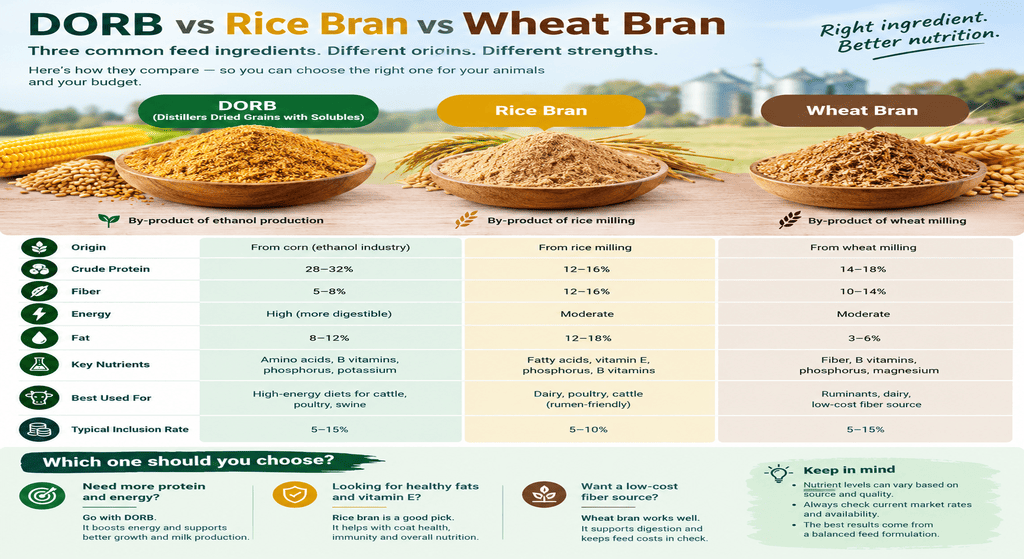
Choosing between brans for a ration? Our comparison of DORB, rice bran and wheat bran covers that. Being in Panipat, in the middle of the northern rice belt, keeps our De-Oiled Rice Bran supply steady through the milling months.
Does DDGS Supply Follow the Grain or the Ethanol Calendar?
The ethanol calendar, mostly. DDGS comes out of grain-based distilleries, and they try to run twelve months a year. So it’s the most even of the five ingredients here.
Grain still plays a small part. When maize or broken rice becomes expensive for the distilleries, DDGS rates firm up as well. A plant going down for maintenance can tighten one region for a few weeks. And because many buyers price DDGS against soy, demand for it rises whenever Soya DOC gets tight in summer.
The thing to really watch with DDGS is the monsoon. From July to September, damp storage and long truck journeys raise the chance of moisture pick-up and mould. Insist on a batch-wise COA, and once it reaches you, follow proper storage practice for DDGS, Soya DOC and DORB.
For current rate ranges, see our corn DDGS price update. We supply Maize DDGS as well as Rice DDGS, every batch with its own lab report.
Should Feed Mills Forward-Buy or Buy Spot?
Both. The question is only how much of each, and the season answers that for you.
When arrivals are strong, book the next two or three months on contract and pick up spot lots on top whenever you find good material at a fair rate. When supply is tight, run on your contracts and stock. Spot only in emergencies.
DDGS is simpler. A rolling monthly contract does the job for most mills.
Whatever you sign, put it in writing. The full spec (protein, moisture, fibre, sand and silica, aflatoxin), delivery dates, who bears freight risk, what happens with an off-spec lot, and a COA with every truck.
And keep an eye on freight. We’ve seen good seasonal rates wiped out by transport costs more than once. Our note on bulk feed raw material transport and logistics shows how to calculate your real landed cost.
How Much Stock Should a Mill Hold for Each Ingredient?
Depends on your godown size, working capital and how far your suppliers are. Start with a days-of-cover range and adjust as you go.
| Ingredient | Cover to hold going into lean months | Cover in normal months | What limits holding |
| Maize | 45 to 60 days | 20 to 30 days | Moisture at intake, insect and mould risk |
| Soya DOC | 45 to 60 days | 20 to 30 days | Moisture control, stack ventilation |
| Mustard DOC | 30 to 45 days | 15 to 30 days | Moisture, stack rotation |
| DORB | 30 to 45 days | 15 to 20 days | Humidity, sand and silica variation between lots |
| DDGS | 15 to 30 days | 15 to 20 days | Shorter shelf life, monsoon moisture pick-up |
These are starting points. Check them against your own consumption and storage before treating them as targets.
More stock only makes sense if it’s looked after. Test moisture when the truck arrives, don’t just go by the COA. Follow FIFO, especially in the rains. Spread deliveries across the contract period so you’re not receiving six weeks of material in one day.
Location helps. Mills close to a supply hub can run on less stock because a refill takes days, not weeks. It’s one reason Panipat has grown into a feed raw material hub for buyers across North India.
What Else Do Buyers Usually Ask Us?
- Which months are the leanest for feed raw materials overall?
July to September. The kharif crop isn’t in yet and old stock is running out, so go into July well covered. - Is it worth buying new-crop maize in early October?
It can be, but check moisture carefully. Early lots tend to be wet. Mid-October to November usually gives better value. - Does a late monsoon change the calendar?
Yes. A late or patchy monsoon can push arrivals and crushing back by two to four weeks. Keep a little extra cover until you actually see arrivals start. - How far ahead should a feed mill plan its purchases?
A quarter ahead works for most mills, with a rough yearly plan built around the arrival months in the table. - Can Mustard DOC take some of the load when Soya DOC is expensive?
Many ruminant feed makers shift part of their protein to Mustard DOC in early summer. How much depends on your formulation, so leave that call to your nutritionist. - What should a forward contract for feed raw materials include?
Full specification, delivery schedule, freight responsibility, how off-spec lots will be handled, and a COA with every dispatch.
How Can Brinda Foods Help You Plan Your Next Season?
Sticking to a buying calendar is a lot easier when your supplier plans with you. Send us your monthly usage and storage capacity, and our team will help you work out a season-wise plan for maize, Soya DOC, Mustard DOC, DORB and DDGS, with a COA on every dispatch.
Send an enquiry | Call: 9992500442 | Email: sales1@brindafoods.com
Who Is Brinda Foods?
Brinda Foods has supplied animal feed raw materials from Panipat, Haryana since 1987. We provide bulk supply of Maize DDGS, Rice DDGS, Maize, Soya DOC, Mustard DOC and De-Oiled Rice Bran (DORB) to feed mills and manufacturers across India. ISO 9001:2015 certified.

[…] and we’re just stepping into it. No surprise, then, that the energy cost gap is this narrow. Our feed raw material buying calendar does the same month by month view for maize, oilcakes and […]
[…] an October harvest means cheaper maize. Not this year. Between mid October and the first week of November, the national average actually […]