
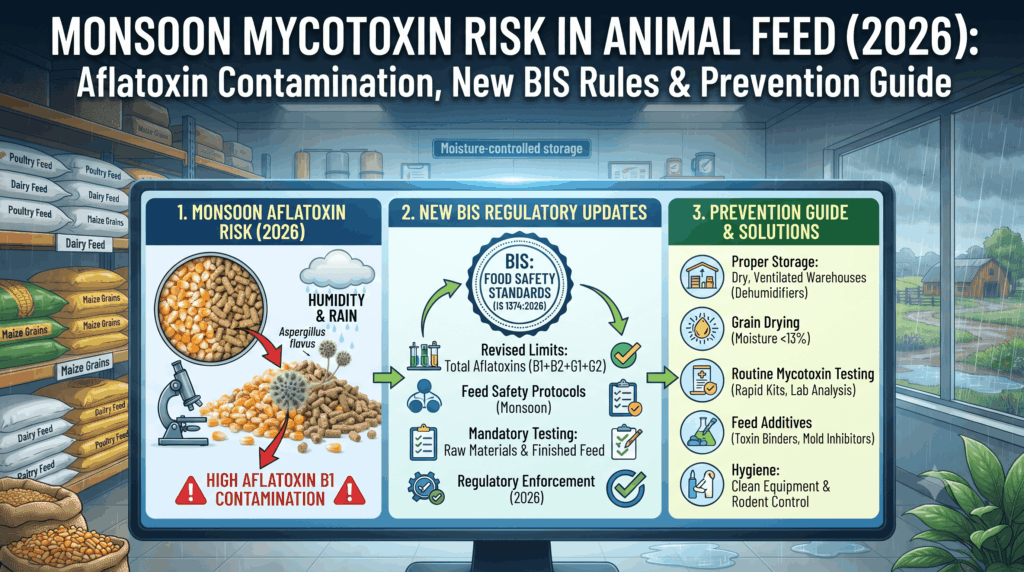
Every monsoon, the same complaint reaches feed millers and veterinarians across India: milk yield drops, birds go off feed, and conception rates fall — with no obvious disease behind it. In a large share of cases, the real culprit isn’t a pathogen at all. It’s mold. Specifically, aflatoxin, a mycotoxin produced by Aspergillus flavus, and its cousins zearalenone and ochratoxin A, all of which thrive in exactly the warm, humid conditions the monsoon brings.
This year the topic carries extra weight for two reasons. First, recent pre-monsoon and monsoon surveillance of maize-based poultry feeds found some maize-intensive ingredient categories exceeding international safety limits by a wide margin — details below. Second, a 2026 Delhi High Court ruling has fundamentally changed who regulates animal feed safety in India, shifting oversight away from FSSAI and onto the Bureau of Indian Standards. If you buy, sell, or formulate feed, both developments affect you directly.
Why Monsoon Is Peak Mycotoxin Season
Mold growth and mycotoxin production depend on three conditions: warmth, moisture, and time. India’s monsoon delivers all three simultaneously.
- Water activity in raw materials rises as ambient humidity climbs, even in grain that looked dry at harvest.
- Storage and transport conditions deteriorate — tarpaulins leak, godowns take on damp, and trucks sit longer in transit on flood-affected routes.
- Field-to-storage handling windows stretch out, giving fungi more time to establish before feed reaches the mill.
Tropical and subtropical regions are already structurally prone to this problem, and India’s combination of high temperature, high moisture, seasonal rains, and flash flooding is a textbook environment for fungal proliferation and mycotoxin production. Improper storage and less-than-optimal conditions during transport and marketing compound the risk further — meaning contamination can happen well before feed ever reaches a mixing plant.
The Data: How Bad Does It Get?
Surveillance of maize-based poultry feeds and feed ingredients in Tamil Nadu compared pre-monsoon and monsoon samples directly, and the seasonal swing was stark. Monsoon-season samples showed measurably higher water activity across ingredients and finished feeds, and — more importantly — a sharp rise in aflatoxin B1 (AFB1) incidence.
| Feed/Ingredient Category | Monsoon AFB1 Level | EU Safety Limit | Multiple Over Limit |
|---|---|---|---|
| Maize DDGS | 329 µg/kg | 20 µg/kg | ~16x |
| Layer Mash II | 64.7 µg/kg | 20 µg/kg | ~3.2x |
| Several other maize-intensive categories | Above 20 µg/kg | 20 µg/kg | Varies |
Several maize-intensive feed and ingredient categories exceeded the EU maximum limit of 20 µg/kg AFB1 during monsoon sampling, with maize DDGS and Layer Mash II among the worst offenders. Maize is the common thread — it’s the single most aflatoxin-susceptible commodity in Indian compound feed, precisely because it’s also the dominant energy source in poultry and dairy rations.
This is not a one-off finding. It reflects a well-documented, recurring seasonal pattern that repeats every monsoon unless storage and sourcing practices are actively managed around it.
What Changed in 2026: FSSAI Is Out, BIS Is In
For years, animal feed safety oversight in India sat in a legal grey zone between the Food Safety and Standards Authority of India (FSSAI) and the Bureau of Indian Standards (BIS). That ambiguity was resolved in 2026.
The Delhi High Court ruled that the definition clauses under the relevant food law do not include animal feed or cattle feed within the scope of “food” — which means FSSAI’s jurisdiction over feed does not hold. The bench struck down FSSAI directions issued between 2019 and 2021 that had required BIS certification for animal feed manufacturers, on the grounds that FSSAI was acting beyond its own statutory authority in the first place.
The practical result: regulation of cattle feed and, by extension, animal feed more broadly, is now consolidated under BIS rather than FSSAI. Under IS 2052, cattle feed is classified into grades based on the animal’s nutritional requirement (for example, high-yield lactating cows versus dry cows), and this standard specifies limits for moisture, crude protein, fat, and crude fibre — while strictly monitoring aflatoxin levels as part of the grading criteria.
What This Means for Feed Millers and Farmers
- BIS/IS 2052 is now the reference standard, not FSSAI labelling and testing requirements that some manufacturers had been building compliance around.
- Aflatoxin monitoring remains mandatory — the regulatory authority changed, but the underlying safety expectation has not relaxed.
- Procurement documentation should reference BIS grading, especially for cattle feed sold as a graded, certified product rather than loose mixed ration.
- Feed millers who had FSSAI-oriented compliance processes should confirm their testing and certification protocols are aligned with current BIS requirements, since enforcement mechanisms have shifted.
This is a fast-moving regulatory area. If your feed operation carries FSSAI-based certification, it is worth confirming current requirements with a BIS-registered testing lab before the next monsoon procurement cycle.
Which Ingredients Carry the Highest Monsoon Risk
Not all feed ingredients are equally vulnerable. Risk concentrates around a few categories:
Highest risk:
- Maize and maize by-products (maize DDGS in particular, per the data above)
- Groundnut cake / groundnut meal
- Cottonseed cake stored in humid conditions
Moderate risk (with proper storage):
- Wheat bran
- Rice polish
Comparatively lower risk:
- De-oiled rice bran (DORB) — lower oil residue reduces the substrate fungi feed on, and the milling/solvent-extraction process brings ingredient moisture down before dispatch
- Mustard DOC (de-oiled cake) — naturally lower susceptibility, and its glucosinolate content has a mild antifungal effect at typical inclusion rates
This is one reason feed formulators increasingly build monsoon-season rations around a higher proportion of DORB and mustard DOC relative to maize — not purely for cost (see our guide on reducing animal feed cost in India), but because it structurally lowers aflatoxin exposure risk during the highest-risk months of the year. It’s worth noting this is a risk-reduction measure, not a substitute for proper testing and storage discipline — no ingredient substitution eliminates mycotoxin risk on its own.
Practical Prevention Checklist
1. Control Moisture Before It Becomes a Problem
- Test incoming grain moisture at receiving, not just at the source. Maize above 14% moisture is at meaningfully elevated risk once stored.
- Use moisture-resistant storage — raised platforms, proper tarping, and ventilation gaps — rather than direct floor stacking during monsoon months.
- Rotate stock on a strict first-in-first-out basis; don’t let monsoon-received grain sit longer than necessary before milling.
2. Test, Don’t Assume
- Run rapid aflatoxin test kits (ELISA-based strip tests) on incoming maize and DDGS lots, especially June through September.
- Retest finished feed periodically, not just raw material — cross-contamination and storage after milling both matter.
- Keep test records. Under BIS/IS 2052 grading, documented aflatoxin monitoring supports your grade classification and gives you a paper trail if a batch is questioned.
3. Use Mycotoxin Binders Where Risk Is Elevated
- Broad-spectrum binders (bentonite/aluminosilicate-based, or yeast cell wall-derived) can meaningfully reduce mycotoxin bioavailability in the gut, particularly for aflatoxin.
- Binder inclusion is not a replacement for clean raw material — it’s a second layer of protection for the monsoon window specifically, not a year-round default in most rations.
- Dairy operations should pay particular attention: aflatoxin M1 carryover into milk is a food-safety concern with its own regulatory limits, separate from the feed-level limit.
4. Adjust Sourcing Strategy Seasonally
- Where possible, shift a higher share of energy/protein contribution toward DORB and mustard DOC during peak monsoon months (roughly June–September), scaling back down as the season dries out.
- Favor suppliers who can demonstrate storage conditions, not just price — a slightly higher per-kg cost from a supplier with proper warehousing is often cheaper than a contaminated lot.
5. Watch the Animals, Not Just the Feed
Subclinical aflatoxin exposure often shows up as performance decline before it shows up as visible illness:
- Reduced feed intake with no other explanation
- Drop in milk yield or egg production over 1–2 weeks
- Poor feed conversion despite unchanged ration
- Reduced conception rates in dairy cattle
If several of these appear at once during monsoon months, mycotoxin testing of the current feed batch should be an early diagnostic step, not a last resort.
Frequently Asked Questions
What is the safe aflatoxin limit for animal feed in India? Under BIS/IS 2052, cattle feed grading includes aflatoxin monitoring as part of quality classification, with limits varying by feed grade and species. As a reference point, the EU maximum limit commonly used in comparative testing is 20 µg/kg AFB1 for complete feed — a threshold that monsoon-season maize DDGS and layer feed samples have been found to exceed by several multiples in recent surveillance.
Does FSSAI still regulate animal feed in India? Following the 2026 Delhi High Court ruling, FSSAI’s jurisdiction over animal feed was struck down on the basis that feed does not fall within the statutory definition of “food.” Regulation has now consolidated under the Bureau of Indian Standards (BIS), with IS 2052 as the primary grading standard for cattle feed.
Which feed ingredient is most prone to aflatoxin contamination during monsoon? Maize and maize by-products, especially maize DDGS, show the sharpest monsoon-season increase in aflatoxin levels in recent Indian surveillance data. Groundnut cake is the other high-risk category.
Can mycotoxin binders fully prevent contamination risk? No. Binders reduce the bioavailability of mycotoxins already present in feed, but they don’t prevent fungal growth or toxin formation. Moisture control, proper storage, and testing at receiving remain the primary prevention measures — binders are a supplementary safeguard.
The Bottom Line
Monsoon-season mycotoxin risk isn’t new, but 2026 brings two changes worth acting on: surveillance data confirming just how far aflatoxin levels can spike in maize-heavy feed during the rains, and a regulatory shift that moves feed safety oversight from FSSAI to BIS under IS 2052. Feed millers and farmers who test incoming grain, manage storage discipline through the wet months, and lean on lower-risk ingredients like DORB and mustard DOC where appropriate will come through the season with fewer unexplained performance drops — and cleaner compliance records under the new BIS framework.
For raw material sourcing during monsoon months, see our guides on DORB price and bulk supply and Mustard DOC as a feed ingredient.

[…] are cheaper but carry real spoilage and mycotoxin risk, especially heading into monsoon — see our Monsoon Mycotoxin & Aflatoxin guide for why this matters more in the rainy […]
[…] up front but reduce the risk of rejected shipments or feed-safety issues downstream — see our Monsoon Mycotoxin Risk in Animal Feed guide for why this matters more during the rainy season […]
[…] anything else you’ll store, which makes it the least forgiving bag in the godown. Our note on monsoon mycotoxin and aflatoxin risk covers the testing and rotation side […]