
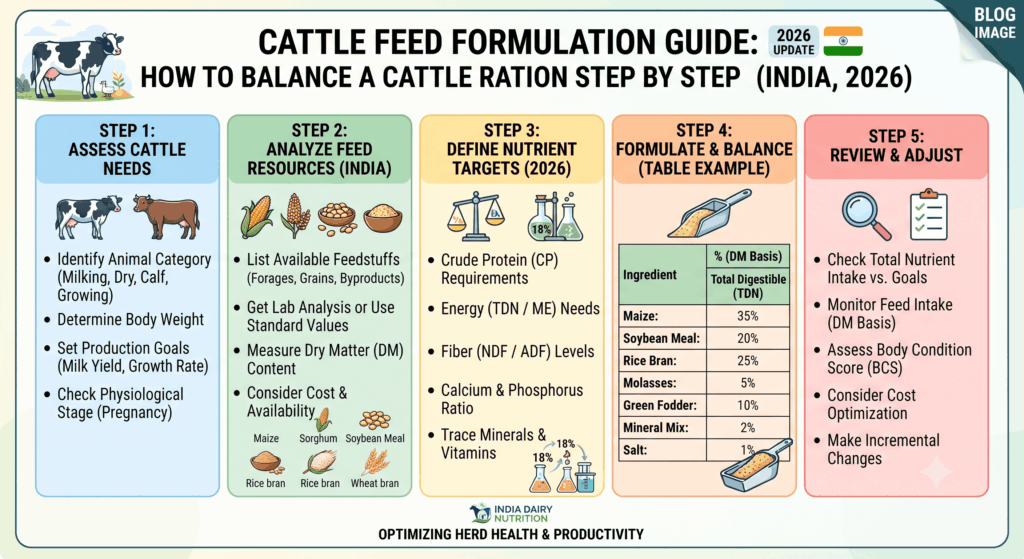
Every kilogram of milk a cow gives back starts with what goes into her trough — and getting that ratio wrong is the single biggest reason Indian dairy farms overspend on feed while under-delivering on yield. Search interest in “cattle feed formulation” has been climbing steadily, yet most of what comes up online is either too academic or written for farms outside India, where ingredient availability and prices are completely different.
This guide walks through cattle feed formulation the way a feed miller or progressive dairy farmer actually needs it: what nutrients to balance, how to use the Pearson Square method with real Indian ingredients like DORB, DDGS, and soya DOC, and sample rations you can adapt for your herd.
What Is Cattle Feed Formulation?
Cattle feed formulation is the process of combining feed ingredients — roughages, concentrates, protein sources, and mineral supplements — in the right proportions to meet an animal’s daily nutrient requirements at the lowest possible cost. A well-formulated ration is built around four things:
- Energy (measured as Total Digestible Nutrients, or TDN)
- Protein (measured as Crude Protein, or CP)
- Minerals, especially calcium and phosphorus
- Fibre, to keep the rumen healthy and functioning
Get any one of these wrong and you see it directly in the milk can: low CP starves milk yield, excess energy without enough protein leads to fat cows that still underperform, and a skewed calcium-to-phosphorus ratio shows up as fertility and bone problems within a few months.
Why Formulation Matters More Than Ever in 2026
Raw material prices for maize, soybean meal, and DOC (de-oiled cake) have been volatile through 2025–26, and feed typically accounts for 60–70% of the total cost of milk production on an Indian dairy farm. Farms that formulate rations scientifically — instead of feeding a fixed “standard mix” regardless of the animal’s stage — routinely cut feed cost per litre of milk without losing yield, simply by substituting cheaper, nutritionally equivalent ingredients when prices shift.
This is exactly where by-product feed ingredients earn their place in the ration. De-oiled rice bran (DORB), maize and rice DDGS, and soya/mustard DOC are lower-cost alternatives to straight grain and full-fat oilseed meal, and they slot directly into the formulation steps below.
The Key Nutrients Every Cattle Ration Must Balance
| Nutrient | Dry (non-lactating) cow | Lactating cow (average yield) | High-yielding cow |
|---|---|---|---|
| Crude Protein (CP) | 10–11% of DM | 14–16% of DM | 17–19% of DM |
| TDN (Energy) | 55–60% of DM | 62–66% of DM | 68–72% of DM |
| Calcium : Phosphorus | ~1.5–2 : 1 | ~1.5–2 : 1 | ~1.5–2 : 1 |
| Roughage : Concentrate | 70:30 | 60:40 | 50:50 |
DM = dry matter basis. These are general working ranges used in Indian dairy nutrition practice and should be fine-tuned against your animal’s body weight, milk yield, and fat percentage.
Step-by-Step: How to Formulate a Cattle Ration
Step 1 — Identify the animal’s nutrient requirement
Group your animals by stage: dry cows, growing heifers, and lactating cows split further by milk yield. Each group needs a different CP and TDN target, so a single “one mix fits all” ration is the most common formulation mistake on Indian farms.
Step 2 — List available ingredients and their nutrient values
Build a simple ingredient table before you start balancing. Typical values used for common concentrate ingredients:
| Ingredient | Crude Protein | TDN | Common role |
|---|---|---|---|
| Maize | 8–9% | 80–82% | Energy source |
| Soya DOC (de-oiled cake) | 42–45% | 72–75% | High-protein source |
| Mustard DOC | 34–38% | 65–68% | Protein + palatability |
| DORB (de-oiled rice bran) | 12–14% | 60–65% | Energy + fibre, cost-effective filler |
| DDGS (maize/rice) | 25–28% | 75–80% | Protein + energy, bypass protein source |
| Wheat/rice bran | 10–13% | 60–65% | Fibre + bulk |
Use lab-tested values from your actual supplier batch wherever possible — moisture and protein content can vary a few points between lots, and formulation accuracy depends on accurate inputs.
Step 3 — Balance energy first, using the Pearson Square method
The Pearson Square is the fastest way to combine two ingredients to hit a target nutrient level, and it’s still the method most Indian feed mills teach their formulation staff.
Worked example: You want a concentrate mix with 20% CP, using soya DOC (44% CP) and maize (9% CP).
- Draw a square. Put the target (20) in the centre.
- Put soya DOC’s CP (44) on the top-left corner, maize’s CP (9) on the bottom-left corner.
- Subtract diagonally: 44 − 20 = 24 (parts maize needed); 20 − 9 = 11 (parts soya DOC needed).
- Total parts = 24 + 11 = 35. So the mix is 11/35 = ~31% soya DOC and 24/35 = ~69% maize by weight.
Repeat the same logic to check TDN, then adjust in small steps — formulation is iterative, not one-shot.
Step 4 — Balance minerals and vitamins
Once protein and energy are set, add a mineral mixture (typically 1.5–2% of the concentrate) to correct the calcium-to-phosphorus ratio and cover trace minerals and vitamin A/D3, which cereal-and-oilcake-based rations are almost always short on.
Step 5 — Fix the roughage-to-concentrate ratio
Roughage (green fodder, dry fodder, silage) should still form the bulk of intake — 50–70% depending on the production stage from the table above. Concentrate mix fills the remaining energy and protein gap that roughage alone can’t meet.
Step 6 — Trial, monitor, and adjust
Feed the new ration for 2–3 weeks and track milk yield, fat %, body condition, and feed refusal. Re-balance if intake drops — palatability issues (usually from too much DORB or mustard DOC too fast) are common and easy to fix by adjusting inclusion levels gradually.
Sample Rations for Different Farm Types
Dry cow (maintenance): Dry fodder ad-lib + 1.5–2 kg concentrate mix (40% maize, 25% DORB, 20% mustard DOC, 12% wheat bran, 3% mineral mixture).
Lactating cow, average yield (8–10 L/day): Green fodder + dry fodder + 4–5 kg concentrate mix (35% maize, 20% soya DOC, 20% DDGS, 20% DORB, 5% mineral + salt).
High-yielding cow (15+ L/day): Green fodder + quality dry fodder + 7–8 kg concentrate mix (30% maize, 28% soya DOC, 22% DDGS, 15% DORB, 5% mineral + bypass fat/vitamin premix).
These are starting formulations, not fixed recipes — always adjust for the actual CP/TDN of the ingredient batch you’re using and your fodder base.
Common Formulation Mistakes That Cost Farms Money
- Ignoring fodder quality and formulating concentrate as if roughage were nutrient-complete.
- Overusing a single by-product (e.g., pushing DORB above 25–30% of concentrate) purely because it’s cheap, which drops palatability and fibre digestibility.
- Skipping the mineral mixture to save cost — this is the single most common cause of poor conception rates on formulation-conscious farms.
- Not re-balancing when ingredient prices or nutrient content change — a ration formulated once in April is rarely still optimal by August.
Sourcing Ingredients for Your Formulation
Formulation only works as well as the ingredients behind it. Brinda Foods supplies quality-tested DORB, maize and rice DDGS, and soya and mustard DOC in bulk across India, with consistent CP and TDN values batch to batch — which is exactly what accurate formulation depends on. Related reading on individual ingredients:
- De-Oiled Rice Bran (DORB): Benefits & Nutrition
- What Is DDGS and Its Benefits for Animal Feed
- Benefits of Soya DOC in Animal Feed
- Mustard DOC Animal Feed: Complete Guide
For bulk supply or a custom ingredient mix suited to your formulation, get in touch with the Brinda Foods team.
FAQs on Cattle Feed Formulation
What is the ideal crude protein percentage for a dairy cattle ration? It depends on production stage — roughly 10–11% for dry cows, 14–16% for average-yielding lactating cows, and up to 17–19% for high-yielding cows, all on a dry matter basis.
What is the Pearson Square method used for? It’s a quick manual method to calculate the ratio of two ingredients needed to hit a target nutrient level (usually CP or TDN) — widely used for formulating concentrate mixes before fine-tuning with software or a nutritionist.
Can DORB replace soybean meal in cattle feed? Not directly — DORB is an energy-and-fibre ingredient (12–14% CP) while soybean meal/soya DOC is a high-protein ingredient (42–45% CP). DORB can replace a portion of maize or bran in the ration, while soya DOC remains the primary protein source.
What roughage-to-concentrate ratio should I use? As a starting point, 70:30 for dry cows, 60:40 for average lactating cows, and 50:50 for high-yielding cows — adjusted based on fodder availability and quality.
How often should a cattle ration be re-formulated? Whenever ingredient prices shift significantly, fodder quality changes with the season, or the herd’s average yield moves — most Indian dairy farms benefit from reviewing formulation every 2–3 months.



[…] story. Ingredient by ingredient, the cattle feed price breakdown works the cost through, and the ration balancing guide handles the nutrition […]
[…] way. It depends on the animals, what fodder is around, and what prices look like that week. Our cattle feed formulation and ration-balancing guide goes into it properly. There’s also a separate piece on how much DDGS should go in dairy […]
[…] common starting point, with rice bran added whenever fresh stock comes in at a sensible price. Our cattle feed formulation and ration balancing guide walks through how to balance these step by […]