Most people searching for the “DORB full form” get a quick answer — De-Oiled Rice Bran — and stop there. But if you’re a feed miller, livestock farmer, or procurement manager, the real question is: how does DORB actually get made, and what happens at each stage that determines its quality?
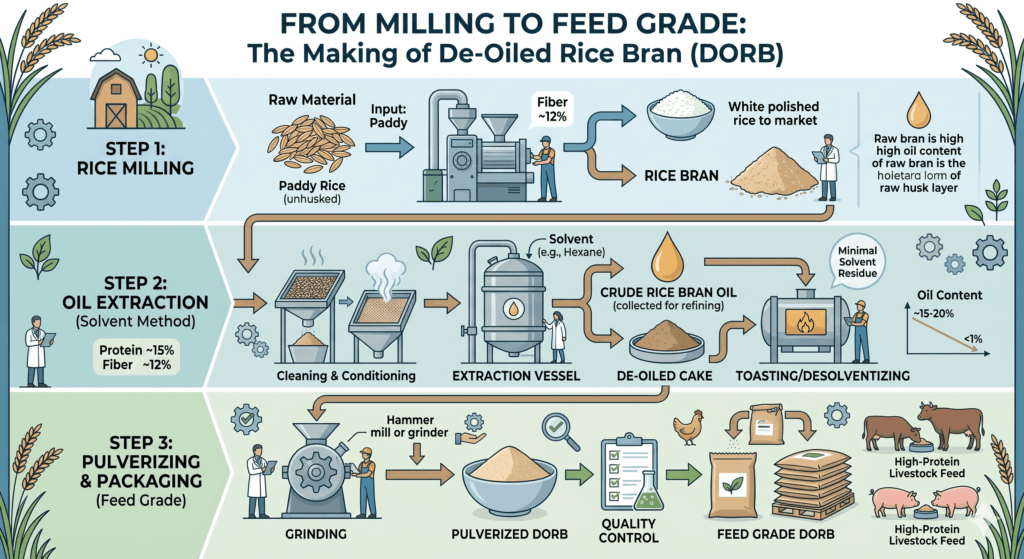
This guide walks you through the complete manufacturing journey of De-Oiled Rice Bran, from the moment paddy enters a rice mill to the point where a finished, feed-grade DORB sack lands in your feed formulation.
What Is DORB? (Quick Definition)
DORB full form: De-Oiled Rice Bran.
It is the solid residue left after extracting oil from rice bran — the thin outer layer removed from the rice grain during milling. Before oil extraction, rice bran contains 18–22% crude fat. After solvent extraction, that fat content drops to just 1–2%, leaving behind a protein- and fibre-rich material that is highly valuable in cattle feed, broiler feed, and aquaculture diets across India and Southeast Asia.
To understand the quality of DORB you’re buying or formulating with, you need to understand the process that created it.
Step 1: Paddy Milling — Where It All Begins
The DORB journey starts at the rice mill, not the oil extraction plant.
When paddy (raw rice) is processed, it passes through a series of machines:
- Hulling: The outer husk is removed, leaving brown rice.
- Whitening / Pearling: The bran layers — comprising the pericarp, aleurone layer, and germ — are abraded away from the white rice kernel. This bran fraction represents roughly 8–10% of the total paddy weight.
- Collection: The separated bran is collected as full-fat rice bran (FFRB) — the raw material from which DORB will eventually be produced.
At this stage, the bran is nutritionally rich but extremely unstable. This instability is the first quality challenge that every DORB manufacturer must confront.
Step 2: Bran Stabilization — The Most Critical (and Most Overlooked) Step
This is where many inferior DORB products are born.
Fresh rice bran contains active lipase enzymes. The moment bran is separated from the kernel, these enzymes begin breaking down fat into free fatty acids (FFAs). Within just 4–8 hours at room temperature, FFA levels can rise from under 2% to over 30%, rendering the bran rancid, foul-smelling, and commercially unusable.
How Stabilization Works
To prevent hydrolytic rancidity, processors must inactivate the lipase enzymes before storage or transport. The primary method used in India is hydrothermal treatment:
- Fresh bran is fed into a stack cooker or steam stabilizer
- It is exposed to temperatures of 100–120°C for 10–20 minutes
- Heat denatures the lipase enzyme, arresting FFA formation
- Moisture is simultaneously controlled to 8–10% to prevent microbial activity
Some larger plants use extruder-expander systems, which achieve stabilization through mechanical shear and heat in a single pass — a faster and more consistent method.
Why This Matters for DORB Quality
Bran that is not stabilized before oil extraction produces DORB with:
- Higher residual FFA levels in the extracted oil (lowering oil value)
- Darker colour and off-odour in the final DORB cake
- Lower shelf life and higher rancidity risk in feed
When you assess a DORB supplier, one of the first questions to ask is: do you stabilize fresh bran before extraction, or are you working with stored, partially rancid bran?
Step 3: Pre-Treatment and Conditioning
Before the stabilized bran enters the extraction plant, it undergoes physical conditioning:
- Screening and cleaning: Removes husk fragments, stones, and foreign material that would contaminate the final DORB or clog extraction equipment.
- Flaking / Expanding: The bran is passed through flaking rolls or an expander to rupture cell walls and increase surface area. This dramatically improves oil yield during solvent extraction — a well-flaked bran releases 5–8% more oil than unconditioned bran.
- Moisture adjustment: Bran moisture is set at 8–10% — too dry causes static and poor solvent penetration; too wet reduces extraction efficiency and promotes microbial growth in the residue.
Step 4: Solvent Extraction — The Core Process
This is where the oil is separated from the bran, and DORB is formed.
The Extractor
Conditioned bran is fed into a continuous-loop solvent extractor — most commonly a sliding-cell or drag-chain extractor. Inside:
- The bran moves slowly on a perforated conveyor or in a series of cells
- Food-grade hexane (boiling point ~69°C) is sprayed counter-currently over the bran bed
- Hexane is a non-polar solvent — it selectively dissolves fat while leaving proteins, fibres, and carbohydrates behind
- The oil-rich hexane solution (called “miscella”) drains through the bed and is collected for oil recovery
- The bran, now stripped of most of its oil, is called “wet marc” or “spent flakes” at this stage
Extraction Parameters That Affect DORB Quality
| Parameter | Optimal Range | Effect if Off |
|---|---|---|
| Solvent-to-bran ratio | 1:1 to 1.5:1 by weight | Too low → incomplete extraction; too high → higher energy cost |
| Extraction temperature | 55–65°C | Higher temps improve yield but risk protein denaturation |
| Contact time | 45–90 minutes | Too short → residual fat >3%; too long → protein damage |
| Bran moisture entering extractor | 8–10% | Higher moisture reduces oil yield |
After extraction, the spent bran typically contains 0.5–1.5% residual fat — the benchmark for well-extracted DORB in commercial practice.
Step 5: Desolventization — Removing Hexane from DORB
The wet marc exiting the extractor still contains 25–35% hexane by weight. Before it becomes safe, stable DORB, all solvent must be removed.
The Desolventizer-Toaster (DT)
The spent marc is transferred to a Desolventizer-Toaster (DT) — a vertical vessel with multiple steam-heated trays:
- Upper trays (desolventizing zone): Live steam at ~100°C strips hexane from the surface of the bran. Hexane vapour rises and is collected for recovery and reuse.
- Lower trays (toasting zone): Dry superheated steam at 105–115°C completes solvent removal and toasts the bran. This also:
- Reduces anti-nutritional factors such as trypsin inhibitors
- Improves protein digestibility
- Destroys residual microbial load
The bran exits the DT at approximately 100–110°C with a moisture content of 8–11% and residual hexane below 300 ppm (the regulatory limit for food-grade materials; feed-grade norms are similar).
Cooling and Drying
The hot DORB is conveyed to a rotary cooler where ambient or chilled air reduces temperature to 30–40°C before bagging. Cooling is critical — hot DORB packed into jute or HDPE sacks will undergo moisture condensation and accelerated oxidation, causing clumping and rancidity.
Step 6: Hexane Recovery — The Environmental and Economic Loop
Modern solvent extraction plants are closed-loop systems. Hexane is never discarded:
- Hexane vapour from the DT is condensed and recycled back into the extractor
- Hexane losses in a well-run plant are less than 1–2 litres per tonne of bran processed
- This makes solvent extraction both economically efficient and environmentally responsible compared to mechanical pressing, which leaves 4–6% residual fat and cannot match the oil yield of solvent extraction
Step 7: Quality Grading — From Extractor to Feed Grade
Not all DORB is the same. In India, commercial DORB is broadly graded based on key parameters tested at the processing plant and again on arrival at the feed mill:
Indian DORB Quality Grades
| Parameter | Grade I (Premium) | Grade II (Standard) |
|---|---|---|
| Crude Protein (CP) | ≥ 16% | 14–16% |
| Crude Fibre (CF) | ≤ 10% | 10–14% |
| Crude Fat (EE) | 1–2% | 1–3% |
| Moisture | ≤ 10% | ≤ 12% |
| Total Ash | ≤ 10% | 10–12% |
| Acid-Insoluble Ash (AIA) | ≤ 2% | ≤ 3–4% |
AIA (Acid-Insoluble Ash) is the most important adulteration marker. It measures silica and sand content — both are commonly used to inflate the weight of DORB. An AIA above 3–4% is a strong red flag for silica contamination and should trigger rejection or price renegotiation.
What Affects the Final DORB Quality? A Summary
Understanding the manufacturing process explains why DORB from different suppliers can vary significantly:
- Bran freshness at stabilization → directly affects FFA, odour, and colour
- Flaking/expansion quality → affects residual fat levels post-extraction
- DT toasting temperature and time → affects protein digestibility and anti-nutritional factor reduction
- Cooling discipline → affects shelf life and clumping
- Sand/silica contamination → inflates weight, dilutes nutrition — always check AIA
For feed millers, the implication is clear: buy DORB with a full Certificate of Analysis (CoA), not just on price. The cheapest DORB is rarely the most cost-effective.
DORB in Your Feed Formulation
Now that you understand how DORB is made, you can see why its nutritional profile looks the way it does:
- Protein (14–18%): Concentrated from bran after fat removal; quality varies with processing temperature
- Fibre (8–14%): Bran cell walls remain intact post-extraction — beneficial for rumen function in cattle, but limits inclusion rates in poultry
- Fat (1–2%): Most oil has been extracted; residual fat provides some energy and carries fat-soluble vitamins
- Phosphorus: High, but primarily as phytate phosphorus — consider phytase supplementation for monogastric diets (broilers, layers, swine)
For detailed inclusion rates and species-specific recommendations, read our companion guide: De-Oiled Rice Bran (DORB): Nutrition & Benefits in Animal Feed.
Frequently Asked Questions
What does DORB stand for? DORB stands for De-Oiled Rice Bran — the byproduct remaining after extracting oil from rice bran using solvent extraction.
What solvent is used to make DORB? Food-grade hexane is the most widely used solvent. It selectively dissolves fat without affecting protein or fibre, and is fully recovered and recycled within the plant.
Is DORB safe for animals given hexane is used in production? Yes. The desolventization process reduces residual hexane to below 300 ppm — well within safe limits for animal feed. No hexane is detectable in properly processed DORB at the point of feeding.
Why does DORB quality vary so much between suppliers? Variability comes from differences in bran stabilization practices, extraction efficiency, toasting conditions, cooling discipline, and adulteration risk. Always insist on a CoA with CP, CF, moisture, total ash, and AIA before purchase.
What is a good AIA level for DORB? Grade I DORB should have AIA ≤ 2%. Values above 3–4% indicate sand or silica adulteration and should be rejected.
How is DORB different from full-fat rice bran? Full-fat rice bran (FFRB) contains 18–22% crude fat and is highly perishable. DORB has 1–2% fat, is shelf-stable, and has a higher concentration of protein and fibre per unit weight.
The Bottom Line
DORB’s value in animal nutrition isn’t accidental — it’s the product of a carefully controlled manufacturing chain. From stabilizing fresh bran within hours of milling, to running a precisely tuned hexane extractor, to toasting and cooling the final product under controlled conditions, every step shapes the DORB that reaches your feed mill.
At Brinda Foods, we source DORB only from processing plants that follow validated stabilization and extraction protocols, and every lot is tested for CP, CF, moisture, total ash, and AIA before dispatch. If you want to discuss DORB specifications or need samples, get in touch with our team.