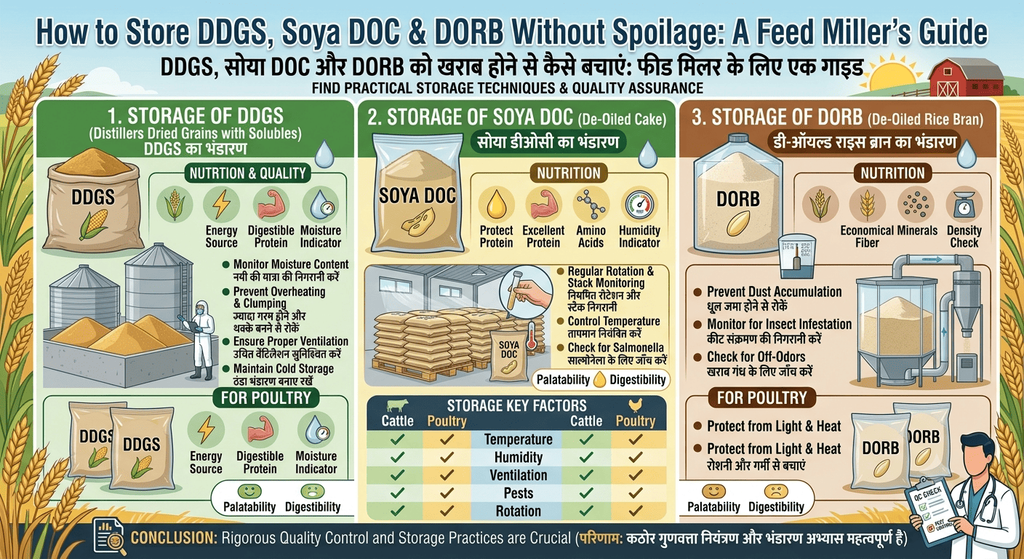
Quick answer: Keep moisture low, keep stacks cool and don’t hold stock longer than you have to. Take in only lots that match the COA (around 11 to 12% moisture for Soya DOC and DDGS, roughly 10 to 11% for DORB), put every bag on pallets away from the walls, keep DDGS stacks shorter than your oilmeal stacks and use the oldest lot first. In the humid months, buy smaller and check stack temperatures every week.
Every feed miller has a story like this. The lot came in fine. The moisture reading was fine. Then three weeks later somebody cuts open a bag from the middle of the stack, and it smells off, or there are lumps, or a thin web of insects near the seam. And just like that, the good price you got on that purchase is gone.
We’ve seen this happen in godowns across Punjab, Haryana and UP, and honestly, most of it can be avoided. None of what follows needs expensive equipment. It needs a few habits your team sticks to every week.
Why Do DDGS, Soya DOC and DORB Spoil in Different Ways?
On paper, all three are dry ingredients. In a godown, they behave very differently. Fat level, particle size and how quickly they soak up moisture from the air decide how long they last.
| Raw material | Typical fat level | Main storage risk | What you usually notice first |
| Maize DDGS / Rice DDGS | Moderate to high (often 8 to 12% in maize DDGS) | Caking, heating, fat oxidation | Darker colour, hard lumps, stale smell |
| Soya DOC | Low (solvent extracted) | Moisture pickup, mould, insects | Musty smell, soft lumps near seams |
| DORB | Low (de-oiled) | Insects, moisture, dust loss | Webbing, live insects, clumps at the base |
DDGS is the one to keep an eye on. The solubles in it pull moisture out of humid air, and because it carries more fat than an oilmeal, a big tight stack of DDGS can slowly warm up from the inside. Soya DOC is easier to live with, though mould finds it quickly once moisture climbs. DORB? Insects love it. It’s fine, fibrous and sits there like an open invitation if the floor isn’t swept.
New to DDGS or want to brush up on the two types? Our post on DDGS full form and meaning covers it.
What Should You Check When a Lot Arrives?
Whatever shape a lot is in when it reaches your weighbridge, that’s the best it will ever be. Your godown can hold quality. It can’t fix it.
So what should your gate team actually do?
Take a moisture reading on the spot and match it against the COA. A calibrated meter settles disputes before they start. Put a hand on the bags too. If the truck stood in the sun all afternoon, those bags will be warm, and warm bags stacked tight straight away is how heating problems begin. Let them cool in an airy corner first.
Open a bag and smell it. Good Soya DOC smells clean and slightly nutty. DDGS should be an even golden brown without dark patches. DORB should pour freely. Any torn, wet or stained bags get kept aside, either for immediate use or for rejection, and never go into the main stack.
Finally, send a sample from each batch for aflatoxin, moisture and protein testing. It protects your formulation, and if something goes wrong later, you have a record.
In our experience, a lot of what mills call “storage trouble” turns out to be intake trouble.
How Should the Godown Be Set Up?
You don’t need a new building. You need a dry one.
Walk the roof before the monsoon and again after it. One small leak over a corner of a DDGS stack can spoil several tonnes before anyone notices.
Concrete floors draw up ground moisture, especially in low areas. Stack on wooden pallets or dunnage about 10 to 15 cm high, and lay polythene below if the floor stays damp.
Leave 45 to 60 cm between stacks and walls. Air can move, condensation stays off the bags and your team can actually walk around and check things.
Ventilate on dry, sunny days. Shut vents when it rains and on sticky nights, because that’s when the outside air is wetter than the air inside.
And put mesh on vents, seal gaps under doors and keep bait stations around the outside. Birds and rats bring more trouble than people think.
How High Should You Stack DDGS, Soya DOC and DORB?
Tall, heavy stacks squash the bottom bags, hold heat and make rotation a headache.
| Guideline | DDGS | Soya DOC | DORB |
| Stack height (50 kg bags) | Keep lower; many mills stay near 12 to 15 bags | Can go taller if dry and cool | Moderate; watch the base |
| Stack pattern | Criss-cross with small air gaps | Criss-cross | Criss-cross |
| Separate by lot | Yes, labelled with lot and date | Yes | Yes |
| Space between stacks | About 1 m | About 1 m | About 1 m |
A small habit that pays off: stick a label on every stack with the lot number, supplier, arrival date and intake moisture. If a problem shows up, you’ll find the source in minutes, not hours.
How Do the Seasons Change Things?
North Indian weather decides a lot of your storage risk, so plan buying and holding time around it.
| Season | Conditions | What to focus on |
| Summer (April to June) | Hot, mostly dry | Heating in DDGS stacks; cool bags first; ventilate early morning |
| Monsoon (July to September) | Very humid | Buy closer to use; shut vents in rain; check stacks twice a week |
| Post-monsoon (October to November) | Humid mornings, warm days | Insects pick up; tighten cleaning and rotation |
| Winter (December to February) | Cool, drier | Easiest storage months; watch for morning condensation |
Keep a cheap probe thermometer in the godown. Push it into the middle of a stack once a week. If the core is running more than about 5°C warmer than the shed, open that stack, look for damp or insects, and move that lot up the usage queue.
A wall hygrometer helps too. When humidity sits above about 70% for a few days running, dry ingredients start taking on moisture. That’s your signal to shorten holding time.
How Do You Keep Insects Out of Feed Stock?
DORB is most exposed here, with Soya DOC not far behind. Prevention does most of the work. Fumigation is the backup, not the routine.
Clear old spillage from corners and pallets before new stock goes down, since that’s where infestations usually start. Rotate faster when it’s warm and humid, because insects need time to build up numbers and quick rotation takes that time away.
If fumigation is needed, call a licensed pest control operator. Grain fumigants are regulated in India and should only be handled by trained people under sealed covers. And keep all chemicals in a separate locked room, well away from feed stock.
How Long Can You Store DDGS, Soya DOC and DORB?
Everyone agrees with first in, first out. It’s on a rushed Tuesday afternoon that it quietly stops happening. The fix is layout: keep the oldest lot nearest the loading point and never park a fresh lot in front of an older one.
This is a rough planning guide many mills work with. Your actual numbers depend on intake quality and your shed.
| Raw material | Dry, cool season | Humid season |
| DDGS | About 60 to 90 days | Aim for 30 to 45 days |
| Soya DOC | About 60 to 90 days | Aim for 45 to 60 days |
| DORB | About 60 to 90 days | Aim for 45 to 60 days |
With soybean meal prices sitting high this season (we explained why in our post on the soybean meal export halt), a tonne saved in the godown is real money saved.
What Are the Signs a Lot Is Spoiling?
Teach your warehouse staff to look for:
- a sour, musty or rancid smell from an opened bag
- bags in the middle of a stack that feel warm
- hard lumps that don’t crumble in the hand
- grey, green or white spots near the seams
- DDGS looking darker than the intake sample
- webbing, live insects or fine powder at the stack base
- damp floor patches or damp bottom bags
Spot any of these and open the stack, pull out affected bags and retest the lot before it reaches the mixer. Caught early, you lose a handful of bags. Caught late, you lose the lot.
What Your Supplier Should Already Be Doing?
Honestly, good storage begins before the truck leaves your supplier’s gate.
At Brinda Foods, each lot is checked at source with approved suppliers, sampled at several stages, lab tested for nutritional specs, cross-checked against a nutrient matrix and handled on FIFO in our own storage. So the DDGS, Soya DOC and DORB you receive start off in good shape, with a current COA in hand. Our quality credentials are on the certifications page.
Weekly Godown Storage Checklist
- Note shed temperature and humidity every day
- Probe each DDGS stack weekly, twice a week in the monsoon
- Check the roof and walls after heavy rain
- Make sure the oldest lot is going out first
- Look at stack bases for insects, dust and damp bags
- Sweep spillage and clean empty pallet spots
- Keep stack labels and the stock register up to date
FAQs!
- What moisture level is safe for storing DDGS and Soya DOC?
Most trade specs put the upper limit around 11 to 12% for both. Match your gate reading with the supplier’s COA, and be careful with lots sitting near the top of that range in humid weather. - Why does DDGS heat up in storage?
It has more fat than oil meals and absorbs moisture from humid air. Pack it into a tall tight stack and it can slowly warm up. Shorter stacks, air gaps and faster use prevent that. - How long can DORB be stored?
In a clean, dry shed, usually around two to three months. In warm, humid weather, use it sooner and watch for insects. - Can DDGS, Soya DOC and DORB share one warehouse?
Yes. Keep each lot on its own pallets, label it clearly and leave space around it for air and inspection. - One stack has mould. What now?
Separate the affected bags straight away, retest the lot for moisture and aflatoxin and check the stacks next to it. Visibly spoiled material shouldn’t go into production. - Should I buy in smaller lots?
In the monsoon and just after, yes. Smaller, more frequent deliveries mean less time in the godown and fresher material at the mixer. For timing purchases, our DDGS price in India guide helps.
Need DDGS, Soya DOC or DORB that arrives ready for storage, with a current COA? Send Brinda Foods an enquiry for bulk rates and supply across India.