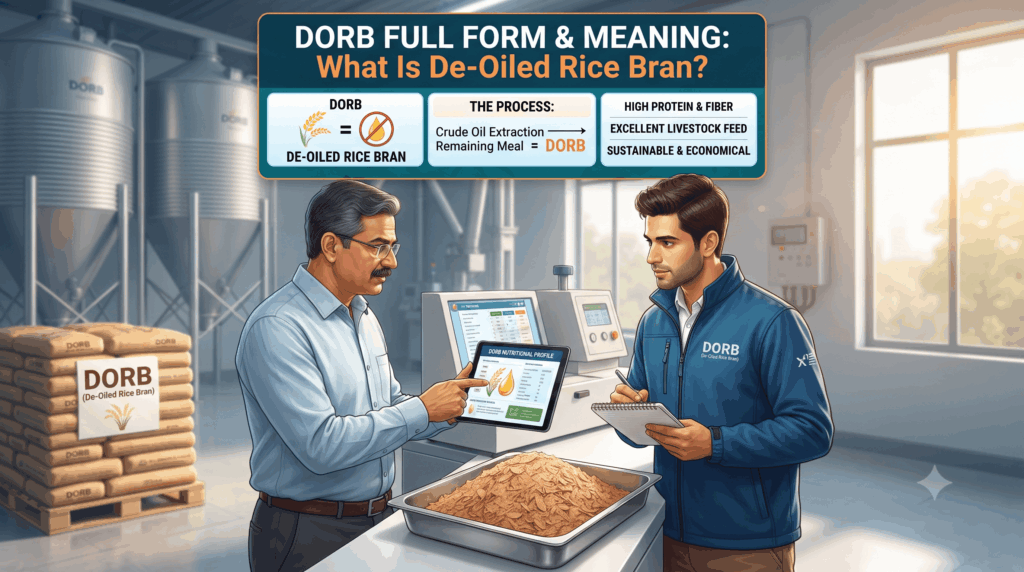
DORB stands for De-Oiled Rice Bran — the fibrous, protein-rich byproduct left over after oil is extracted from rice bran during rice milling. It’s one of the most widely used raw materials in Indian cattle, poultry, and swine feed formulations because it’s affordable, high in fiber and protein, and available in large volumes wherever rice is milled.
If you searched “DORB full form,” “DORB meaning,” or “what is DORB,” you’re in the right place — this guide answers every version of that question, plus the practical ones: how much protein DORB actually contains, whether it’s safe for cattle and poultry, and how it’s priced.
DORB Full Form
DORB = De-Oiled Rice Bran.
You may also see it written as De-oiled Rice Bran (DORB), DRB, or occasionally spaced out as “D O R B” — all referring to the same product. It should not be confused with rice bran oil, raw (non-de-oiled) rice bran, or rice bran extraction meal from other grains.
Is “DORB” a Medical Term?
No. A number of people search “DORB full form in medical” or “DORB medical term,” but DORB has no established meaning in medicine or clinical terminology. It is exclusively an agricultural and animal-feed industry term describing a rice-milling byproduct. If you landed here searching for a medical abbreviation, DORB is not it — you may be thinking of a different acronym, or this term is being used informally.
What Is DORB, Exactly?
Rice bran is the outer layer of the rice grain removed during milling. Because raw rice bran contains a relatively high percentage of oil, it’s commercially processed to extract that oil (used for cooking oil, biodiesel, and other applications). What remains after extraction is de-oiled rice bran (DORB) — a dry, granular material that’s lower in fat but concentrated in fiber, protein, and residual nutrients.
This de-oiling process is what makes DORB shelf-stable and suitable for bulk storage and transport, unlike raw rice bran, which spoils quickly due to its oil content going rancid.
DORB Nutritional Profile
DORB is valued in feed formulation for a combination of:
- Protein: a meaningful, cost-effective protein contributor in compound feed rations (exact percentage varies by mill and processing method — check your supplier’s certificate of analysis for the precise figure on any given batch)
- Crude fiber: higher than in raw bran, useful for gut health and digestion in ruminants
- Energy: a moderate energy contributor despite reduced oil content
- Minerals: contains phosphorus and other trace minerals typical of rice bran-derived products
Because protein and fiber content can shift batch to batch depending on the milling process and rice variety, always request a current lab analysis (COA) from your supplier rather than relying on generic averages when formulating rations.
DORB in Cattle Feed
DORB is a staple ingredient in Indian dairy and cattle feed formulations, typically used as a partial substitute for costlier protein and fiber sources. It’s commonly blended into compound cattle feed alongside ingredients like DDGS, DOC (de-oiled cake), and maize to balance protein, fiber, and energy at a lower overall cost per kilogram of ration.
DORB in Poultry Feed
In poultry — particularly layer and broiler diets — DORB is used more conservatively than in cattle feed, since poultry have a lower fiber tolerance than ruminants. It’s typically included at controlled inclusion rates as a partial fiber and energy source rather than a primary protein contributor. Feed millers formulating poultry rations should work within recommended inclusion limits to avoid impacting digestibility.
How DORB Is Made
DORB goes through a defined industrial process: raw rice bran is stabilized (to halt enzyme activity that causes rancidity), the oil is extracted (via solvent extraction or expeller pressing), and the remaining solids are dried and processed into the granular DORB sold to feed manufacturers. For a full breakdown of this process, see our detailed guide on how DORB is made.
DORB Price Today
DORB pricing moves with rice milling volumes, seasonal paddy supply, and regional demand from feed manufacturers. For current DORB rate per kg and bulk supply pricing, see our DORB price guide, updated regularly.
DORB FAQs
What does DORB stand for? DORB stands for De-Oiled Rice Bran, a byproduct of rice milling used in animal feed.
Is DORB the same as rice bran? No. Raw rice bran still contains its natural oil content; DORB has had that oil extracted, making it more stable for storage and different in nutritional composition.
What is DORB used for? DORB is primarily used as a raw material in cattle, dairy, and poultry feed formulations, valued for its protein, fiber, and cost-effectiveness.
Is DORB safe for cattle and poultry? Yes, when sourced from a quality-controlled supplier and included at appropriate rates for the species. Always verify batch quality via a certificate of analysis.
Where can I buy bulk DORB in India? Feed manufacturers and dairy producers can source bulk DORB directly from established suppliers like Brinda Foods. Request a quote for current rates and availability.
Looking for a reliable DORB supplier for your feed mill or dairy operation? Get in touch with Brinda Foods for bulk pricing and quality specifications.