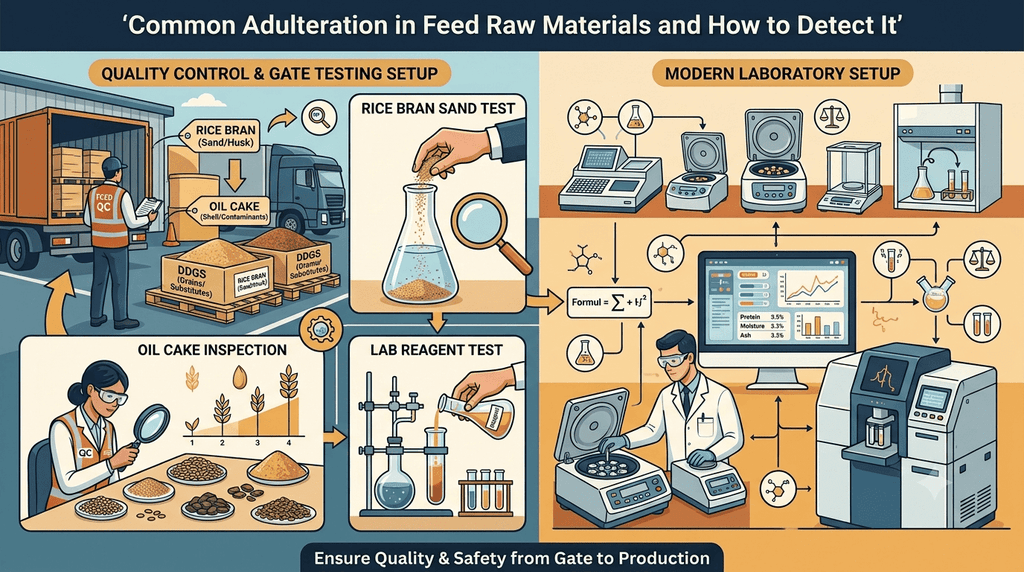
Quick answer: Sand in rice bran, urea in oil cake, husk in bran and cheap cake mixed into good cake are the four I run into most at Indian feed mill gates. Sand gives itself away through acid insoluble ash (AIA). Urea makes protein look better than it is, and a DMAB or urease test catches it. Husk drives crude fibre up. Five minutes at the gate and one lab figure usually settle the matter.
A mill owner near Karnal told me once that his best lot of the year was also his worst. Protein came in two points over normal, he paid extra without a second thought, and it turned out to be urea.
Versions of that story reach me every few months. And the funny part? None of it is clever. Sand costs nothing. The rice mill next door is practically giving husk away. And the lab, bless it, multiplies nitrogen by 6.25 without asking where the nitrogen came from.
So think of this as what I’d tell a new QC hand in their first week at the gate. One ingredient at a time, no lecture. For general quality checks (the stuff every lot gets), see our cattle feed raw materials guide. This piece is only about material somebody has fiddled with.
Which adulterants turn up most often?
Sand or soil in DORB, easily, if we’re talking North India. Then urea in soya and mustard cake. Then husk in bran. After those you get blending, where a lower grade cake is mixed into a better one, and DDGS that got cooked too hard at the plant but is sold as normal anyway.
Is burnt DDGS technically adulteration? Not really. Your money goes the same way though, so it stays on the list.
Limestone powder in cake turns up now and then too. So do bags that somehow gained a few kilos of water on the road.
One table to keep at the gate!
| Ingredient | Likely adulterant | Quick gate check | Lab parameter that flags it |
| DORB / rice bran | Sand, soil, silica | Water settling test: grit sinks to the bottom | AIA above about 4%, total ash above 14% |
| DORB / rice bran | Rice husk | Shiny, pointed flakes; phloroglucinol stain turns pink red | Crude fibre above about 15% |
| DORB | Raw (non de-oiled) bran | Oily feel, rancid smell | Ether extract above 2% |
| Soya DOC, Mustard DOC | Urea | DMAB test turns yellow; ammonia smell when warmed with water | Crude protein suddenly above normal range; NPN test |
| Soya DOC, Mustard DOC | Limestone or marble powder | Fizzes with a few drops of dilute HCl | Total ash up, AIA normal, calcium high |
| Soya DOC, Mustard DOC | Cheaper cake blend | Off colour, mixed texture under a hand lens | Protein below contract, crude fibre up; feed microscopy |
| Maize or Rice DDGS | Overheating / burning | Dark brown to black colour, burnt or smoky smell | High ADICP (heat damaged protein), low lysine |
| Any ingredient | Added water | Moisture meter, clumping, warm bags | Moisture above 12% |
I use these limits for North Indian supply, as-is basis. If your contract says otherwise, the contract wins.
- Sand in DORB: you’ll see this one the most!
Grab a glass of water. Spoon in some bran, stir, then go check the paperwork for two minutes.
Come back and look at the bottom. Bran floats or drifts about. Sand doesn’t drift anywhere; it drops and sits there in a grey layer. Every rice bran leaves a bit of grit (that’s just rice), so a light dusting is fine. If there’s enough to scrape up with a spoon, that’s your answer.
On paper, AIA is the line to read. The lab burns the sample, boils what’s left in acid, and whatever refuses to dissolve is basically sand and silica. Rice carries its own silica, so DORB will always read higher than soya cake. Don’t compare apples with oranges. For DORB, I’m relaxed up to roughly 3%. Past 4%, with protein sliding too, I’d turn the truck around.
That pairing is the real clue. Protein down, total ash up, AIA up, all in the same lot? Somebody filled the gap with soil. If your team is still learning what clean DORB looks like, our DORB full form and FAQ guide is a good primer.
- Urea in oil cake: the protein that isn’t there
Quick bit of background, because it explains everything.
Labs don’t actually measure protein. They measure nitrogen, then multiply by 6.25 and call the result crude protein. Urea happens to be almost half nitrogen. Mix a little through a truckload of cake and the “protein” climbs a few points, while the real protein in the bag hasn’t changed at all. Your nutritionist ends up formulating around a figure that was never there.
Which is why, when a Soya DOC lot comes in at 50% and you normally see 45 to 48, my advice is: don’t celebrate. Ask questions.
The checks are cheap. For the DMAB test, you shake some cake with water, add a few drops of p-dimethylaminobenzaldehyde reagent to the liquid, and watch. Yellow means urea’s probably in there. The urease test comes at it from the other side: add a urease source and phenol red, and if urea is present it breaks into ammonia and the colour goes pink. Honestly, your nose can help too. Warm a pinch of cake with water in a closed jar, open the lid, and see whether ammonia hits you.
Anything suspicious? Ask the lab to report NPN (non-protein nitrogen) or true protein alongside crude protein.
One soya-specific warning. Soya DOC that wasn’t cooked enough at the plant has urease activity of its own, measured by a separate test with separate limits. Tell your lab exactly what you’re checking so the two don’t get muddled.
Oh, and when comparing protein from two suppliers, put both reports on the same basis first. The as-fed vs dry matter guide shows you how.
- Husk in bran: obvious once you’ve seen it twice
Husk is the hard jacket around the paddy grain. Mostly fibre and silica, almost no feed value, and rice mills have heaps of it lying about. You can see the temptation.
Spread a little sample on a white tray. Husk bits are shiny, stiff, little boat shapes with sharp tips. Bran is soft and dull, nearly floury. See them side by side a couple of times and you’ll spot husk from across the room.
Want something to show the supplier? Phloroglucinol. Husk is packed with lignin, and this stain turns lignin a pinkish red, so the husk pops out against pale bran. Husk floats in water, too, while bran gets soggy and slowly sinks.
The lab backs this up through crude fibre. Good DORB tends to sit at 11 to 14%. Over 15% and husk is the first thing I’d suspect, usually with AIA nudging up as well since husk brings silica of its own.
- Burnt DDGS: fine on paper, damaged in the bag
Good Maize DDGS is golden or light brown and smells mildly sweet, a bit like a fermentation tank. Overcooked DDGS looks dark brown, sometimes nearly black, smells burnt, and often has hard toffee-like lumps.
The sneaky part is that crude protein hardly moves. Heat doesn’t drive nitrogen out, so the report looks normal. What heat does is lock some of that protein away where the animal can’t get at it.
Keep a jar from a good lot at the gate and compare samples next to it in daylight. Tube lights in the cabin fool everybody. If colour or smell bugs you, ask the lab for ADICP (acid detergent insoluble crude protein) or reactive lysine. More ADICP means more protein cooked out of reach.
Rice DDGS is a shade darker than maize to begin with, so only judge it against a rice reference.
- Blended cakes: the slow leak
Personally, this is the one that irritates me most, because nothing in the bag is fake. Some lower value cake gets mixed into Mustard DOC or soya cake, protein drops a point, fibre rises a point, and on any single day it passes as normal variation.
You catch it with a record, not a chemical. Log protein, fibre and ash for every truck from every supplier. A plain spreadsheet does the job. Over five or six deliveries, a slow slide stands out like a sore thumb.
A 10x hand lens helps at the gate, since blended lots often show two colours or textures jumbled together. And once a season (or whenever the log starts drifting), send a sample for feed microscopy. A decent analyst will spot seed coats that shouldn’t be there.
What goes in the gate kit?
Not much, really. A moisture meter set up for each ingredient. A glass jar. A hand lens and a white tray. A dropper bottle of dilute hydrochloric acid, because limestone fizzes the moment acid touches it. DMAB reagent. Phloroglucinol. A few jars from good lots for colour and smell.
All of it is pointless if the sample doesn’t represent the truck, mind you. Three bags off the tailgate only tell you about those three bags. Our truckload sampling procedure explains how many to probe and how to mix the sample down.
Also, the kit is a sieve, not a judge. A bad result at the gate means hold the truck and send a sample. The lab makes the final call.
Which lab line catches which problem?
AIA is your sand detector. Urea shows up as protein higher than usual, which NPN then confirms. Husk pushes crude fibre up. Raw bran slipped into DORB raises ether extract past 2%, because the oil was never taken out. Limestone is a bit of an odd one: total ash rises but AIA stays flat (limestone dissolves in acid, sand doesn’t), and calcium shoots up. Heat damage needs ADICP or reactive lysine. Water, obviously, shows in moisture.
For a line-by-line walk through a real report format, read how to read a feed lab report. For judging the supplier’s own certificate, our COA guide lists what a believable one includes.
A lot that didn’t get through!
The numbers here are illustrative. The sequence, though, happens at gates every single season.
A DORB truck turns up with a supplier sheet claiming 15% protein. Moisture reads 9.7%, no complaints. Then the water test leaves a thick grey band in the bottom of the glass, and the gate pass goes on hold.
Lab results come back: 13.1% protein, 16.8% total ash, 7.2% AIA. Every number moved the wrong way together. The truck leaves within the hour, and a headache that would have shown up weeks later in finished feed never gets into the godown.
Where gate tests run out?
I won’t pretend a gate kit catches everything. It’s blind to aflatoxin and other mycotoxins, so anything maize-based needs a proper mycotoxin panel. A 5% blend of a similar cake can sail past every quick test. And pesticide residues or heavy metals need a specialised lab.
Stopping it before it reaches you!
Most of the real protection happens when you sign the contract. Write AIA, crude fibre and an NPN clause in there, not just protein and moisture. Ask for a COA with every lot. Test often enough that suppliers know you actually will.
And please, don’t choose suppliers on rate per tonne alone. The cheapest truck of sandy DORB you ever buy will cost you more than anything else that month. Keep the suppliers who don’t mind you testing, retesting and walking round their godown. Our guide on how to choose a feed raw material supplier in India covers what else is worth checking.
How we handle it at Brinda Foods?
Same checks, our side of the gate, before anything leaves Panipat. Each lot of our De-Oiled Rice Bran is tested for AIA and fibre. Our Rice DDGS gets held up against a reference jar for colour. Protein and moisture, on everything.
What I’m after is this: when your QC team tests our material, their numbers match ours, truck after truck.
Want a sample, a COA, or a hand setting up these checks with your intake staff? Drop us an enquiry. Honestly, these are my favourite conversations.
Frequently asked questions!
- What’s the most common adulterant in DORB?
Sand or soil, no contest. Look for AIA climbing while protein drops. - How do I check oil cake for urea?
DMAB spot test on a water extract. Yellow? Hold the lot and get the lab to run NPN before you pay for that protein. - What AIA level in DORB is a problem?
About 3% is normal for rice bran. Above 4%, especially if protein is slipping, I’d hold the truck. - How can I tell husk from bran?
On a white tray husk looks shiny and pointed, bran soft and dull. Phloroglucinol turns husk pink, and fibre over roughly 15% settles it. - Why does burnt DDGS still show normal protein?
Because heat doesn’t remove nitrogen. Some protein just becomes unusable, and ADICP or reactive lysine will show you how much. - Can limestone in cake be spotted at the gate?
Easily. Drip on some dilute HCl. Fizzing means calcium carbonate. - Are gate tests enough on their own?
No. They screen, the lab decides. Mycotoxins and small blends always need lab work.