
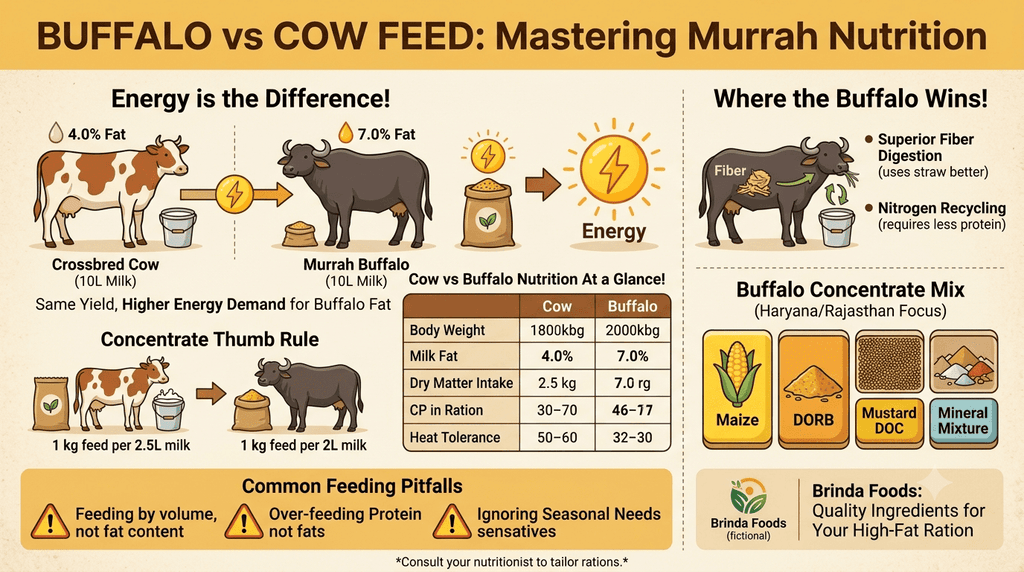
Quick answer: A buffalo can eat everything a cow eats. The difference is in how much. Buffaloes do brilliantly on straw, but their milk has close to double the fat of cow milk, and fat needs a lot of energy. So don’t feed a Murrah by litres. Feed her by fat-corrected milk, and give her a bit more concentrate per litre than a cow giving the same yield.
On most dairy farms in Haryana, the buffalo and the HF cross share a khurli. Same bhusa, same green, same daana scooped out of the same bag. It’s convenient and honestly, it mostly works.
Mostly.
What happens over a few months is quieter. The buffalo’s fat reading drops half a point. She loses a bit of flesh around her hips at the peak. The dairy slip comes in slightly lower and everyone blames the weather or the breed. Very few people look at the trough.
So let’s look at it.
The Fat in Buffalo Milk Isn’t Free!
A good Murrah gives milk with roughly 6.5 to 8% fat and 9 to 9.5% SNF. Your crossbred cow sits around 3.5 to 4.5% fat, SNF near 8.5.
That fat is why dairies pay more for buffalo milk (Mumbai saw a record hike in buffalo milk rates just this month). It’s also why the buffalo eats more. Milk fat is the most energy-hungry part of the whole litre. The animal has to get that energy from feed, or she takes it from her own body.
A quick calculation
Nutritionists compare animals using 4% fat-corrected milk, FCM for short. The formula’s simple enough to do on a phone calculator:
4% FCM = (0.4 × milk in kg) + (15 × fat in kg)
Two animals, 10 litres each:
| Crossbred cow | Murrah buffalo | |
| Daily milk | 10 litres | 10 litres |
| Fat % | 4.0% | 7.0% |
| Fat in kg | 0.40 | 0.70 |
| 4% FCM | 10 kg | 14.5 kg |
Look at that last row. The buckets match. The work doesn’t. Energy-wise, your buffalo is doing what a 14 or 15 litre cow does, and if her daana is the same as the cow’s, she’s short every day.
How Much Daana, Then?
The usual thumb rule in India: 1 kg concentrate per 2.5 litres for cows, 1 kg per 2 litres for buffaloes. Add a maintenance share of 1 to 2 kg. Heavier Murrahs (550 kg and up) go toward the top of that.
For 10 litres, that’s about 5.5 kg a day for the cow and around 6.5 to 7 kg for the buffalo.
Don’t treat it as gospel. Lush berseem lets you trim it. Dry bhusa and a high fat test mean you’ll likely need more. We’ve covered the cow numbers properly in our piece on concentrate feed for dairy cows, and once you adjust for the buffalo’s richer milk, the same thinking holds.
Straw: Where the Buffalo Wins?
Old farmers will tell you a buffalo can live on bhusa where a cow would struggle. They’re not wrong.
Feed sits longer in a buffalo’s rumen, and her microbes chew through tough fibre better than a cow’s do. Same paddy straw, more nutrition pulled out of it. She’s also clever with nitrogen, recycling urea back into the rumen so microbes can rebuild it into protein.
The catch? Straw barely moves the energy needle. It fills her and keeps the rumen ticking. It won’t pay for 7% fat. Concentrate and do that.
Cow vs Buffalo at a Glance!
| Parameter | Crossbred cow (HF or Jersey cross) | Murrah buffalo |
| Body weight | 400 to 500 kg | 500 to 650 kg |
| Milk fat | 3.5 to 4.5% | 6.5 to 8% |
| Milk SNF | 8.3 to 8.7% | 9 to 9.5% |
| Dry matter intake | 3 to 3.5% of body weight | 2.5 to 3% of body weight |
| Concentrate per litre | about 1 kg per 2.5 litres | about 1 kg per 2 litres |
| CP in total ration (DM basis) | 14 to 16% | 12 to 14% |
| Use of straw and coarse fibre | Good | Very good |
| Room for higher DORB | Moderate | More |
| Heat tolerance | Moderate | Lower, needs shade and water |
| Main calving months | Through the year | Mostly July to December |
Working ranges from Indian dairy practice. Ask your nutritionist to fit them to your animals.
She Needs Less Protein Than You’d Guess!
Because of that nitrogen recycling, a milking buffalo usually manages fine on 12 to 14% crude protein in the total ration (dry matter basis). Cows at similar yields typically get 14 to 16%.
Your concentrate can still be 18 to 22% CP. That’s normal. The point is about where the money goes. Plenty of farmers buy an expensive high protein mix meant for cows and feed it to buffaloes, so they’re paying for soya the buffalo doesn’t fully use. Meanwhile energy, the thing she’s actually short of, stays short.
Want to work out your own balance? Our cattle feed formulation and ration balancing guide does it step by step with the Pearson Square and local ingredients.
Can You Push DORB Higher? Usually!
Thanks to that strong fibre digestion, yes. High-yield cow mixes often hold de-oiled rice bran at 15 to 20%. Buffalo mixes run 25 to 30% without much fuss. Just make sure energy still lands where it should, and that your mineral mixture brings enough calcium, because DORB is heavy on phosphorus.
A buffalo mix you’d find at plenty of mills in the North looks something like this:
| Ingredient | Share |
| Maize | 28% |
| DORB | 30% |
| Mustard DOC | 20% |
| Rice DDGS | 15% |
| Wheat bran | 4% |
| Mineral mixture | 2% |
| Salt | 1% |
That comes to roughly 19 to 21% CP, depending on your DDGS grade. Maize and DDGS hold up the energy. You’ll notice soya’s gone, and mustard DOC is doing the protein work instead. In Haryana and Rajasthan that makes sense anyway. Buffaloes like it and it’s usually cheaper than soya here.
Comparing brans before you lock the DORB level? We’ve put DORB, rice bran and wheat bran side by side.
May and December Are Two Different Months
A buffalo in a Haryana summer is not a happy animal. Dark skin, very few sweat glands. By noon she’s eating less and looking for water. Feed the bulk of her daana early morning and late evening. Keep water in front of her. Shade, a sprinkler, a johad to sit in, whatever you’ve got. And since she’s eating less, make each kilo count with a slightly denser mix.
Winter’s her season. Most Murrahs calve between July and December, so peak milk lands in the cold months when she’s hungry. This is exactly where farmers lose milk without noticing, by feeding November the same as August.
Bonus: a lot of ingredients get cheaper around then. Our feed raw material buying calendar shows maize and DORB easing from October, right as buffalo demand climbs.
A Few Mistakes We See Often!
Feeding by the bucket is the big one. 8 liters at 7.5% fat beats 10 liters at 3.5% for energy demand every time.
Then there’s leaning on straw, overbuying protein, and running the same ration all year. And one more. When you move a buffalo onto her own mix, it takes a week or ten days. Rumens don’t like surprises.
For schedules, minerals and water across both species, our guide on the best cattle feed for high milk production has more.
Where Brinda Foods Fits In?
Buffalo rations come down to energy at a fair price, and that depends on raw materials that don’t swing from lot to lot. We’re based in Panipat, which puts us in the middle of North India’s buffalo country. We supply lab-tested DORB, mustard DOC, rice and maize DDGS, maize and soya DOC in bulk, each lot with its COA. Your nutritionist formulates on real numbers, not book values.
Planning buffalo feed for the season ahead? Reach out to our team for current rates and stock.
FAQs
- Can my buffalo eat the same feed as my cow?
Same ingredients, yes. Different quantities. Her milk is much richer in fat, so she needs more energy per litre, though she’s usually fine with a little less ration protein than a cow. - How much concentrate does a Murrah need?
Start at about 1 kg per 2 litres of milk and add 1.5 to 2 kg for maintenance. A 10 litre Murrah usually ends up near 6.5 to 7 kg a day. Adjust for fodder and fat test. - Why does buffalo milk take more feed?
It’s the fat. Buffalo milk runs 6.5 to 8% fat against roughly 3.5 to 4.5% in cow milk, and fat needs a lot of energy to produce. - What protein level suits a milking buffalo?
About 12 to 14% crude protein in the whole ration (dry matter basis) suits most. The concentrate itself can stay at 18 to 22% CP. Energy is usually where she falls short. - Can a buffalo mix carry more DORB?
Generally, yes. 25 to 30% is common in buffalo concentrates, provided energy targets are met and the minerals keep calcium and phosphorus in balance. - Does summer hit buffaloes harder than cows?
Yes. Fewer sweat glands and dark skin mean they eat less sooner in the heat. Cooler feeding hours, lots of water, shade and a denser mix help.



[…] We’ve written about where brans sit in a full ration in our guide to concentrate feed for dairy cows. Buffalo feed makers, take the energy point seriously. A Murrah’s milk is much richer in fat, so she needs more energy per litre (more on that in our buffalo vs cow feed comparison). […]