
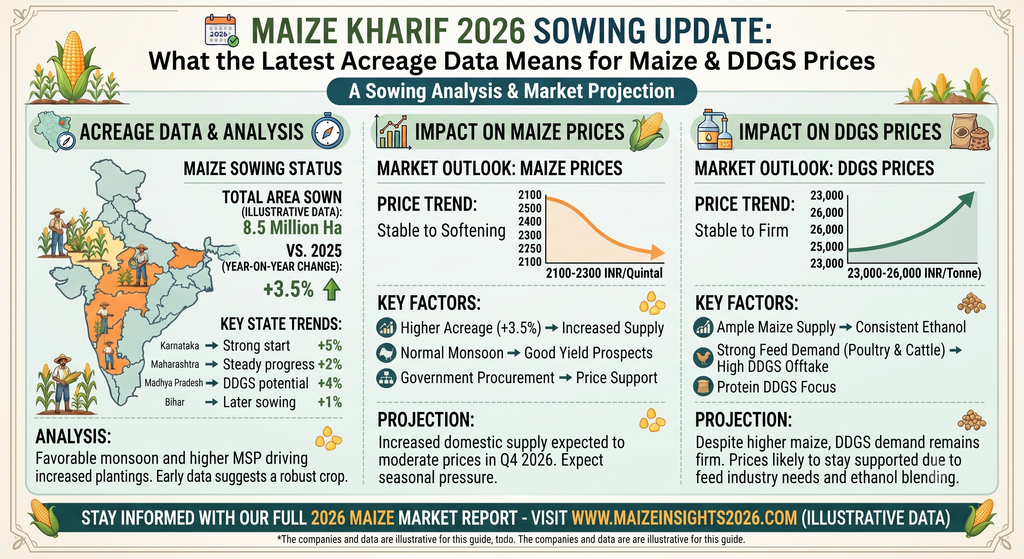
Quick summary: As of the latest government data (week ending August 21, 2026), India’s overall kharif sowing is running just 1.5% below last year — close to normal — but maize specifically is lagging by roughly 4%, one of only a handful of major crops still showing a year-on-year decline this late in the season. Meanwhile, the soybean acreage uncertainty we flagged in our July sowing update has largely resolved in the optimistic direction — oilseeds and soybean acreage are now running above last year. Sowing data moves weekly through the season; treat this as a dated snapshot and confirm current figures before making large procurement commitments.
What the Latest Data Actually Shows
Per data reported as of August 21, 2026, India’s total kharif sowing stood at roughly 1,056.7 lakh hectares, against 1,104.45 lakh hectares “normal” — a gap of about 1.5% versus last year and 95.7% of the long-term normal. That’s a meaningful improvement from earlier in the season, when the shortfall was wider.
| Crop | 2026 Area (lakh ha, as of early-to-mid Aug) | YoY Change | Status |
|---|---|---|---|
| Maize | ~87.15 (Aug 7 cut) | −3.84% to −4.06% | Lagging — one of the largest YoY declines of any major kharif crop |
| Oilseeds (total) | 180.20 | +2.96% | Recovering — a positive reversal from earlier-season shortfalls |
| Soybean | 119.92 | Roughly flat to slightly up | Recovering — see comparison below |
| Rice (paddy) | — | Down ~13.19 lakh ha | Lagging, but tracking near 98.3% of normal |
| Sugarcane | 58.44 | Above normal (107.8%) | The only major crop sown above its normal area |
| Total kharif | 1,056.70 | −1.5% | Near-parity with last year |
Maize is one of the few major crops still showing a clear year-on-year decline this late into the sowing window, alongside paddy, moong, and ragi — while cotton, sugarcane, and now oilseeds/soybean have closed or reversed their earlier-season gaps.
Why Maize Is Lagging While the Overall Picture Improves
A modest, single-digit sowing shortfall isn’t a crisis on its own — India’s kharif maize area is still running at roughly 110% of its long-term “normal” benchmark even with the year-on-year dip, meaning this year’s area is still historically solid, just below last year’s unusually strong base. A few factors are likely at play:
- Uneven monsoon distribution. The southwest monsoon has run roughly 13% deficient cumulatively from June 1 through late August, with the shortfall concentrated in June, even as later rainfall helped narrow gaps for several other crops.
- Crop-switching economics. As covered in our soybean sowing update, soybean traded at a multi-year high through mid-2026 after last year’s supply crisis, which likely pulled some marginal acreage that might otherwise have gone to maize back toward soybean — consistent with oilseeds gaining exactly where maize and some other crops have lagged.
- Regional rainfall gaps in specific maize belts, which the national aggregate figures don’t break out in the sources available for this update.
What This Means for Maize and DDGS Prices
A roughly 4% national sowing shortfall, on its own, is not the kind of shock that drove last year’s soybean meal crisis — but it’s a data point worth watching for a few reasons directly relevant to feed procurement:
Quick Read: Mustard DOC Price in India (2026)
Quick Read: DORB Price in India (2026)
Quick Read: Maize Rate Today in India (2026)
Quick Read: Cattle Feed Price in India
Quick Read: Soya DOC Price in India
Quick Read: Broiler Feed Price in India
Quick Read: DDGS Price in India
Quick Read: Maize Price Per Kg in India
Maize demand keeps growing regardless of supply. Poultry feed (maize anchors 55–60% of most rations), ethanol blending, and industrial starch demand are all structurally growing calls on the same crop — see our maize price per kg guide for the demand-side detail. A modest supply shortfall against growing demand is generally a firming factor, not a neutral one.
It’s a sowing number, not a yield number. Area sown and final production are two different things — rainfall distribution through the rest of the season, and harvest-time conditions in September–October, will determine whether this acreage gap shows up as a real production shortfall or gets offset by better-than-expected yields on the area that was sown.
DDGS supply tracks maize processing volume, not just acreage. Because Maize DDGS is a co-product of ethanol production, a tighter maize crop can tighten DDGS availability on the same timeline — worth watching alongside our Maize DDGS price guide as the harvest comes in.
The soybean comparison offers a useful contrast. Soybean’s acreage uncertainty earlier this season triggered real anxiety about a second consecutive tight year (see our soybean sowing update from July) — and by August, that concern has largely eased as oilseed acreage recovered. Maize’s current shortfall is smaller in percentage terms than soybean’s mid-season scare was, but it’s worth tracking with the same discipline rather than assuming it resolves the same way by default.
What Feed Buyers Should Do With This Information
- Don’t treat a 4% sowing gap as a supply emergency — it’s a data point to monitor, not a reason for panic buying, especially with total kharif acreage otherwise near-normal.
- Watch the September–October harvest window closely. That’s when sown area converts to actual production, and when the real picture on maize (and DDGS) supply for the 2026-27 season becomes clear.
- Track our maize rate today page for live mandi pricing through the harvest transition, since sowing-stage uncertainty typically shows up in day-to-day price movement well before final production numbers are confirmed.
- Talk to your supplier about forward coverage if your operation has meaningful maize or Maize DDGS volume exposure heading into Q4 2026, rather than waiting for the harvest picture to fully clarify.
Frequently Asked Questions
Is India’s maize crop facing a shortage in 2026? Not based on current data. Maize kharif sowing is running roughly 4% below last year, but still close to its long-term normal area. It’s a data point to watch through the September–October harvest, not evidence of a shortage on its own.
How does this compare to last year’s soybean meal crisis? Last year’s crisis followed a much larger, roughly 17% drop in soybean production. The current maize sowing gap is smaller in percentage terms, and unlike soybean earlier this season, overall kharif conditions have been improving through August rather than deteriorating.
Will this affect Maize DDGS prices? Possibly, since DDGS supply tracks maize processed for ethanol rather than acreage directly. A tighter maize crop can tighten DDGS availability on the same timeline, which is worth watching alongside acreage data as the harvest approaches.
When will the real picture on the 2026 maize crop be known? Final production estimates typically firm up after the September–October harvest. Sowing-stage data like this is directional, not a production forecast.
Where can I get a current bulk quote for maize or Maize DDGS? Request a quote from Brinda Foods — pricing is confirmed at time of order given ongoing seasonal movement.
About Brinda Foods
Brinda Foods has supplied animal feed raw materials from Panipat, Haryana since 1987. We provide bulk supply of Maize, Maize DDGS, Soya DOC, Mustard DOC, and other feed ingredients to mills and farms across India. ISO 9001:2015 certified.
Get today’s bulk quote: Submit an enquiry or contact our team.

[…] Maize Kharif Sowing 2026 Ddgs Price OutlookDDGS Price in IndiaLayer Feed Price in IndiaBroiler Feed Price IndiaCattle Feed Price in IndiaMaize Price Per Kg India 2026Feed Raw Material Price Comparison IndiaCorn DDGS Price India 2026Rice Gluten Meal Price India 2026Dorb Price In India 2026Maize Gluten Meal Price India 2026Soya Doc Price India 2026Maize DDGS Price India 2026Mustard Doc Price India 2026Maize Animal Feed Price Nutrition Guide India 2026Rice Ddgs Price India 2026 […]
[…] Maize Kharif Sowing 2026 DDGS Price OutlookDDGS Price in IndiaLayer Feed Price in IndiaBroiler Feed Price IndiaCattle Feed Price in IndiaMaize Price Per Kg India 2026Feed Raw Material Price Comparison IndiaCorn DDGS Price India 2026Rice Gluten Meal Price India 2026Dorb Price In India 2026Maize Gluten Meal Price India 2026Soya Doc Price India 2026Maize DDGS Price India 2026Mustard Doc Price India 2026Maize Animal Feed Price Nutrition Guide India 2026Rice DDGS Price India 2026 […]
[…] Maize Kharif Sowing 2026 DDGS Price OutlookDDGS Price in IndiaLayer Feed Price in IndiaBroiler Feed Price IndiaCattle Feed Price in IndiaMaize Price Per Kg India 2026Feed Raw Material Price Comparison IndiaCorn DDGS Price India 2026Rice Gluten Meal Price in India 2026Dorb Price in India 2026Maize Gluten Meal Price India 2026Soya Doc Price India 2026Maize DDGS Price India 2026Mustard Doc Price India 2026Maize Animal Feed Price Nutrition Guide India 2026Rice DDGS Price India 2026 […]
[…] Maize Kharif Sowing 2026 DDGS Price OutlookDDGS Price in IndiaLayer Feed Price in IndiaBroiler Feed Price IndiaCattle Feed Price in IndiaMaize Price Per Kg India 2026Feed Raw Material Price Comparison IndiaCorn DDGS Price India 2026Rice Gluten Meal Price India 2026Dorb Price In India 2026Maize Gluten Meal Price India 2026Soya Doc Price India 2026Maize DDGS Price India 2026Mustard DOC Price India 2026Maize Animal Feed Price Nutrition Guide India 2026Rice DDGS Price India 2026 […]