
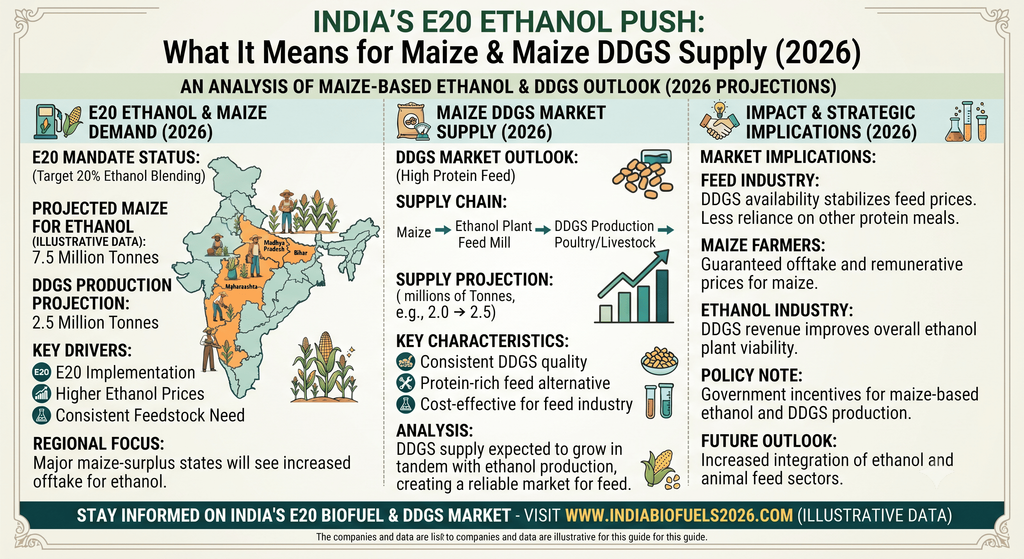
Quick summary: India’s nationwide E20 petrol rollout — 20% ethanol-blended fuel, mandated ahead of the original 2030 target — has been one of the country’s biggest consumer and policy stories of 2026, with vehicle owners reporting mileage complaints and the matter reaching the Supreme Court. Less widely discussed: maize now accounts for roughly 35% of India’s total ethanol production, per Petroleum Minister Hardeep Singh Puri, a sharp structural shift that directly affects maize demand, pricing, and — importantly for feed buyers — the supply of Maize DDGS, the protein-energy byproduct of that same process.
What’s Happening With E20
India mandated E20 (20% ethanol-blended) petrol at fuel stations nationwide in 2025, accelerating a target originally set for 2030. The rollout has generated real public friction: motorists report fuel efficiency drops from roughly 18–20 km/litre to 16–17 km/litre — over 10% — along with sluggish acceleration and concerns about long-term engine wear in older, non-E20-compatible vehicles. The issue reached India’s Supreme Court, with the Attorney General describing the rollout in June 2026 as an ongoing “experiment.” The government maintains that mileage impact is marginal (1–2%) in compatible vehicles and points to energy security and farmer income as the programme’s core benefits.
That consumer-facing controversy is well covered elsewhere. What matters more directly for feed procurement is the feedstock story behind it.
Why Maize Is Displacing Sugarcane as an Ethanol Feedstock
India’s ethanol programme has historically run on sugarcane, and Maharashtra’s sugar mills still dominate production. But the shift toward maize is accelerating for a few concrete reasons:
- Water efficiency. Sugarcane is one of the most water-intensive crops grown in India; maize requires meaningfully less water per unit of ethanol produced, a significant consideration given water stress across several sugarcane-growing regions.
- Agro-climatic flexibility. Maize grows across a far wider range of Indian regions and conditions than sugarcane, giving farmers and the ethanol programme more geographic flexibility.
- Energy security priorities. Diversifying ethanol feedstock away from a single crop reduces supply concentration risk for a programme central to India’s crude oil import reduction strategy.
The result: maize now supplies roughly 35% of India’s ethanol production, a striking figure for a feedstock shift that’s moved faster than sugarcane-dominated assumptions would have suggested even a couple of years ago.
Why This Matters for Maize Demand and Price
This is a structural, not seasonal, demand story — and it compounds on top of maize’s existing roles in poultry feed (55–60% of most rations) and industrial starch use, which we cover in our maize price per kg guide. A fixed or even modestly growing maize crop supplying a fast-growing ethanol demand pool, alongside steady feed and food demand, is a textbook setup for sustained price support — one reason we’ve flagged ethanol blending as a factor to watch in both our maize price and maize rate today coverage, though this 35% figure gives that factor far more concrete weight than earlier estimates.
It’s also worth reading alongside our kharif 2026 maize sowing update: this year’s maize sowing is running about 4% below last year even as ethanol-driven demand grows — a combination that argues for closer supply planning rather than assuming maize availability will simply track historical patterns.
Agricultural economists cited in coverage of the shift have flagged the classic food-vs-fuel tension: diverting a growing share of the maize crop to ethanol raises questions about price pressure on the feed and food side, which is exactly the dynamic Indian feed millers are already navigating.
Quick Read: Mustard DOC Price in India (2026)
Quick Read: DORB Price in India (2026)
Quick Read: Cattle Feed Price in India
Quick Read: Soya DOC Price in India
Quick Read: Broiler Feed Price in India
Quick Read: DDGS Price in India
The Upside for Feed Buyers: More Maize DDGS in the Supply Chain
Here’s the part of this story that’s genuinely useful for feed procurement, not just a cost concern: Maize DDGS is the direct co-product of maize-based ethanol production. Every tonne of maize processed for ethanol yields a protein- and energy-dense byproduct that returns to the feed chain — meaning the same shift pushing up demand for raw maize is also expanding the domestic supply base for Maize DDGS.
For feed millers managing rising maize costs, this is a relevant lever: Maize DDGS (28–32% crude protein, per our Maize DDGS price guide) becomes a more consistently available substitute or partial replacement in rations that would otherwise lean more heavily on increasingly expensive raw maize or Soya DOC. It’s the same logic covered in our feed cost reduction guide, applied to a genuinely new supply-side driver rather than a one-off substitution tip.
What This Means for Your Procurement Planning
- Treat ethanol demand as a structural factor, not a passing headline, when budgeting maize costs through the rest of 2026 and into 2027 — a 35% ethanol-feedstock share is a durable shift, not a pilot programme.
- Watch Maize DDGS availability as a genuine hedge, not just a cost-saving substitute — expanding maize-ethanol capacity should, in principle, expand DDGS supply alongside it, though regional distribution and quality consistency still need verifying supplier by supplier.
- Track sowing-to-harvest data closely (see our kharif sowing update) since a below-normal sowing year colliding with structurally higher ethanol demand is a tighter combination than either factor alone.
- Secure forward supply agreements for both Maize and Maize DDGS if your operation carries meaningful volume exposure, rather than waiting to react to price moves that this demand shift makes more likely to be sustained.
Frequently Asked Questions
How much of India’s ethanol now comes from maize? Roughly 35%, per Petroleum Minister Hardeep Singh Puri — a sharp increase from a historically sugarcane-dominated ethanol programme.
What is E20 and why is it controversial? E20 is petrol blended with 20% ethanol, mandated nationwide in India in 2025 ahead of the original 2030 target. It’s drawn public criticism over reported fuel efficiency drops (roughly 10%+) and reached the Supreme Court, while the government maintains the mileage impact is marginal in compatible vehicles.
Does the ethanol shift mean maize prices will keep rising? It’s a genuine structural demand driver alongside existing feed and food demand, and worth factoring into cost planning — though actual price movement also depends on crop size, monsoon outcomes, and other factors covered in our maize price and kharif sowing coverage.
Will more maize going to ethanol reduce Maize DDGS availability? The opposite, in principle — Maize DDGS is a direct co-product of maize ethanol production, so more maize processed for ethanol should expand the domestic DDGS supply base, not shrink it.
Where can I source bulk Maize or Maize DDGS as this demand shift plays out? Request a quote from Brinda Foods for Maize or Maize DDGS — our team can also advise on securing forward supply given current market dynamics.
About Brinda Foods
Brinda Foods has supplied animal feed raw materials from Panipat, Haryana since 1987. We provide bulk supply of Maize, Maize DDGS, Soya DOC, Mustard DOC, and other feed ingredients to mills and farms across India. ISO 9001:2015 certified.
Get today’s bulk quote: Submit an enquiry or contact our team.

[…] ₹65/kg on weaker production and cancelled exports, pulling Soya DOC to multi-year highs, while ethanol demand for maize kept grain firm. The export halt analysis covers the protein […]
[…] are coming out the other end over time. We covered what that does to availability in our piece on the E20 push and maize DDGS […]