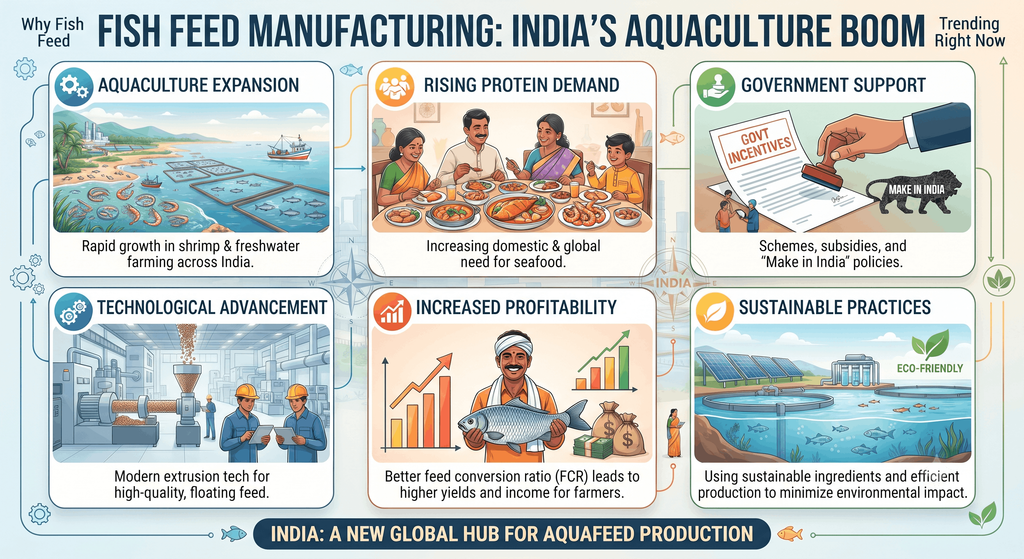
This isn’t a niche or speculative growth story — it’s backed by consistent, multi-year government data:
- India’s total fish production grew from 141.60 lakh tonnes in 2019-20 to 197.75 lakh tonnes in 2024-25 — a 38% increase in five years under the Pradhan Mantri Matsya Sampada Yojana (PMMSY), the central government’s flagship fisheries scheme.
- Aquaculture productivity rose to roughly 4.7 tonnes per hectare by early 2025, up from about 3 tonnes per hectare before PMMSY — meaning more fish (and more feed demand) from the same water area.
- The government has backed 52,058 reservoir cages, 22,057 RAS & Biofloc units, and 1,525 sea cages with over ₹3,040 crore in technology investment — infrastructure that only makes sense with a feed supply chain to match.
- Fish and fishery product exports rose 33.7%, from ₹46,662.85 crore (2019-20) to ₹62,408.45 crore (2024-25), pulling more commercial-scale, feed-dependent farming into the sector.
- India’s aquafeed market itself was sized at roughly 2.05 million tonnes in 2025, and is projected to reach 4.28 million tonnes by 2034 — a 7.8% CAGR, meaning the market is on track to more than double within a decade.
Put together: this is a real, government-backed, multi-year growth trend — not a passing search-volume spike — which is exactly why demand for reliable fish feed manufacturers and raw material suppliers keeps climbing alongside it.
Where Fish Feed Manufacturing Concentrates in India
Aquafeed demand isn’t evenly spread across the country — it follows water, species, and existing aquaculture infrastructure:
| Region | Leading states | Why it leads |
|---|---|---|
| East India | West Bengal, Odisha, Bihar | The largest aquafeed region by share (roughly 35% of the national market) — extensive freshwater carp-farming infrastructure and the longest-established aquaculture tradition in the country |
| South India | Andhra Pradesh, Telangana, Tamil Nadu | India’s shrimp export hub, anchored by Andhra Pradesh’s Vannamei shrimp belt — feed demand here is more export- and shrimp-driven than the freshwater-carp east |
| North India | Uttar Pradesh, Bihar (border states) | Among the top five inland fish-producing states nationally, with fast-growing freshwater aquaculture alongside traditional cattle/poultry feed demand |
| West India | Gujarat, Maharashtra | Fast-growing coastal and brackish-water aquaculture, adding to the region’s already-large poultry and cattle feed base |
Species mix shapes formulation too: carp feed accounts for roughly 58.5% of India’s aquafeed market by volume — the largest single segment — with shrimp, tilapia, and catfish feed making up most of the remainder. A carp-feed formulation and a shrimp-feed formulation draw on the same raw-material categories below, but in different ratios and with different quality tolerances (shrimp feed is far less forgiving of inconsistency).
What Actually Goes Into Fish and Shrimp Feed
Regardless of species or region, Indian aquafeed formulations are built from a consistent set of raw material categories:
| Raw material | Role in aquafeed | Typical share of India’s aquafeed ingredient mix |
|---|---|---|
| Fishmeal | Primary high-quality protein, especially in hatchery/starter feeds | Largest single ingredient category (~27.5% of the mix), but supply-constrained and increasingly expensive |
| Soya DOC | Primary plant-protein replacement for fishmeal | Core protein base across carp, shrimp, and tilapia formulations |
| Rice DDGS | Protein-energy supplement, partial fishmeal/soybean meal replacement | Growing share as manufacturers manage feed cost |
| Maize DDGS | Protein-energy supplement | Similar role to Rice DDGS, used where maize-processing byproduct is available |
| De-Oiled Rice Bran (DORB) | Cost-effective energy and bulking component | Used in carp and lower-value finfish formulations more than in premium shrimp diets |
| Fish oil | Essential fatty acids, especially for marine species | Smaller but critical share, particularly in hatchery diets |
Fishmeal’s high cost and limited domestic supply (roughly 250,000–350,000 metric tonnes a year) is the single biggest reason plant- and grain-based proteins like Soya DOC and Rice DDGS have moved from “alternative” to “standard” in Indian aquafeed formulation over the past few years — the nutritional detail, inclusion rates by species, and quality checks specific to formulation are covered in our companion guide, Rice DDGS & Soya DOC for Aquaculture Feed in India.
What to Look for in a Fish Feed Raw Material Supplier
Aquafeed is less forgiving of ingredient inconsistency than cattle or poultry feed — pelleted and extruded feed has to hold its shape in water, and species like shrimp are highly sensitive to contamination. Whether you manufacture finished feed or buy raw material to blend in-house, the same evaluation criteria apply:
- Batch-level Certificate of Analysis (COA), not just a spec sheet at onboarding — critical given aquafeed’s low tolerance for substitution error.
- Verified mycotoxin-controlled processing. Shrimp and larval fish are especially sensitive to aflatoxins, making this a non-negotiable check.
- Consistent moisture control (under 10%) to prevent fungal growth during storage before pelleting or extrusion.
- Relevant certifications for formal procurement — ISO 9001:2015, HACCP, and CLFMA membership signal a supplier built for scaled, quality-sensitive buyers.
- Blended sourcing from one supplier — Soya DOC, Rice DDGS, Maize DDGS, and DORB from a single source simplifies formulation logistics for feed millers blending multiple protein and energy sources.
More detail on supplier evaluation generally is in How to Choose a Feed Raw Material Supplier in India.
Brinda Foods: Raw Material Supply for India’s Aquafeed Manufacturers
Brinda Foods (Brinda Feeds Private Limited) has supplied animal feed raw materials from Panipat, Haryana since 1987, and increasingly serves the aquafeed segment as India’s aquaculture industry scales. Core raw materials supplied for fish and shrimp feed formulation include:
- Soya DOC — 44–48% crude protein, primary plant protein for aquafeed
- Rice DDGS and Maize DDGS — cost-effective protein-energy alternatives, lab-verified on every batch
- De-Oiled Rice Bran (DORB) — energy and bulking component for carp and lower-value finfish diets
Every dispatch ships with a verified lab report — a standard we hold across cattle, poultry, and aquafeed customers alike, but one that matters most in a segment as quality-sensitive as shrimp feed. Review our certifications or learn more about our company.
Frequently Asked Questions
How big is India’s fish feed (aquafeed) industry? India’s aquafeed market was sized at roughly 2.05 million tonnes in 2025 and is projected to reach 4.28 million tonnes by 2034, growing at a 7.8% CAGR — driven by government-backed fish production growth of 38% over the past five years under PMMSY.
Which Indian states have the most fish feed manufacturing? East India (West Bengal, Odisha, Bihar) leads with roughly 35% of the national aquafeed market, built on established freshwater carp-farming infrastructure. Andhra Pradesh, Telangana, and Tamil Nadu lead the shrimp-feed segment tied to India’s shrimp export industry.
What raw materials do fish feed manufacturers use most? Fishmeal remains the largest single ingredient category, but plant- and grain-based proteins — particularly Soya DOC, Rice DDGS, and Maize DDGS — now make up a growing share of formulations as manufacturers manage fishmeal’s cost and supply constraints.
Is fish feed manufacturing different from shrimp feed manufacturing? They draw on the same raw material categories, but shrimp feed generally has tighter quality tolerances (lower fibre, stricter mycotoxin limits) and a different inclusion ratio than carp or catfish feed, which tolerates plant-based ingredients more easily.
Does Brinda Foods supply raw material for fish and shrimp feed manufacturing? Yes. Brinda Foods supplies Soya DOC, Rice DDGS, Maize DDGS, and De-Oiled Rice Bran to aquafeed manufacturers and feed mills, with batch-level lab verification suited to aquaculture’s quality-sensitive requirements.
How do I request pricing for bulk aquafeed raw material? Request a quote or contact our team with your required product, protein specification, and delivery location.
Sourcing raw material for a fish or shrimp feed manufacturing operation in India? Request a quote from Brinda Foods today.