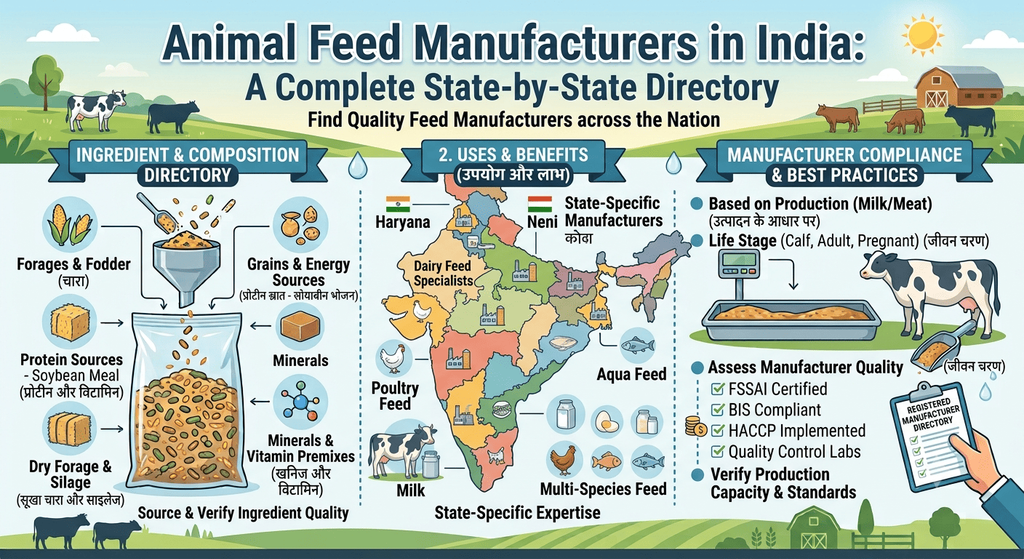
Quick answer: India’s feed manufacturing base is not spread evenly. It clusters around three things: dairy density, commercial poultry belts, and aquaculture zones. Uttar Pradesh, Rajasthan, Madhya Pradesh, Gujarat, and Maharashtra drive cattle feed volume. Andhra Pradesh, Tamil Nadu, Telangana, West Bengal, and Karnataka drive poultry feed. Andhra Pradesh alone anchors aqua feed. This directory walks through every major state, what kind of manufacturers operate there, and what raw material actually moves the cost line in each one.
Why a State-by-State View Beats a Company List?
Most “top feed manufacturers” lists are just company names in a row. Useful for five minutes, useless when you are actually placing an order.
What a procurement head or mill owner really wants to know is different:
- Which states have surplus feed capacity and which are net importers of raw material
- Where the byproduct supply sits (ethanol distilleries, solvent extraction plants, rice mills)
- What freight looks like from the nearest raw material hub
- Which quality benchmarks buyers in that state expect as standard
So this guide is organised by geography, and every state entry answers the same practical question: if you are milling or buying here, what should you know?
The National Picture in One Minute!
India’s animal feed market is large and still climbing. The Indian animal feed market was valued at around USD 14.90 billion in 2025 and is projected to grow at roughly 3.90% CAGR to 2035, with poultry feed holding the dominant share at about 56% in 2025. Expert Market ResearchIMARC
Three official production figures shape almost every sourcing decision in the country:
- Milk: India produced 247.87 million tonnes in 2024 to 2025, with Uttar Pradesh (15.66%), Rajasthan (14.82%), Madhya Pradesh (9.12%), Gujarat (7.78%) and Maharashtra (6.71%) together making up 54.09% of national output. Utkarsh
- Eggs: 149.11 billion eggs, led by Andhra Pradesh (18.37%), Tamil Nadu (15.63%), Telangana (12.98%), West Bengal (10.72%) and Karnataka (6.67%), together 64.37% of the total, with commercial poultry contributing 84.49% of output. Press Information Bureau
- Meat: 10.50 million tonnes, with West Bengal (12.46%), Uttar Pradesh (12.20%), Maharashtra (11.57%), Andhra Pradesh (10.84%) and Telangana (10.49%) making up 57.55%. Utkarsh
Read those three lists together, and the feed map draws itself.
The Three Types of Manufacturer You Will Meet
Before the state entries, it helps to know who you are actually dealing with.
1. Integrators with captive feed mills. Poultry integrators run their own mills to feed contract farms. They buy raw material in very large lots and rarely sell finished feed outside their network.
2. Cooperative and dairy federation plants. State milk federations run cattle feed plants that supply member unions. Volume is steady, tenders are formal, and specification sheets are strict.
3. Regional commercial mills and toll millers. The widest group by number. They sell branded compound feed, concentrates and mash to local dealers, and this is where most third-party raw material demand sits.
Behind all three sits a fourth layer that never appears on directory lists: the raw material suppliers who feed the mills. That layer is where consistency is won or lost.
North India
- Uttar Pradesh
UP is the single biggest demand centre in the country. It leads national milk production, carries a very large livestock base, and has a fast-growing commercial poultry sector alongside it.
Manufacturing here is a mix of cooperative cattle feed plants run under the state dairy federation, a dense layer of regional mills across the western districts, and integrator feed capacity near the Delhi corridor.
UP is also now a major ethanol state, which means a growing domestic supply of distillery byproducts. That matters for anyone formulating with DDGS. The state’s full demand picture is covered in this Uttar Pradesh sourcing guide, and buyers looking specifically at distillery co-products should read the Rice DDGS guide for UP.
What moves cost here: maize, DORB, DDGS and soya. Freight from Haryana and western UP hubs is short, which keeps landed cost competitive.
- Haryana
Haryana punches far above its size. It has high buffalo milk yields, a strong broiler belt around Jind, Karnal and Sonipat, and one of the best road networks for feed logistics in India.
You will find large integrator feed mills, a state cooperative cattle feed plant at Rohtak, and a heavy concentration of raw material trading houses along the GT Road belt.
Panipat in particular has become a genuine raw material hub, sitting close to rice, maize and mustard processing. Buyers in the state can read the Haryana Rice DDGS supplier guide for lead time and freight detail.
What moves cost here: proximity. Haryana mills generally pay the lowest freight component on North Indian raw material of any state.
- Punjab
Punjab has the highest per capita milk availability in the country and recorded the highest growth rate in milk production among states. Its dairy cooperative network is in an active capacity expansion phase. VetExtension
Manufacturing is dominated by cooperative cattle feed plants at Bhattian (Khanna) and Batala, a large multinational dairy feed plant at Bathinda, and a strong regional mill presence around Ludhiana and Jalandhar.
Poultry is smaller than dairy here but growing steadily in the Malwa belt. The Punjab sourcing guide covers the demand drivers, and the Punjab Rice DDGS delivery guide covers bulk logistics into the state.
What moves cost here: bypass protein for high-yield dairy rations, plus energy sources to balance the paddy straw base.
- Delhi NCR
Delhi itself is not a manufacturing state, it is a trading and demand hub. North India accounts for roughly 31% of India’s total animal feed market, and NCR sits at the centre of that. brindafoods
What you find here is procurement offices, trading firms, distribution warehouses and a ring of mills in Ghaziabad, Bahadurgarh, Sonipat and Faridabad. Buying decisions for a surprising share of North Indian feed volume are actually made inside NCR. The Delhi NCR sourcing guide has the district-level detail.
- Rajasthan
Rajasthan is the second largest milk-producing state and India’s mustard capital. That combination shapes everything about its feed industry.
Mustard DOC is the default protein source in Rajasthan rations because it is local, available and priced well against imported alternatives. Cooperative cattle feed plants under the state dairy federation serve the milk unions, while private mills cluster around Jaipur, Alwar, Bharatpur and Kota.
Kota and Alwar also host solvent extraction capacity, making the state a genuine raw material origin rather than only a consumer. Mills formulating around this base can review Mustard DOC specifications.
What moves cost here: mustard DOC availability and the seasonal spread between crush season and off season.
- Uttarakhand and Himachal Pradesh
Both are smaller markets served largely from the plains. Uttarakhand has cooperative cattle feed capacity around Rudrapur and a growing industrial belt near Haridwar and Pantnagar. Himachal is primarily a consuming state with feed moving in from Punjab and Haryana.
For mills here, the practical question is rarely “who manufactures locally” and more “who can deliver reliably up the hill.”
Central and West India!
- Madhya Pradesh
MP is where a large share of India’s soybean crush happens. Indore is the country’s biggest crushing hub, which makes the state the origin point for soybean meal moving across India.
Feed manufacturing itself is mid-sized: cooperative cattle feed plants at Indore and Sehore, plus regional mills serving the dairy belt. But MPs’ real importance is upstream. When soya prices move in Indore, formulation sheets change in Tamil Nadu.
2026 has been a volatile year for that ingredient, covered in detail in this soybean meal export halt analysis.
What moves cost here: the soy crush margin and whether mills substitute towards alternative protein sources.
- Gujarat
Gujarat runs one of the most organised cooperative feed systems in the world. The dairy union network operates large cattle feed plants at Kanjari, Sarsa, Bhuj and elsewhere, supplying member unions on standardised specifications.
Alongside that sits a fast-growing maize ethanol sector. Gujarat has become one of the leading maize DDGS-producing states in the country, which reshaped regional protein economics. Anyone sourcing that ingredient should read the guide to Corn DDGS manufacturers in India.
What moves cost here: distillery output and port access for imported additives.
- Maharashtra
Maharashtra is the headquarters state. Several of India’s largest feed and integration businesses are based in or around Mumbai and Pune, with manufacturing spread across Baramati, Nashik, Pune and Nagpur.
It ranks in the top five for milk and top three for meat production, so both cattle and poultry feed demand are substantial. Pulses processing byproducts such as tuvar chuni and chana chuni also feature heavily in local cattle rations, which is a genuinely regional formulation habit.
Milk pricing here directly affects feed budgets, as the September 2026 milk price analysis sets out.
What moves cost here: competition between the dairy belt and the poultry belt for the same protein ingredients.
- Chhattisgarh
Small state, outsized feed presence. Chhattisgarh hosts one of India’s largest integrated poultry and feed operations, centred around Rajnandgaon and Bhilai, and supplies feed and day-old chicks well beyond its borders.
Rice milling is abundant here, making DORB locally available and competitively priced. Mills evaluating that ingredient can review De-Oiled Rice Bran specifications.
South India
- Andhra Pradesh
AP is the most concentrated feed market in India, and it runs on two engines.
- Poultry: the state leads national egg production, with commercial layer farms clustered around the Godavari districts and Vijayawada.
- Aqua: this is where AP is genuinely unmatched. It is the largest domestic fish producer and seafood exporter, with aquaculture production of 55.39 lakh tonnes in 2025 to 2026, an aquaculture base of around 7.6 lakh hectares, more than 2.75 lakh farmers, and clusters such as Bhimavaram forming the backbone of its export-oriented ecosystem. The sector contributes nearly 34% of India’s seafood exports. manoramayearbookmanoramayearbook
Aqua feed plants in the state are large, technically advanced and export-quality driven. The growth story behind them is covered in why fish feed manufacturing in India is trending.
What moves cost here: protein quality tolerance is tighter than anywhere else in India. Aqua feed buyers test harder and reject faster.
- Telangana
Telangana is a poultry powerhouse with a well-defined feed mill ring around Hyderabad, running through Medak, Rangareddy, Vikarabad and Siddipet.
Several large integrators and layer groups are headquartered here, and the state combines a big consuming population with genuine manufacturing capacity. Maize moves in from Karnataka, Bihar and Madhya Pradesh depending on the season. The Hyderabad sourcing guide breaks down the district ring in detail.
What moves cost here: maize landed price, since broiler and layer rations here are maize-heavy.
- Tamil Nadu
Tamil Nadu is the second largest egg-producing state and home to some of India’s most established poultry integrators, with Coimbatore, Erode, Namakkal and Salem forming a genuine feed manufacturing corridor.
Namakkal in particular is one of the densest layer-farming clusters in Asia, and feed demand there is continuous rather than seasonal. Mills’ pricing of the finished product against branded competition will find the layer feed price guide useful for benchmarking.
What moves cost here: egg realisation. When egg prices soften, layer mills immediately reformulate toward cheaper energy sources.
- Karnataka
Karnataka balances a strong dairy cooperative network with a solid poultry sector. The state milk federation runs cattle feed plants serving its unions, and Bengaluru hosts significant private feed manufacturing.
Karnataka is also a major maize-producing state, which gives local mills a structural advantage on energy ingredients. Current mandi movement is tracked in the maize rate guide.
What moves cost here: local maize harvest timing, which can swing regional pricing sharply.
- Kerala
Kerala is a deficit state that depends heavily on inbound feed and raw material. It hosts a long-established listed cattle feed manufacturer based in the Thrissur district, alongside cooperative capacity under the state milk federation.
Because almost every ingredient arrives from outside the state, Kerala mills tend to be extremely disciplined about moisture specification and storage. Buyers working with concentrate blends can review feed concentrate options.
East and Northeast India!
How to Vet a Feed Manufacturer or Raw Material Supplier in Any State?
The state changes. The checklist does not.
- or a Certificate of Analysis on every lot, not just at onboarding. Onboarding samples are always good. Batch three is the real test.
- Check certifications before the first order. ISO 9001:2015, HACCP and trade body membership are baseline expectations for formal mill procurement, not premium features. You can see what a certified supplier profile looks like here.
- Confirm moisture handling and storage practice. Moisture is a commercial number, not a technical footnote. Byproducts like DDGS and DORB are especially sensitive during monsoon months.
- Get clarity on tax and documentation. Compound feed sits under a specific HSN classification with a Nil GST rate, and getting this right avoids invoice disputes later. The full breakdown is in the cattle feed HSN and GST guide.
- Compare on cost per unit protein, not price per kg. A cheaper bag with lower protein is rarely cheaper once it hits the formulation sheet.
- Ask how they handle a rejected lot. The answer tells you more about a supplier than any brochure.
A longer version of this framework is available in how to choose the right feed raw material supplier in India.
Where Brinda Foods Fits in This Map?
We are not a compound feed brand, and we do not compete with the manufacturers listed above. We supply the raw material behind them.
Brinda Foods has operated from Panipat, Haryana, since 1987 as a family-run business, supplying feed millers, compounders and integrators across India and export markets, including Vietnam, the UAE, and Thailand.
Our core range covers Soya DOC, Maize DDGS, Rice DDGS, Mustard DOC, DORB, Maize, Maize Gluten, and Rice Gluten, with lab-verified specifications and a Certificate of Analysis on every lot.
Our position in the North Indian raw material belt gives buyers in Haryana, Punjab, UP, Delhi NCR, Rajasthan, and Uttarakhand a short freight leg, and we ship in bulk to Central, Western, and Southern states as well. State-level delivery detail is mapped in our state-by-state Rice DDGS sourcing guide.
If you are comparing suppliers for the next quarter, send us your specification and we will quote against it directly.
Frequently Asked Questions!
- Which state has the most animal feed manufacturers in India?
By volume of commercial feed capacity, Tamil Nadu, Andhra Pradesh, Telangana, and Maharashtra lead, driven by poultry and aqua. By cattle feed volume, Gujarat, Uttar Pradesh, Rajasthan, and Punjab lead through cooperative and private plants.
- Which state is the biggest market for cattle feed raw material?
Uttar Pradesh, on the back of national leadership in milk production, was followed closely by Rajasthan and Gujarat.
- Where is poultry feed demand highest?
Andhra Pradesh, Tamil Nadu, and Telangana together account for a very large share of national egg output, which makes them the densest poultry feed markets in the country.
- Which states produce DDGS in India?
Grain-based ethanol capacity is concentrated in Gujarat, Uttar Pradesh, Bihar, Madhya Pradesh, Punjab, Haryana, Karnataka, and Maharashtra. Current pricing across both types is tracked in the DDGS price guide, and the difference between the two is explained in Rice DDGS or Maize DDGS.
- Do I need a manufacturer in my own state?
Not necessarily. What matters is landed cost, batch consistency, and lead time reliability. A well-organiSed supplier two states away often beats a local one with inconsistent lots.
- What should a first order from a new supplier look like?
Small, tested, and documented. Sample, COA review, trial lot, then volume. Skipping straight to volume is where most sourcing regrets begin.