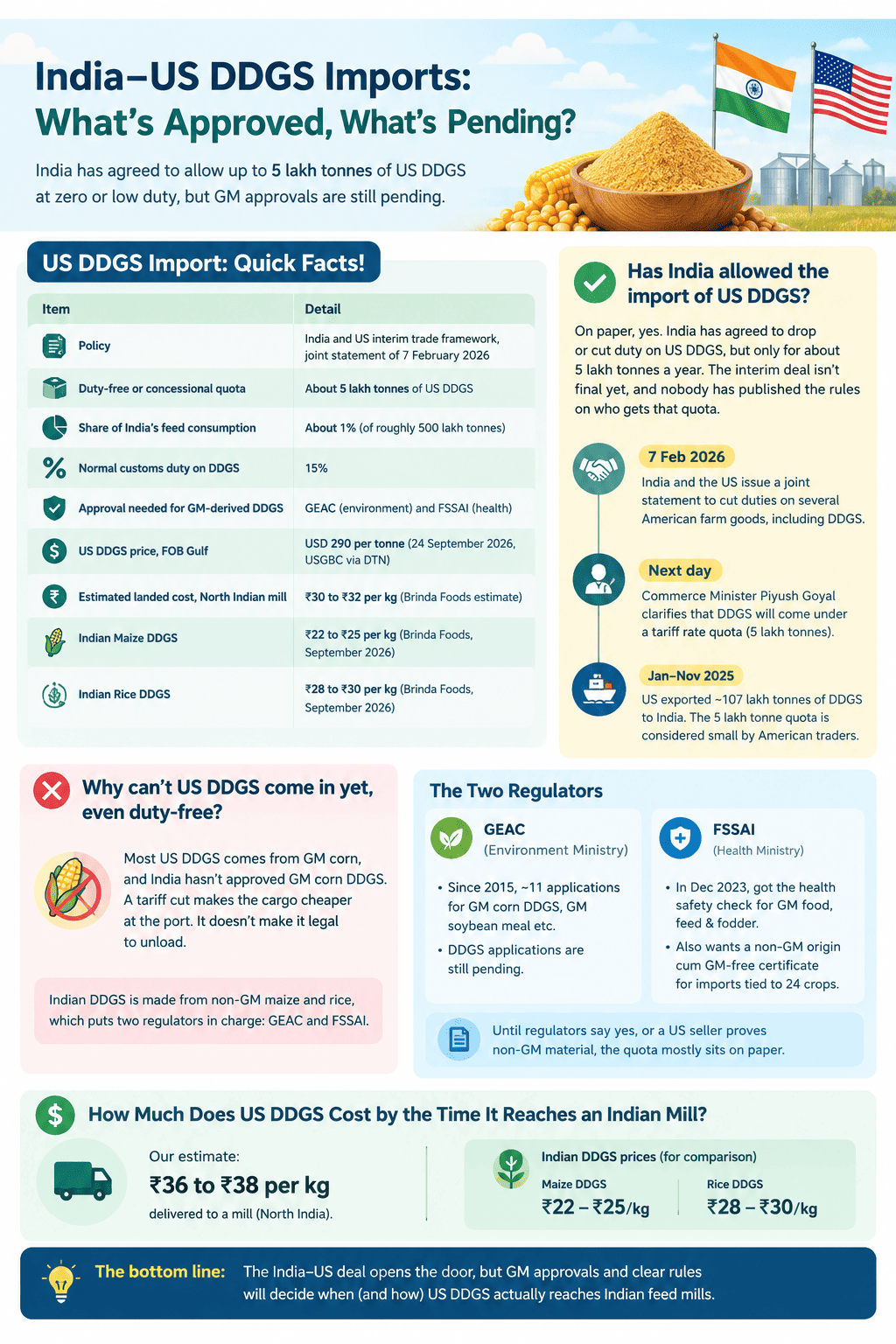
Quick answer: India will let in up to 5 lakh tonnes of US DDGS a year at zero or low duty, under the India and US interim trade framework of February 2026. But GEAC and FSSAI still have to clear GM corn DDGS. And at USD 290 a tonne, US DDGS lands at ₹36 to ₹38 a kg, while Indian Maize DDGS sells for ₹30 to ₹32.
US DDGS import: quick facts!
| Item | Detail |
| Policy | India and US interim trade framework, joint statement of 7 February 2026 |
| Duty-free or concessional quota | About 5 lakh tonnes of US DDGS |
| Share of India’s feed consumption | About 1% (of roughly 500 lakh tonnes) |
| Normal customs duty on DDGS | 15% |
| Approval needed for GM-derived DDGS | GEAC (environment) and FSSAI (health) |
| US DDGS price, FOB Gulf | USD 290 per tonne (24 September 2026, USGBC via DTN) |
| Estimated landed cost, North Indian mill | ₹30 to ₹32 per kg (Brinda Foods estimate) |
| Indian Maize DDGS | ₹22 to ₹25 per kg (Brinda Foods, September 2026) |
| Indian Rice DDGS | ₹28 to ₹30 per kg (Brinda Foods, September 2026) |
Has India allowed the import of US DDGS?
On paper, yes. India has agreed to drop or cut duty on US DDGS, but only for about 5 lakh tonnes a year. The interim deal isn’t final yet, and nobody has published the rules on who gets that quota.
It started with a joint statement from India and the US on 7 February 2026. In it, India said it would cut or scrap duties on a list of American farm goods. Distillers’ grains came first on that list. Red sorghum for feed, tree nuts, fruit and soybean oil followed.
The very next day, Commerce Minister Piyush Goyal clarified something feed buyers needed to hear. DDGS would come in under a tariff rate quota. So a set volume gets the low rate, and anything over it pays full duty. Reports put that volume at 5 lakh tonnes.
Is that a lot? Not really. Between January and November 2025, the US shipped out about 107 lakh tonnes of DDGS, going by S&P Global. American traders themselves said India’s quota wasn’t a big number.
Why can’t US DDGS come in yet, even duty-free?
Because most of it comes from GM corn, and India hasn’t approved GM corn DDGS. A tariff cut makes the cargo cheaper at the port. It doesn’t make it legal to unload.
Indian DDGS is made from non-GM maize and rice. That’s the whole difference, and it puts two regulators in charge.
The first is GEAC, the Genetic Engineering Appraisal Committee under the environment ministry. Since 2015, it has received roughly 11 applications to import GM corn DDGS, GM soybean meal and the like. The DDGS ones are still waiting.
The second is FSSAI, the Food Safety and Standards Authority of India. In December 2023, the government gave it the health safety check on GM food, feed and fodder, and left the environmental side with GEAC. FSSAI also already wants a non-GM origin cum GM-free certificate on imports tied to 24 listed crops.
Asked about GM content in DDGS, Piyush Goyal said the environment ministry’s process would apply. So the trade deal didn’t go around the regulators. Until they say yes, or a US seller can prove the material is non-GM, the quota mostly sits on paper.
How much does US DDGS cost by the time it reaches an Indian mill?
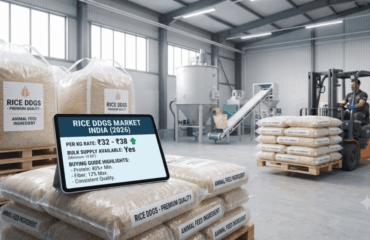
Our estimate is ₹36 to ₹38 a kg, delivered to a mill in Haryana or Punjab, inside the quota. Without the quota, the 15% duty adds about ₹5. Indian Maize DDGS, for comparison, is at ₹22 to ₹25.
US prices have been rising quickly. The US Grains and Bioproducts Council (USGBC) puts out weekly export prices, and DTN carried the 24 September 2026 figure: USD 290 a tonne FOB Gulf. In early August it had been USD 243. So, about 25% higher in roughly seven weeks.
We worked out what one tonne would cost by the time it reached a mill near Panipat:
- FOB US Gulf: USD 304 per tonne
- Sea freight and insurance to Mundra or Nhava Sheva, in containers: we assumed USD 45 to 65 a tonne (your forwarder’s quote may differ)
- Rupee at roughly ₹96 to the dollar
- Port charges, clearing and trucking inland: around ₹2 to ₹3 a kg
- Delivered: about ₹30 to ₹32 per kg
But nobody buys DDGS for the bag. They buy it for the protein. So we also did the sum per kg of protein.
Brinda Foods analysis: cost per kg of protein, September 2026
| Raw material | Delivered rate (₹/kg) | Crude protein | Cost per kg of protein (₹) |
| Rice DDGS (India) | 28 to 30 | 40 to 45% | about 68 |
| Maize DDGS (India) | 22 to 25 | 28 to 32% | about 78 |
| Soya DOC (India) | 40 to 46 | 44 to 46% | about 96 |
| US corn DDGS, quota landed | 36 to 38 | typically 26 to 30% | about 132 |
The Indian rates are Brinda Foods’ indicative bulk feed-grade rates for September 2026, and the costs use the middle of each range. The US row is our own estimate, built from the USGBC price and the assumptions above.
That bottom row is the one people don’t expect. A kg of protein from US DDGS comes out roughly 70% dearer than from Indian Maize DDGS. It’s even costlier than Soya DOC protein, and soya brings a much better amino acid profile.
Is US DDGS better quality than Indian DDGS?
US DDGS does have a good name for consistency, colour and low aflatoxin. Well-handled Indian DDGS can match that, though. It comes down to moisture, sampling and storage.
Feed buyers in Vietnam and South Korea keep going back to US DDGS. One importer in Vietnam even said local millers like its golden yellow colour. On our side, Indian traders have admitted that high aflatoxin, usually from damp maize, is what keeps Indian DDGS out of some export markets.
That isn’t a permanent problem. It’s a handling problem. Check moisture at the source, sample more than once, test in a lab against a nutrient matrix, and run FIFO in the godown. As a buyer, insist on a CoA with every lot. Look at moisture, aflatoxin, crude protein, sand and silica before you sign for it.
Will US DDGS imports change prices for Indian DDGS, maize or soybean?
Probably not for a while. The quota is only about 1% of India’s feed use, and US DDGS currently costs more to land than local DDGS does. E20 ethanol output and Soya DOC rates will move prices far more.
Still, different parts of the trade have reacted differently.
The Poultry Federation of India (PFI) welcomed it. Feed makes up 60 to 70% of what it costs to produce poultry in India, so another protein source helps. PFI also thinks feed demand will outrun Indian supply by the early 2030s.
Soybean farmers and crushers see it the other way. They worry DDGS will take business from soymeal, and farmer groups protested in New Delhi about it in March 2026.
Grain-based ethanol distilleries have reason to be uneasy too. India already has more DDGS than it needs, and demand for ethanol has slowed since the E20 target was reached. More DDGS in the market could bring down what they get for it.
The Compound Livestock Feed Manufacturers Association (CLFMA) expects hardly any effect on maize, and only some effect on soymeal, because DDGS can’t fully take soybean meal’s place in a ration.
If you want the bigger picture, we’ve covered the E20 push and maize DDGS supply and the Soya DOC squeeze separately.
What should feed mills do about US DDGS right now?
Carry on buying Indian DDGS, but buy it strictly on spec. Compare every ingredient by the cost of its protein. And keep contracts loose enough to switch if the GM rules or US prices change.
Most of the mills Brinda Foods supplies aren’t changing course. They’re still buying Indian Maize DDGS and Rice DDGS, because today these are the cheapest protein on the sheet. Where they save money is by picking the right lots.
They’re also redoing the per-kg-of-protein comparison every month. A cheap bag with too much moisture ends up costing more.
Few of them swap one ingredient straight for another. DDGS sits best alongside Soya DOC or Mustard DOC in a blend. Our guides on cutting feed cost through substitution and on DDGS in poultry formulation go into inclusion limits and amino acid balance.
Contracts are staying flexible, with short cover on Soya DOC and rolling deals on DDGS. That way, if things shift within a quarter, mills can move with them.
And they’re asking suppliers for proper traceability: where the material came from, how it was processed, its CoA and how it was stored. If imported lots ever enter the market, that paper trail will matter even more.
What should feed buyers keep an eye on?
The GM decision from GEAC and FSSAI, the official quota notice, and US DDGS prices along with freight.
The GM decision is the big one. If GEAC or FSSAI clears GM corn DDGS, the quota becomes usable. If they don’t, it stays theoretical.
Next is the quota notice itself. Watch for a DGFT or customs notification saying who gets the 5 lakh tonnes, how it’s divided, and over what period.
Then there’s price. The weekly USGBC figures on DTN are simple to track. If FOB Gulf drifts back toward USD 290 and freight gets cheaper, it’s worth redoing the landed cost.
Frequently asked questions
1. What is the import duty on DDGS in India?
It’s normally 15%. Once the India and US interim agreement comes into force, US DDGS within the 5 lakh tonne quota should enter at zero or reduced duty.
2. How much US DDGS can India import duty-free?
Around 5 lakh tonnes a year under the quota. That’s roughly 1% of the 500 lakh tonnes of feed India uses annually.
3. Is US DDGS genetically modified?
Most of it is, since it’s made from GM corn. Indian DDGS comes from non-GM maize and rice. GM-derived DDGS can’t be imported without approval from GEAC and FSSAI.
4. Is US DDGS cheaper than Indian DDGS?
Not right now. At USD 290 a tonne FOB Gulf in September 2026, it lands at about ₹36 to ₹38 a kg in North India, against ₹30 to ₹32 for Indian Maize DDGS.
5. How much protein does US DDGS have?
US corn DDGS usually runs at about 26 to 30% crude protein. The Maize DDGS Brinda Foods supplies carries 28 to 32%, and our Rice DDGS 40 to 45%.
6. When will US DDGS start arriving in India?
No date has been confirmed. The interim agreement must be finalised first, then a quota notice issued, and GEAC and FSSAI have to clear GM DDGS.
7. Will US DDGS imports bring feed costs down in India?
Unlikely in the short run. The quota is small, and landed prices sit above Indian rates. DDGS supply from E20 ethanol plants and Soya DOC prices have a much bigger say.
8. Where can I buy lab-tested Maize DDGS and Rice DDGS in North India?
Brinda Foods supplies bulk, lab-tested Maize DDGS and Rice DDGS from Panipat, Haryana, to mills in Punjab, Haryana, Uttar Pradesh and beyond. Send an enquiry for live rates and a CoA.
About Brinda Foods
Brinda Foods has been supplying animal feed raw materials from Panipat, Haryana, since 1987. We supply Soya DOC, Maize (Corn) DDGS, Rice DDGS, De-Oiled Rice Bran (DORB) and Mustard DOC in bulk to feed mills across India, and we export to markets including Vietnam, the UAE and Thailand. Each lot is checked at the source, sampled at several stages, lab tested against nutritional specs and stored using FIFO. We’re ISO 9001:2015 certified and GAFTA and FOSFA compliant.
About the author: Dr. Rishabh Chugh is a veterinarian and animal nutrition expert at Brinda Foods. His work brings technical feed knowledge and business sense together, particularly around DDGS, dairy nutrition and feed quality.