Quick answer: Mustard is sown in October and November and reaches crushers around March. So whatever farmers plant over the next few weeks will decide how much mustard DOC is around in 2027. A good sowing season with decent moisture usually means easier prices after the crush. A poor one, tighter supply.
Why look at 2027 prices this early?
Simple. The mustard DOC you’ll be buying next April is being sown this month.
Unlike most things a feed mill buys, you can’t just ask for more of it later. There’s one crop a year. Once sowing wraps up in November, next year’s supply is pretty much decided, give or take the weather.
You can check the current mustard DOC price for where things stand today. This piece is about where they might go.
When is mustard sown and harvested?
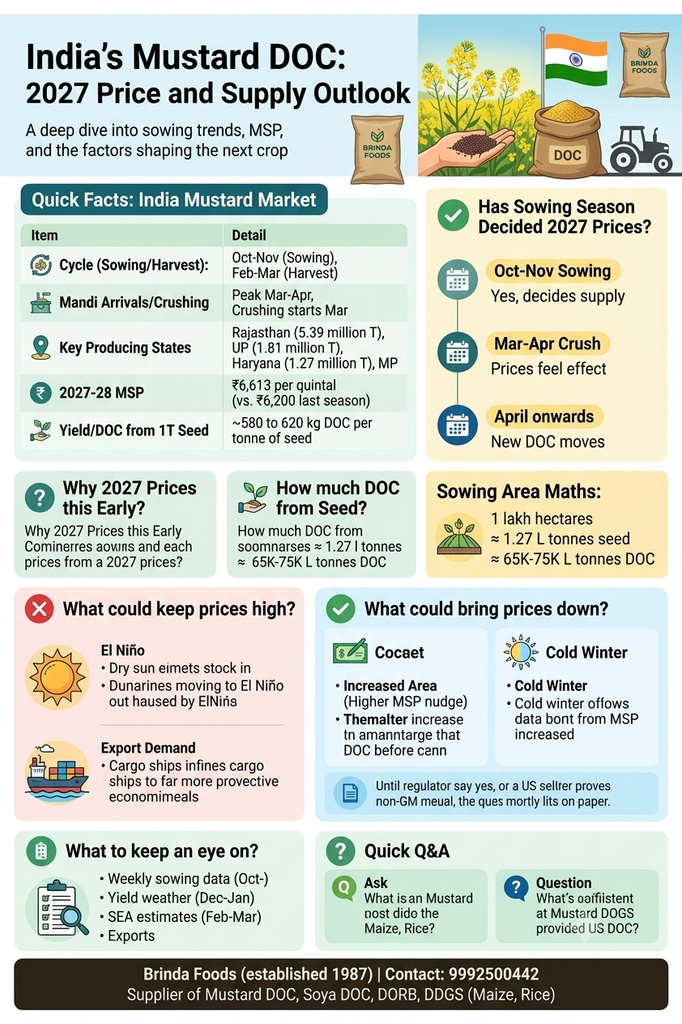
Sowing runs through October and into mid November. In parts of Haryana and UP, farmers often sow a bit late, after clearing paddy.
The crop comes off in February and March. Arrivals in the mandis peak around March and April, crushing picks up from March, and fresh DOC starts moving by the end of that month.
So roughly six months from field to feed mill. That’s the window we’re looking into.
Which states really matter?
Mostly Rajasthan.
India produced about 11.94 million tonnes of rapeseed mustard in 2025-26, as per SEA, and close to 5.39 million tonnes of that came from Rajasthan alone. UP had a good year at about 1.81 million tonnes. Haryana gave around 1.27 million tonnes. MP matters too, mainly for area.
If you run a mill in Haryana, Punjab or western UP, this works in your favour. The khal is produced practically next door, freight stays low, and that’s half the reason mustard DOC stays such good value up north.
What’s the MSP for this season’s crop?
People mix this up all the time, so let’s clear it first. Mustard sown in 2026 is sold in 2027. That puts it in the 2027-28 marketing season.
The Cabinet has fixed the MSP for that season at ₹6,613 per quintal, a jump of ₹413. Last season it was ₹6,200.
That’s a healthy hike, and farmers notice these things. It nudges more of them towards sarson instead of wheat or chana, which is great news for DOC supply. It also lifts the seed price floor though, and crushers do pass some of that on. So, more cake, but not necessarily cheaper cake.
How much DOC comes out of a tonne of seed?
Mustard seed is roughly 38 to 42% oil. Press it, run it through solvent extraction, and you’re left with around 580 to 620 kg of DOC per tonne of seed.
Not every bag of seed takes that route, mind you. Some is saved for sowing, and a fair bit goes to kachi ghani units that produce cake rather than DOC (we’ve explained mustard DOC vs mustard cake if you’re comparing the two). Across the country, about half the seed crop ends up as meal.
How does sowing area show up in prices?
Here’s the back of the envelope maths we use.
Last season, SEA put mustard at 93.91 lakh hectares with yields of about 1,271 kg a hectare. So every lakh hectare is worth roughly 1.27 lakh tonnes of seed, which turns into something like 65,000 to 75,000 tonnes of DOC.
Now say sowing ends up 5 lakh hectares higher than last year. That’s around 3.5 lakh tonnes of extra DOC hitting the market in 2027. Lower by the same amount, and that much goes missing. Either way, prices feel it for months.
What we usually see: a big, well watered crop keeps prices soft from April to June. An average crop leaves mustard DOC following soya and exports. A short crop, and prices start climbing well before the monsoon.
Area isn’t everything, of course. One warm spell during flowering and even a big acreage can underdeliver.
So what could keep prices high?
Weather is the big one this year. In late September, Agriculture Secretary Atish Chandra said El Niño could make the rabi season tough for rainfed areas, with some states facing too much moisture and drier ones facing long stretches of stress. Since a lot of Rajasthan’s mustard grows on stored moisture, this one’s worth following.
Exports matter too. Overseas buyers like Indian rapeseed meal, and in May 2026 India’s oilmeal exports rose about 18% from a year earlier to 3.73 lakh tonnes, largely thanks to rapeseed meal going to China and other Asian markets.
Then there’s soya. Soya DOC prices are still well up, so a lot of mills have moved some of their protein to mustard. In September, mustard DOC was around ₹19 to ₹25 a kilo, while soya DOC was ₹40 to ₹46. With a gap like that, demand for mustard isn’t going anywhere soon.
Anything that could bring prices down?
Yes, quite a bit actually.
Seed has been selling above support price most of this year, and now there’s a bigger MSP too. Farmers have good reason to plant more. If the kharif soybean crop takes some heat off soya DOC by year end, part of the rush towards mustard should calm down as well. We tracked that crop all season in our soybean sowing 2026 outlook.
And a properly cold winter would help more than anything. Mustard loves it.
What should you keep an eye on till March?
From mid October, the Agriculture Ministry puts out weekly rabi sowing data. Look at the rapeseed mustard number, and look at Rajasthan’s state figures too, since that’s where most of it happens.
December and January weather tells you about yield. SEA’s crop estimate usually comes out around February or March. And the monthly export numbers show how much meal is leaving.
If all of that is pointing the same way by February, you’ll know where you stand.
Lock in now, or wait?
We’d say, do a bit of both.
Book what you need for the next few months, because old crop stock tends to thin out after January. Keep some of your April to June quantity open until sowing is done and the winter looks clearer. Have another look in February when the first harvest reports are out.
Buying ahead means storing longer, so have a quick read of our guide on storing DOC without spoilage. And whatever you buy, match it to the paperwork. Here’s how to read a certificate of analysis if you need it.
Thinking of using more mustard while it’s this good value? Our complete guide to mustard DOC in animal feed covers inclusion levels for each species.
Got a question?
- When does new crop mustard DOC come in?
Late March, once crushing gets going. By April there’s plenty around.
- What’s the MSP for mustard sown this year?
₹6,613 per quintal, for the 2027-28 marketing season. It was ₹6,200 last season.
- Which state grows the most mustard?
Rajasthan, with about 5.39 million tonnes of the 11.94 million tonnes India produced in 2025-26.
- How much DOC does a tonne of mustard seed give?
Around 580 to 620 kg, depending on oil content and processing.
- Will mustard DOC be cheaper in 2027?
It could be, if sowing goes well and the winter is kind. A dry winter, strong exports or costly soya could keep it firm though.
- Can I use mustard DOC in place of some soya DOC?
In most cattle and general poultry rations, yes, within limits. It’s far cheaper right now. Just fix the inclusion with your nutritionist, because glucosinolates cap how much you can use.
Planning your protein buying for 2027?
We’ve been supplying feed raw materials from Panipat since 1987. Our Mustard DOC is lab tested and comes with spec documents on every batch, and we also supply Soya DOC, DORB, Maize DDGS and Rice DDGS.
Send us an enquiry or give us a call on 9992500442.