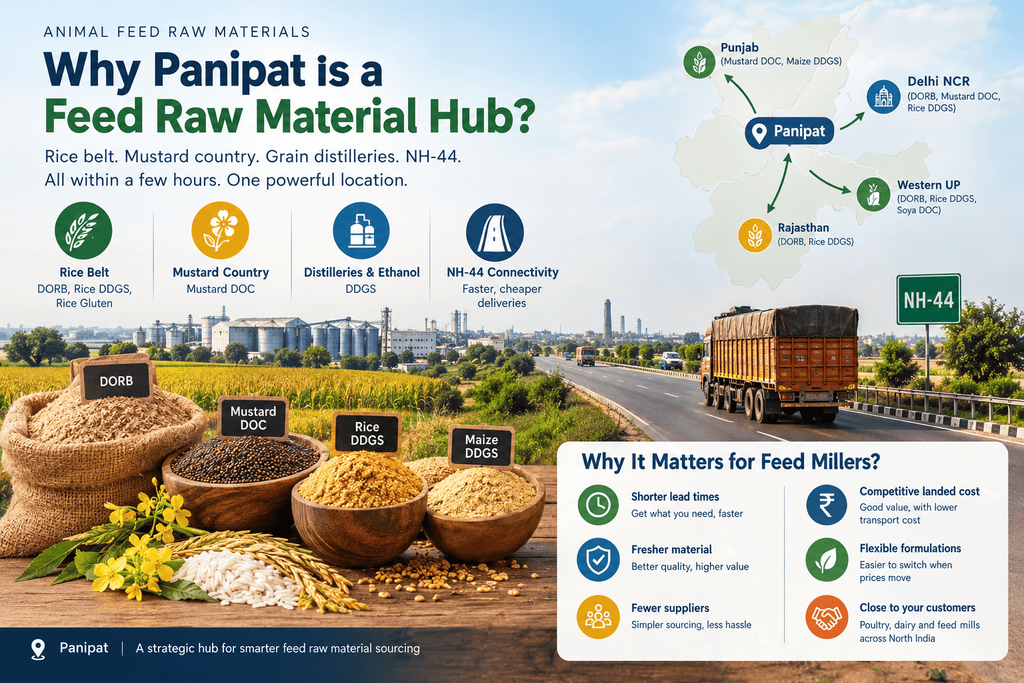
Quick answer: Panipat sits in the middle of an unusual cluster. Haryana’s basmati milling belt is on one side, the state’s high-yield mustard country is on the other, and India’s busiest north–south highway runs straight through town. Rice mills produce bran for DORB, oil crushers produce mustard cake, and grain distilleries produce DDGS, all within a few hours’ drive. Feed mills in Punjab, Delhi NCR, western UP and Rajasthan can reach all of it quickly. For a feed miller, that means shorter lead times, fresher material, and fewer suppliers to manage.
Most people know Panipat for its history, or for its blankets and home textiles. Ask a feed miller in North India, though, and you may get a different answer. For many of them, Panipat is where the trucks come from.
We have been supplying feed raw materials from GT Road, Panipat since 1987, so we have watched this change up close. What used to be a local trading town now ships bran, oil cakes and distillery co-products to compound feed plants in several states. This is not luck. It is geography, crops and infrastructure working together, and it is worth understanding if you buy raw materials at scale.
1. The Rice Belt Next Door
Start with paddy. Haryana grows some of India’s finest basmati, and the milling capacity around Panipat is huge. One state-level count listed about 1,790 rice mills in Haryana, with 350 in Karnal, 270 in Kurukshetra, 250 in Kaithal and 50 in Panipat itself. Karnal’s border is only a short drive north of Panipat. The Financial World
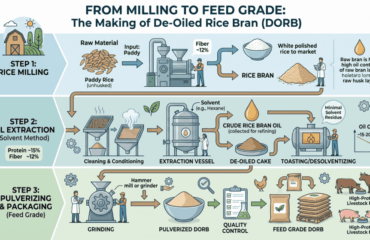
Every one of those mills produces rice bran. After the oil is extracted, what remains is de-oiled rice bran, the dependable fibre and energy ingredient in cattle and poultry rations across the country. Milling also produces broken rice, a common distillery feedstock, and that eventually comes back to the feed industry as rice DDGS and rice gluten.
In practice, a buyer sourcing De-Oiled Rice Bran from this region is buying from one of the densest bran-producing zones in India. When supply is concentrated like this, a feed mill can usually get consistent grades week after week, and it is easier to pick batches by protein and fibre specifications.
If you are budgeting for bran this quarter, our DORB price guide for 2026 explains what moves the rate per kg.
2. Mustard Country Within Reach
The second pillar is mustard. Rajasthan is still the biggest grower, but Haryana is a strong producer with an advantage on yield. The Solvent Extractors’ Association estimated Haryana’s 2025-26 rapeseed-mustard output at 1.27 million tonnes, and in the previous season the state recorded the highest productivity in the country at about 1,723 kg per hectare. Business StandardIgrain
High yields support a busy crushing sector, and every crusher produces cake. That is why Mustard DOC flows through Panipat’s trade channels in reliable volumes, and why this protein source has become so relevant for North Indian formulators this year. With soybean meal still expensive in 2026, many mills are putting mustard cake to work in their rations. Our Mustard DOC price tracker follows how those rates are moving.
3. Distilleries, Ethanol and a Growing Co-Product Stream
The third reason is ethanol. India’s blending push has increased grain-based distillation across the north, and every grain distillery produces DDGS as a co-product. Rice-based units in the Haryana and Punjab paddy belt feed a steady supply of Rice DDGS into the market, and maize-based plants add to the mix.
Panipat has also become a symbol of India’s biofuel ambitions. Indian Oil’s second-generation ethanol plant near the Panipat refinery was designed to process about 2 lakh tonnes of paddy straw (parali) a year. To be clear for feed buyers: that plant uses straw, not grain, so it does not produce feed-grade DDGS. What it shows is that Panipat’s industrial base is already built around turning farm streams into value, and grain distillation in the wider region continues to grow alongside it. We looked at the demand side of this in our piece on E20 ethanol and maize DDGS demand. Drishti IAS
4. NH-44: The Highway That Changes the Maths
Raw material is only half the story. The other half is freight.
Panipat is on NH-44, roughly 90 km from Delhi, with Karnal, Ambala and Punjab to the north. For a feed mill, freight per tonne can decide whether a “cheaper” ingredient is actually cheaper once it arrives. A truck leaving Panipat in the morning can reach mills across NCR the same day, and plants in Punjab, western Uttar Pradesh and northern Rajasthan are within easy overnight range.
Here is how that works out for buyers in different directions:
| Buyer location | Typical raw materials sourced via Panipat | Why Panipat works for them |
| Delhi NCR feed plants | DORB, Mustard DOC, Rice DDGS | Same-day delivery, smaller and more frequent lots possible |
| Punjab and Chandigarh belt | Mustard DOC, Maize DDGS | Adds to local rice products with a protein source Punjab grows less of |
| Western Uttar Pradesh | DORB, Rice DDGS, Soya DOC | Short haul across the Yamuna, competitive landed cost |
| Northern Rajasthan | DORB, Rice DDGS | Rice co-products that Rajasthan’s own crop mix does not produce much of |
| Haryana poultry and dairy clusters | Full basket | Next-door sourcing, very low transit time |
Routes and ingredient preferences vary by mill. The table shows common sourcing patterns, not fixed rules.
5. Right Next to the Customers!
A raw material hub works best when its buyers are close by, and Panipat’s are. Haryana is one of North India’s major poultry states. The Barwala belt alone is described as North India’s egg capital and the NECC benchmark for the region, and commercial layer farming is also concentrated in Ambala, Karnal, Panipat, Sonipat and Rohtak. KisanDealsToday Price Rates
Add Haryana’s strong dairy economy and the compound feed plants that serve it, and you get something useful for everyone: the ingredients are produced next to the people who need them. Poultry integrators and feed mills around Panipat can inspect a batch, compare samples and place a repeat order without waiting for material to cross half the country. For a look at who is manufacturing feed across the states, our state-by-state directory of animal feed manufacturers is a good place to start.
What a Hub Actually Gives a Feed, Miller?
Put these pieces together, and the benefits for a buyer are practical, not theoretical.
One call covers multiple ingredients. When bran, oil cakes and DDGS are all traded from one location, a mill can build a mixed consignment instead of dealing with four suppliers in four states.
Fresher material. Shorter transit means less time in hot, humid trucks. That matters most for rice bran products and DDGS, where storage conditions affect how well the material holds its specifications.
Easier substitution. When soybean meal gets expensive, formulators want alternatives quickly. Having mustard cake, rice DDGS and Maize DDGS available in one place makes it easier to rebalance a ration and move on. If you are reworking poultry diets, our explainer on why DDGS keeps appearing on poultry formulation sheets walks through the thinking, and dairy formulators may find our guide on concentrate feed for dairy cows useful.
Clearer price comparisons. With several ingredients traded side by side, it is easier to compare cost per unit of protein or energy instead of only the headline rate. Our feed raw material price comparison is built for exactly that exercise.
A Few Honest Caveats!
A hub is not a guarantee, and we would rather you hear this from a supplier than learn it the hard way.
Concentration brings variation. With hundreds of mills and crushers nearby, quality can differ a lot from one source to the next. Protein, fibre, moisture and sand content in DORB, for example, depend heavily on the mill and the extraction process. Seasonality matters too: bran supply follows the paddy milling calendar, and mustard cake availability follows the rabi harvest and crushing cycle.
The advantage of Panipat comes with a responsibility, which is testing. Ask for batch-level specifications, check moisture before you unload, and work with suppliers who will stand behind their documentation. That is how you get the benefits of the hub without its risks.
Where Brinda Foods Fits In?
We have worked from Panipat’s GT Road for nearly four decades, as a family business that grew along with this trade. Our work is simple to describe and demanding to do well: we source from this belt, test every batch, and supply feed mills and manufacturers with raw materials that match the specifications their formulations depend on. Our quality systems are listed on our certifications page.
Our role stops at the ingredient. We do not formulate your feed for you. What we can do is make sure the protein, energy and fibre sources arriving at your plant are consistent, documented and delivered on time, so your nutritionist can build on a reliable base.
Frequently Asked Questions
- Why is Panipat considered an animal feed raw material hub?
Panipat sits between Haryana’s large rice milling belt (Karnal, Kurukshetra, Kaithal) and its high-yield mustard growing areas, with grain distilleries in the wider region and NH-44 running through the city. Together, these give feed buyers easy access to DORB, Mustard DOC and DDGS from one trading base. - Which feed raw materials are most commonly sourced from the Panipat region?
De-oiled rice bran, mustard DOC, rice DDGS, maize DDGS, rice gluten and maize are the most commonly traded. Soya DOC is also available through regional trade channels, though it is mainly produced in central India. - Is buying from a regional hub cheaper than buying from the source state?
Often it is, once freight is included. The landed cost at your plant is what matters. For mills in NCR, Punjab, western UP and northern Rajasthan, Panipat’s location usually keeps transport costs and transit time low, though actual savings depend on the ingredient, the season and the lot size. - How can I check the quality of raw materials sourced from Panipat?
Ask for a batch-wise specification sheet covering protein, fat, fibre, moisture and ash, and do your own moisture check at unloading. Reliable suppliers will share test documentation and accept samples before you confirm a bulk order. - Does Brinda Foods supply outside Haryana?
Yes. We supply feed mills, compound feed manufacturers and livestock operations across India from our Panipat base. Send an enquiry with your ingredient, quantity and delivery location for a current quote.
About Brinda Foods
Brinda Foods is a family-owned animal feed raw material supplier based in Panipat, Haryana, serving the industry since 1987. We supply Maize, Soya DOC, Mustard DOC, Maize DDGS, Rice DDGS, De-Oiled Rice Bran (DORB), Maize Gluten and Rice Gluten in bulk to feed mills, dairies and poultry operations across India. ISO 9001:2015 certified.
Planning your next bulk order? Talk to our team or call 9992500442.