Every raw material delivery comes with paperwork. There’s the invoice, the weighbridge slip, the transport docs, and somewhere in that pile, a one page Certificate of Analysis.
Plenty of mills file it and move on. That’s a missed opportunity, because this small sheet decides whether the protein your nutritionist planned for is actually sitting in your warehouse.
So let’s go through a COA the way a seasoned QC person would, from the top of the page to the bottom.
So, what is a COA?
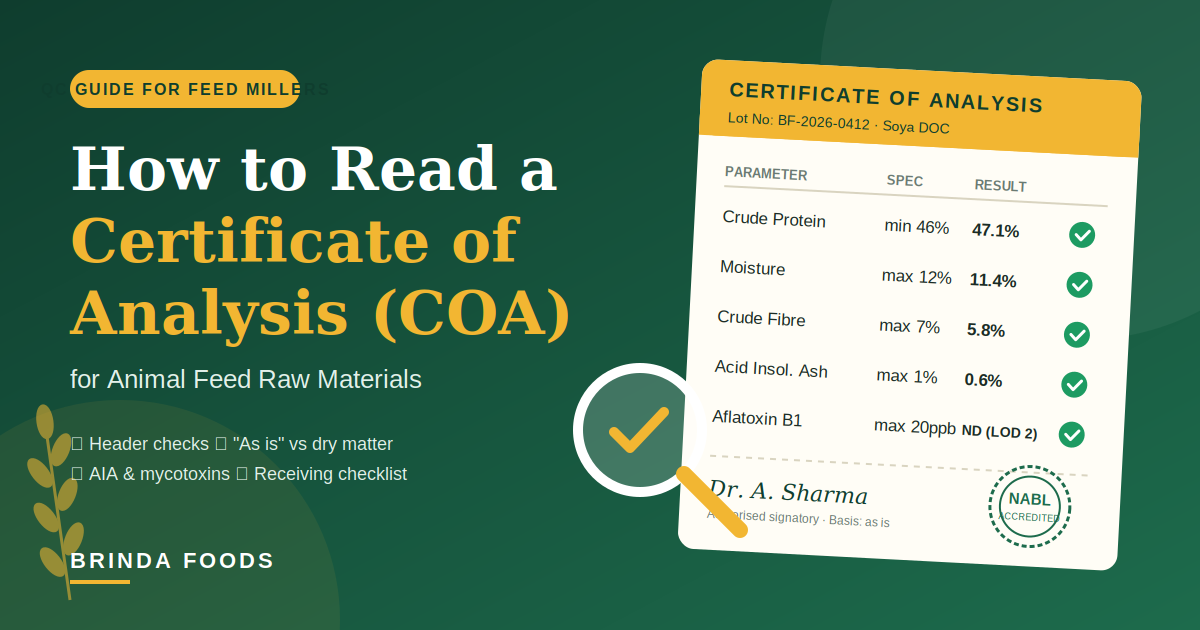
Simply put, it’s a lab report for one particular lot of material. It lists what was tested, what the results were and what limits you and your supplier agreed on.
One lot. That’s the part to hold on to. If the same COA turns up with three different trucks, you’re holding a sales sheet, and it’s fair to ask for the real thing.
Check the Top of the Page First!
Before looking at protein or moisture, spend half a minute on the header. You’d be surprised how often problems show up right here.
Does the product name match your purchase order, grade included? “Maize DDGS” and “high-protein maize DDGS” aren’t the same thing.
Is there a batch or lot number, and does it match what’s written on the truck papers or bags?
Look at the dates too. Material gets made, then sampled, then analysed. If the analysis date comes before the production date, something is off.
Then the lab. In India, NABL accreditation is what you want to see, and it’s worth checking that the tests on your sheet fall inside the lab’s accredited scope. Some labs are accredited for proximate analysis but not for mycotoxin testing.
Finally, someone should have signed it. A name and signature mean a person is standing behind those numbers.
Reading the Results Table!
Most COAs have four columns: parameter, specification, result and method.
The specification is your agreed limit, usually written as a minimum (protein min 46%) or a maximum (moisture max 12%). The result is what the lab found. Step one is just making sure each result falls on the right side of its limit.
The method column matters more than people think. Protein measured by Kjeldahl and protein measured by NIR can differ on the same sample. When you’re comparing two suppliers, check they tested the same way.
The “as is” trap!
This one catches a lot of buyers.
Results can be reported “as is”, meaning the material as it arrived, water and all. Or they can be reported on a dry matter basis, which removes the water on paper.
Say your Soya DOC shows 46% protein as is, at 12% moisture. Convert it to dry matter and you get 46 ÷ 88 × 100, which comes to about 52.3%.
Nothing changed in the bag. Only the maths did. If your formulation software works on as is values and the COA quotes dry matter, your rations will quietly drift. Always ask which basis is being used.
The Numbers Worth Your Attention!
- Moisture is where money hides. Every extra point of water is water billed at protein prices. Wetter material also moulds faster in storage, and during the monsoon that risk climbs quickly. A moisture meter at the gate pays for itself.
- Crude protein is usually the headline figure and often the pricing basis. Match it against your contract, keeping the as is question in mind.
- Crude fat tells you about energy. In a de-oiled product, low fat is normal. In DDGS, fat depends heavily on the plant it came from, so steady numbers from lot to lot count for a lot.
- Crude fibre pulls down usable energy in poultry and swine diets. If it jumps suddenly between two deliveries, give your supplier a call.
- Acid insoluble ash (AIA) is one of the most useful numbers on the sheet. Total ash covers minerals in general, but AIA points to sand, silica and soil. When AIA runs high, it usually means dilution or careless handling. Keep this one tight in your contracts.
- Mycotoxins need a careful look, especially for maize-based material. Aflatoxin should ideally be shown as B1 and total. Depending on the product, you may also want DON, zearalenone, ochratoxin and fumonisin. Compare results with your contract and with current BIS and FSSAI limits.
One small tip here. “Not Detected” only means something when the detection limit is printed alongside it. “ND (LOD 2 ppb)” tells you a story. “ND” by itself doesn’t tell you much at all.
Extra Checks by Product!
Different materials have their own telltale parameters. If these are missing, it’s perfectly reasonable to ask for them.
| Raw material | Look for |
| Soya DOC | Urease activity and KOH protein solubility, both signs of correct processing |
| Mustard DOC | Glucosinolates or allyl isothiocyanate |
| Maize DDGS | Sulphur, colour and a full mycotoxin panel |
| Rice DDGS | Fibre and AIA consistency across lots |
| DORB | Residual oil, fibre and AIA |
| Maize Gluten | Protein and xanthophyll content |
| Rice Gluten | Protein and AIA |
When a COA Looks a Little Too Good!
Real lab results are slightly messy. That’s how you know they’re real. A few things should make you look twice:
- Every figure is a neat round number
- Two different lots show identical results
- Several values sit exactly on the spec limit
- AIA or mycotoxins are simply left off
- It says “typical analysis” instead of naming a batch
- The dates don’t follow a sensible order
None of these proves anything by itself. They’re just good reasons to pick up the phone.
Trust, then check.
A COA is where quality control starts. It isn’t where it ends.
Quick gate testing with a moisture meter or NIR tells you within minutes whether the delivery matches the paperwork. Close enough? Unload. Noticeably different? Hold the lot and ask.
Keep a labelled retention sample from each delivery for the agreed period. If a question comes up three weeks later, you’ll be glad it’s there.
Every so often, send a sample to an independent lab, even for suppliers you know well. It keeps things honest on both sides.
And log your COA values in a simple sheet, supplier by supplier. Slow drift in moisture or AIA is almost invisible one truck at a time, but it jumps out on a chart.
One more thing: a result is only as good as the sample behind it. Material pulled from several bags or several points in the truck gives a far fairer picture than one scoop off the top.
A Checklist for Your Receiving Team!
Stick this near the QC desk:
☐ Product and grade match the PO
☐ Batch number matches delivery documents
☐ Dates run in a logical order
☐ Lab is named and accredited for these tests
☐ All results are within spec
☐ Basis (as is or dry matter) is mentioned
☐ Methods are listed
☐ Moisture, AIA and mycotoxins are included
☐ Product specific checks are present
☐ Gate results roughly agree with the COA
Where Brinda Foods Stands?
For us, a COA is a promise written down. Every lot we dispatch carries its own batch specific analysis, so your nutritionist can formulate with real numbers and your buying team can compare deliveries fairly. You can explore our full range of feed raw materials [link to products page].
[Add one or two lines on Brinda’s actual testing setup: which lab, which parameters are checked for every lot, and how retention samples are kept.]
Want a sample COA, or help matching specifications to your formulation? Just reach out. Our team enjoys these conversations.
Quick Answers!
- What does a COA cover in animal feed?
The test results for one specific lot of raw material, set against the agreed specification.
- Which parameters should a feed miller never skip?
Moisture, protein, fat, fibre, acid insoluble ash and mycotoxins, plus the product-specific checks in the table above.
- Why do dry matter figures look higher?
Because the water has been taken out of the calculation. The material itself hasn’t changed.
- Can I rely on the supplier’s COA alone?
Use it as your starting reference, then confirm the key numbers at your gate and through an occasional independent lab test.