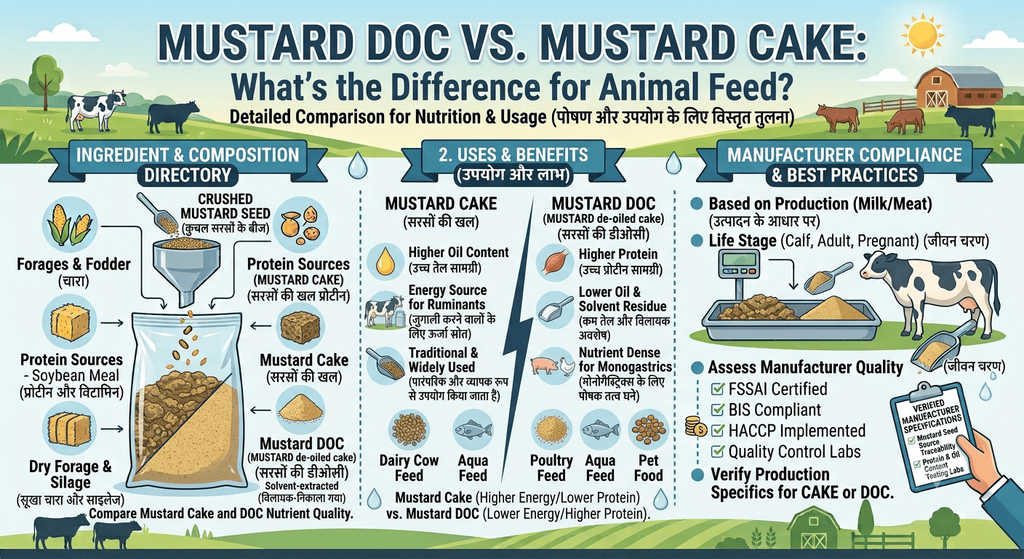
Quick answer: Both come from the same mustard seed. Mustard cake (sarson khal) is what remains after the seed is pressed in a ghani or expeller, so it still carries roughly 6 to 12% oil and around 30 to 35% crude protein. Mustard DOC goes one step further. The pressed cake is solvent-extracted, which brings residual oil below about 1.5% and lifts crude protein to roughly 35 to 40%. For a compound feed mill, DOC usually wins on batch consistency, storage life and cost per kg of protein. Cake still has its place where extra energy from oil is welcome and the material gets used fresh.
One question reaches our sales team almost every week, and it usually sounds like this:
“Your Mustard DOC rate is lower than the khal my local oil mill is selling. Is it the same product?”
Same seed, yes. Same product, no.
And the difference matters a lot more than the name on the bag. It changes your protein numbers, your energy numbers, how long the material sits happily in your godown, and what you are really paying for every kg of protein. So let’s walk through it properly.
Same seed, two very different journeys
Every tonne of mustard seed that reaches a crusher starts on the same path. What happens next decides whether it leaves as cake or as DOC.
- The cake route (pressing only)
- Seed goes into a kachi ghani or a mechanical screw expeller.
- Pressure squeezes out most of the oil, but not all of it.
- What comes out is mustard cake, often called khal or oil cake, still holding a good share of oil.
- The DOC route (pressing plus solvent extraction)
- The pressed cake travels on to a solvent extraction plant.
- A food-grade solvent pulls out almost all the remaining oil.
- The meal then passes through a desolventiser toaster, where heat drives off the solvent.
- The result is Mustard DOC (De-Oiled Cake): a drier, leaner, protein-heavy meal.
Put simply, DOC is cake that has been through one more round of processing. That one extra step changes almost everything a feed miller cares about.
Side by side: the numbers that matter at your mill
| Parameter | Mustard Cake (khal) | Mustard DOC |
| Process | Mechanical pressing (ghani or expeller) | Pressing, then solvent extraction |
| Residual oil | About 6 to 12% | About 0.5 to 1.5% |
| Crude protein | About 30 to 35% | About 35 to 40% |
| Energy | Higher, thanks to retained oil | Lower, protein-led |
| Batch to batch consistency | Varies with the press and the operator | Tighter, controlled industrial process |
| Physical form | Slabs, flakes or lumps; usually needs grinding | Free-flowing mash or small pellets |
| Storage behaviour | Shorter; oil can oxidise in heat and humidity | Longer; low oil keeps it more stable |
| Typical buyer | Local dairies, direct farm use, manure trade | Compound feed mills, integrators, exporters |
Indicative ranges. Always go by the lab report on the lot you are buying.
- Protein: why DOC reads higher on the lab sheet
Nobody adds protein to DOC. The extra percentage points come from taking something out.
Here’s a simple way to see it. Start with 100 kg of cake holding 10 kg of oil and 32 kg of protein. Pull out almost all of that oil and you are left with roughly 91 kg of meal. The protein hasn’t gone anywhere, so it now makes up a bigger share of the bag, somewhere around 35%.
That concentration effect is why DOC is the go-to choice when your formulation is chasing a protein target. You get more protein in every tonne you truck, store and mix.
- Oil: a bonus for energy, a headache in the godown
Now for the fair side of the argument. That leftover oil in cake is not waste. It carries real energy, and in ruminant rations some nutritionists are happy to count it.
The trouble starts in three places:
- Variation. One lot of khal might carry 7% oil, the next 11%, depending on the press, the seed and how hard the operator ran the machine. That swing shifts your energy value, and your formulation quietly drifts with it.
- Rancidity. Oil oxidises. In a North Indian summer or a humid monsoon month, a high-oil cake can turn stale far faster than a low-oil DOC.
- Handling. Oily cake tends to clump, stick in hoppers and resist even grinding. DOC flows and blends far more predictably in a mixer.
If your mill runs large batches and holds stock for weeks, low and steady oil is usually worth more to you than a few extra calories.
3. Glucosinolates: both carry them, processing shapes the load
Mustard belongs to the brassica family, so both cake and DOC contain glucosinolates. This is the main reason mustard products come with inclusion limits, especially in poultry and swine diets.
Processing plays a part here. The toasting stage in a solvent plant applies controlled heat, which helps deactivate myrosinase, the enzyme that converts glucosinolates into their active form. Traditional cold pressing uses much less heat, so the picture for cake can vary more from mill to mill.
The practical takeaway is simple: whichever product you buy, ask for glucosinolate data if you plan to use it in monogastric diets. For species-wise limits and formulation rules, our complete guide to Mustard DOC in animal feed lays it all out.
4. Cost per kg of protein: the comparison that actually counts
Comparing ₹ per kg of bag is where many buyers go wrong. What you are really buying is protein, so divide the price by the protein share.
Here is an illustration with round numbers:
- Mustard DOC at ₹24/kg with 37% CP works out to about ₹65 per kg of protein.
- Mustard cake at ₹28/kg with 32% CP works out to about ₹88 per kg of protein.
The cake does bring extra energy, and your nutritionist may put a value on that. Even so, when protein is the job, DOC usually comes out ahead. Marketplace listings for khal swing widely, so plug your own live quotes into the same sum. You can check this month’s Mustard DOC rates by grade before you run it.
This calculation matters even more this year. With the soy protein squeeze following the soybean meal export halt, many mills are leaning on mustard to fill part of the protein gap, and the grade you choose decides how much of that saving you actually keep.
So which one should you buy?
- Mustard DOC is usually the better fit when you:
- Run a compound feed or pellet mill with large, repeatable batches
- Need tight, predictable protein and energy values for formulation software
- Hold stock for more than a few weeks
- Blend for poultry, where specs are tighter
- Supply export buyers who expect standard documentation
- Mustard cake can still make sense when you:
- Use it fresh and locally, with short storage times
- Formulate ruminant rations where the extra energy from oil is welcome
- Buy directly from a nearby oil mill and can check each lot yourself
For most of the feed millers we work with, DOC becomes the protein workhorse in their concentrate mixes, and cake stays a local, occasional buy.
A quick buying checklist!
Before you sign off on any mustard lot, cake or DOC, ask for these in writing:
- Extraction method: expeller pressed or solvent extracted? This tells you what you are really buying.
- Crude protein: confirm it on a lab report, not just a quote sheet.
- Residual oil (ether extract): the fastest way to tell cake from DOC.
- Moisture: 10% or lower keeps storage risk in check.
- Sand and silica: under 2% is a sensible benchmark.
- Glucosinolates and aflatoxin: essential if the lot is heading into poultry or swine feed.
- A Certificate of Analysis for every lot: not one COA for the whole season.
If you are comparing several suppliers, our checklist for vetting a feed raw material supplier goes deeper.
How Brinda Foods supplies Mustard DOC?
We have been supplying feed raw materials from Panipat, Haryana, since 1987, right in the heart of India’s mustard belt. Every lot of our Mustard DOC goes through source-level quality control with approved suppliers, multi-level sampling, lab testing against nutritional specs, cross-verification with a nutrient matrix, and FIFO storage. You can view our certifications anytime.
Planning your next protein purchase? Send us your spec and our team will come back with a lab-backed quote.
FAQs
- Is mustard cake the same as Mustard DOC?
No. Both come from mustard seed, but cake is only pressed, while DOC is pressed and then solvent-extracted. DOC has much less oil and more protein.
- Is sarson khal cake or DOC?
In everyday trade, “khal” is used loosely for both. Traditionally it means pressed cake. Always ask your supplier for the extraction method and residual oil figure.
- Which has more protein, mustard cake or Mustard DOC?
Mustard DOC, typically around 35 to 40% crude protein against roughly 30 to 35% for cake. Removing the oil concentrates the protein that is already there.
- Why is Mustard DOC sometimes cheaper than mustard cake?
Solvent plants recover almost all the oil, and that oil carries its own value. The meal left behind is priced on protein alone, which often makes DOC the more economical protein source.
- Which stores better in hot or humid months?
Mustard DOC. With oil below about 1.5%, it is far less prone to rancidity than cake. Keep moisture under control and follow FIFO for either product.
- Can mustard cake go into pelleted compound feed?
It can, but the higher and more variable oil content makes grinding, blending, and energy calculations harder. Most compound feed mills prefer DOC for that reason.