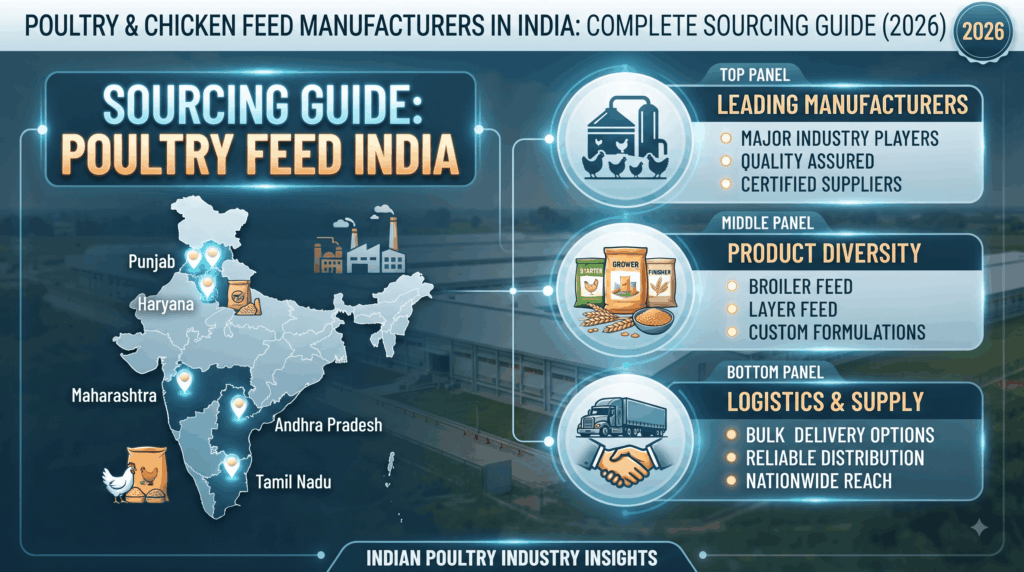
Whether you search for “poultry feed manufacturers in India” or “chicken feed manufacturers in India,” you’re looking for the same thing: a reliable source of raw material or finished feed for a broiler, layer, or breeder operation. This guide covers the size and shape of India’s poultry feed industry, where manufacturing actually concentrates by region, what a poultry ration needs nutritionally, and how to evaluate a raw material supplier — with direct links to state-by-state sourcing guides if you already know where you’re buying from.
India’s Poultry Feed Industry at a Glance
Poultry feed is the single largest segment of India’s animal feed economy, and it’s a genuinely large, growing market:
- India’s poultry feed market was valued at roughly ₹986.1 billion in 2025, projected to reach ₹1,309.1 billion by 2034.
- Poultry accounts for about 44.7% of India’s total compound feed market by animal type — larger than ruminant, aquaculture, and swine feed combined.
- India’s broader compound feed industry was valued at roughly $14.5 billion in 2025, projected to grow to $21.07 billion by 2031 at a 6.43% CAGR — with poultry as its single biggest driver.
- Within poultry feed, broiler feed holds the largest segment share, ahead of layer and turkey feed; pelleted feed leads over mash and crumble, and offline/direct distribution still significantly outpaces online sales.
- Formalization is a visible trend: government schemes like the Animal Husbandry Infrastructure Development Fund (AHIDF) have already backed 372 registered feed manufacturing facilities across the country, alongside a much larger base of smaller and unregistered mills.
For a raw material supplier, that combination — a large, broiler-led market that’s still consolidating — is exactly why “poultry feed manufacturers” and “chicken feed manufacturers” are both real, high-volume search terms: buyers are actively searching for suppliers as the industry formalizes and scales.
Where India’s Poultry Feed Manufacturing Concentrates
Poultry feed demand isn’t evenly spread — it clusters around a handful of regional hubs, each shaped by different agricultural and infrastructure advantages:
| Region | Leading states | Why it leads |
|---|---|---|
| North India | Uttar Pradesh, Punjab, Haryana, Delhi-NCR | India’s largest feed-consuming region overall — dense dairy cooperative infrastructure in UP, strong broiler integration in Punjab, and Delhi-NCR as the region’s demand and distribution hub |
| West India | Maharashtra, Gujarat | The fastest-growing region (7.18% CAGR) — Maharashtra is the single largest regional poultry feed market in India; Gujarat adds fast-growing aquafeed demand alongside poultry |
| South India | Tamil Nadu, Karnataka, Andhra Pradesh, Telangana | Balanced, high-volume demand across poultry and aquaculture, anchored by Telangana/Andhra Pradesh’s combined ~33% share of India’s egg production and Tamil Nadu’s integrated broiler sector |
| East India | West Bengal, Odisha, Bihar, Jharkhand, Assam, Chhattisgarh | Currently lags in feed-industry formalization due to fragmented landholdings, but shows real and growing demand, particularly in West Bengal |
If you already know your state, jump straight to a dedicated sourcing guide: Haryana · Punjab · Tamil Nadu · Hyderabad · Kerala · Delhi-NCR
What Poultry and Chicken Feed Rations Need Nutritionally
Regardless of region, broiler, layer, and breeder rations across India are built around the same core raw material categories:
| Raw material | Crude protein | Role in the ration | Where it fits |
|---|---|---|---|
| Soya DOC | 44–48% | Primary plant protein source | Core protein base in broiler and layer rations nationwide |
| Maize DDGS | 28–32% | Protein-energy supplement | Cost-effective, practical partial substitute for soybean meal |
| Rice DDGS | Variable, typically 25–30% | Cost-effective protein-energy alternative | Blended to manage feed cost, especially where maize supply is tight |
| De-Oiled Rice Bran (DORB) | Moderate protein, high energy/fibre | Cost-effective bulking and energy | Managing overall ration cost across broiler and layer formulations |
Actual inclusion levels should always be set against your specific formulation software and target performance metrics rather than a flat percentage — talk to your nutritionist about the right level for your flock and region.
What to Look For in a Poultry Feed Raw Material Supplier
Whether you’re a large integrated poultry company or an independent feed mill, the evaluation criteria are largely the same across India:
- Consistent, scalable supply capability — a supplier who can grow with your operation, not just fulfill a one-time order.
- Certificate of Analysis (COA) on every batch, not just at onboarding.
- Certifications relevant to formal, large-scale procurement — ISO 9001:2015, HACCP, and CLFMA membership.
- Mycotoxin-controlled processing and storage — poultry’s higher aflatoxin sensitivity makes this a non-negotiable check, particularly through the monsoon season.
- Reliable logistics into your region — transit time and consistency matter more the further you are from the grain-processing belt.
- Transparent, commodity-linked pricing that visibly tracks the underlying market.
More detail in Cattle Feed Ingredients & Quality Standards and How to Choose a Feed Raw Material Supplier in India.
Brinda Foods: Pan-India Raw Material Supply for Poultry Feed Manufacturers
Brinda Foods (Brinda Feeds Private Limited) is based in Panipat, Haryana, and supplies feed millers, integrators, and poultry operations across every major region covered above — North, West, South, and East India. Core raw materials supplied include:
- Soya DOC — 44–48% crude protein, primary layer/broiler protein source
- Maize DDGS — 28–32% crude protein, COA-confirmed on every batch
- Rice DDGS — cost-effective protein-energy alternative
- De-Oiled Rice Bran (DORB) — energy and bulking component
As a veterinarian with an MVSc in Animal Nutrition from NDRI Karnal, I’ve built our quality frameworks around a simple principle: feed performance is decided at the raw material stage, before it ever reaches the mixer. That standard doesn’t change whether the order is going to a broiler integrator in Maharashtra, a layer operation in West Bengal, or a feed mill in Punjab. Learn more on our About Us page, review our certifications, or connect via my author page.
How Pan-India Bulk Supply Works
- Specification alignment — confirming protein, fibre, and moisture targets against your broiler, layer, or breeder formulation.
- Sample and COA review — verifying batch quality before committing to volume.
- Bulk order and freight coordination — rail and road freight from Panipat reaches every major poultry-feed region in the country; see your state’s dedicated guide for region-specific logistics detail.
- Standing supply agreement — most high-volume buyers move to a scheduled or standing order once quality is verified across a few shipments.
FAQs
What is the difference between “poultry feed manufacturers” and “chicken feed manufacturers” in India? None functionally — both terms describe the same category of business: companies that manufacture or supply feed and feed raw material for broilers, layers, and breeders. “Poultry feed” is the industry-standard term; “chicken feed” is the more common everyday phrasing for the same thing.
Does Brinda Foods supply poultry feed raw material across India? Yes. Brinda Foods supplies bulk Soya DOC, Maize DDGS, Rice DDGS, and DORB to feed millers and poultry integrators across North, West, South, and East India, from our Panipat, Haryana facility.
How big is India’s poultry feed industry? India’s poultry feed market was valued at roughly ₹986.1 billion in 2025, projected to grow to ₹1,309.1 billion by 2034. Poultry accounts for about 44.7% of India’s total compound feed market by animal type — the largest single segment.
Which Indian state has the largest poultry feed market? Maharashtra is currently the single largest regional poultry feed market in India, followed by Tamil Nadu, Uttar Pradesh, Gujarat, Karnataka, and West Bengal.
How much DDGS or DOC can go into a poultry ration? Inclusion levels should be set against your specific formulation software and target performance metrics rather than a flat percentage — talk to your nutritionist about the right level for your flock.
What certifications should a poultry feed manufacturer look for in a raw material supplier? ISO 9001:2015, HACCP certification, CLFMA membership, and a documented batch-level COA process. See our certifications page.
How do I request pricing for bulk poultry feed raw material? Request a quote or contact our team with your required product, specification, and delivery location.
Sourcing raw material for a poultry or chicken feed operation anywhere in India? Request a quote from Brinda Foods today.