Quick answer: For most mills, Soya DOC. It has nearly double the lysine of groundnut cake (around 2.8% against 1.6%) and far less aflatoxin trouble. Groundnut cake isn’t a bad ingredient, though. Protein is about the same, 40 to 48%, and cattle eat it happily. At October 2026 prices it even works out roughly ₹13 cheaper per kg of protein. The catch is lysine, where it ends up about 50% dearer, and aflatoxin, where no common cake in India has a worse record. My advice: keep Soya DOC as the base for broilers and layers, and bring groundnut cake into adult dairy rations only when the lot has been tested and the price gap is worth it.
Every year, right around Diwali, the phone starts ringing with the same question. New groundnut has come into the mandis, Gujarat crushers are sending offers, and the rate sheet makes groundnut cake look like a steal next to Soya DOC. The protein figure on the bag is nearly identical. So what’s stopping you?
Honestly, nothing, if crude protein were the whole story. It isn’t. A formulator has to ask how much of that protein the bird or cow can actually use. Then, which amino acid will run out first. And with groundnut cake there’s a third question that matters more than the other two: what else came in on that truck?
Let me walk through it in the order I’d look at it myself.
How do crude protein and lysine compare?
Protein is close to level. Lysine is not. And in a maize heavy ration, lysine is almost always what runs short first.
| Parameter | Groundnut cake (solvent extracted) | Soya DOC |
| Crude protein | 40 to 48% | 44 to 48% |
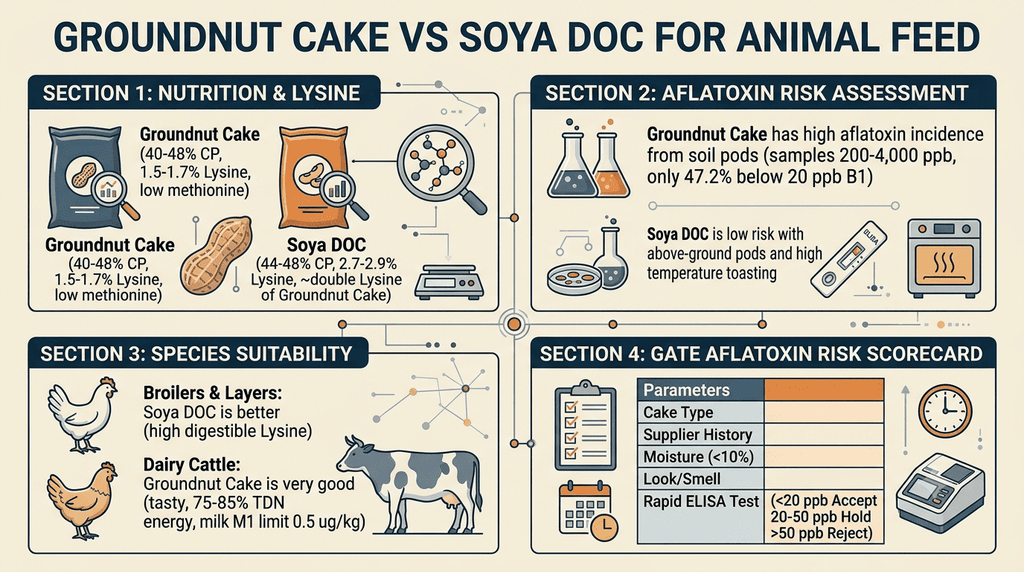
| Lysine (as fed, typical) | About 1.5 to 1.7% | About 2.7 to 2.9% |
| Lysine as % of protein | About 3.5% | About 6% |
| Methionine | Low | Low (topped up in most feeds) |
| Arginine | Very high | High |
| Residual oil | 0.5 to 0.7% (expeller cake 6 to 8%, ghani cake 10 to 12%) | 1 to 2% |
| TDN for cattle | 75 to 85% | About 75 to 80% |
| Palatability | Excellent | Very good |
| Main quality risk | Aflatoxin, rancidity in oily cakes, husk | Under or over toasting (urease, protein solubility) |
I’ve taken the groundnut cake protein, oil and TDN numbers from the NDDB Dairy Knowledge Portal. It also flags the cake as short in lysine, methionine and tryptophan. Feedipedia calls it the go-to protein meal in places where soybean meal costs too much. The Soya DOC figures are standard trade values, and if you want the longer version of why soya is treated as the reference protein, it’s in our piece on the benefits of Soya DOC in animal feed.
So what jumps out?
Lysine, first. Kilo for kilo, groundnut cake gives you only a bit more than half of what soya does. Yes, you can top it up with L-lysine HCl. Just remember to put that bag’s cost into your comparison too, because it’s part of the real price.
Second, “groundnut cake” can mean very different things. A ghani cake from a village expeller and a solvent extracted meal from a large plant can be 10 points apart on oil. Protein moves too. Ask the seller exactly which one he’s quoting before you compare rates.
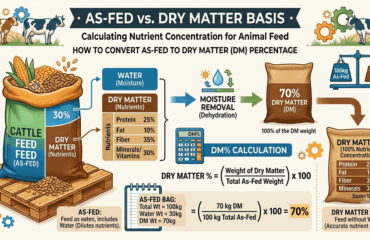
Third, check whether your lab reports are on dry matter or as fed. I’ve seen buyers compare one of each and draw the wrong conclusion. Convert them to the same basis first.
Why is groundnut cake the highest aflatoxin risk cake?
The trouble begins in the soil. Groundnut pods grow underground, in heat, and most of the crop is dug, dried and stored by small farmers with whatever facilities they have. That gives the aflatoxin mould a lot of opportunities. Crushing doesn’t destroy the toxin. If anything, it ends up more concentrated in the cake.
This isn’t a new finding. An ICAR survey of Indian feeds and ingredients found groundnut cake had the highest aflatoxin incidence of everything tested, worse than maize, with positive samples anywhere from 200 to 4,000 ppb. A later national study on cattle feed raw materials, indexed by FAO AGRIS, found that only 47.2% of groundnut cake samples came in below 20 ppb aflatoxin B1. In the west zone, close to 45% were above 100 ppb.
Here’s something many buyers don’t know. IS 3441, the BIS standard for solvent extracted groundnut oilcake as a livestock feed ingredient, was drafted without an aflatoxin limit in it. So effectively, your limit is whatever you put in your own purchase spec.
Soya DOC can have problems too, of course. But soybean pods grow above ground, and the meal goes through high temperature toasting, so you very rarely see numbers like the ones above. The way I’d put it: you test Soya DOC to confirm it’s fine. You test groundnut cake to find out whether you can use it at all.
Most Indian mills borrow the US FDA action levels: 20 ppb for dairy animals and young stock, 100 ppb for laying hens and breeders, 300 ppb for finishing beef cattle. Europe allows 20 ppb aflatoxin B1 in complete feed. If you want the storage and binder side of this, plus what changed with BIS this year, our monsoon mycotoxin guide goes into it.
Which is better for broilers and layers?
Soya DOC, by a long way. Poultry feed is formulated on digestible amino acids, and a broiler’s lysine requirement is high. Groundnut cake is weak exactly where the bird needs it most, and young birds are also the class with the strictest aflatoxin limits.
Still, it can play a small part. In pre starter and starter, I’d keep it out entirely, or nearly so, since a 20 ppb limit is normal at that stage. In finisher feed you have a bit more room, provided the lot tests clean, the price difference is large, and you rebalance lysine, methionine and threonine. Layer feed follows similar logic. The FDA level for laying hens is higher, but careful mills still buy to 20 ppb, and a fresh solvent extracted lot can take over part of the Soya DOC later in the laying cycle.
Whatever the species, run the formula on digestible lysine and not on crude protein. Otherwise the switch will look cheaper on paper than it turns out to be.
Our broiler feed formula article shows how small ingredient changes end up moving FCR. And if you’re looking at other partial substitutes for soya, the DDGS vs Soya DOC vs Mustard DOC vs DORB comparison puts them all on one page.
Which is better for dairy cattle?
This is where groundnut cake shines. For a grown cow or buffalo, it’s honestly a very good protein. Rumen microbes produce most of the amino acids the animal uses, so the lysine shortfall hardly matters the way it does for poultry. Cattle like the taste, it carries good energy, and in Gujarat and the southern states it has been a feed staple for generations.
For dairy, then, the decision is mostly about price and how strict your testing is.
Watch the milk. Aflatoxin B1 eaten by the cow can show up in the milk as M1, and FSSAI’s limit for M1 in milk is 0.5 µg/kg. Dairy cooperatives know this, which is why most of them hold feed to 20 ppb. A cheap lot that puts the milk at risk isn’t really cheap.
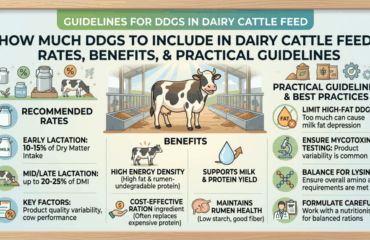
Don’t push the inclusion too high either. NDDB notes a laxative effect when groundnut meal goes beyond about 25% of the diet. Calves are a separate case altogether. They’re much more sensitive than adult cattle, so calf starter should stay on Soya DOC.
Blending is the sensible middle path. Mix groundnut cake with Soya DOC or Mustard DOC and you bring down the aflatoxin load of the final feed. You also aren’t caught out when one cake gets scarce.
Considering cottonseed cake for the same ration? The binola khal guide covers gossypol and safe levels. For where oilcakes sit in the full mix, see our guide to concentrate feed for dairy cows.
How do you compare cost per unit of protein?
It’s simple. Take the price per kilo and divide it by the nutrient content, written as a fraction (0.45, not 45). Do it once for crude protein and once for lysine. Quite often the two answers disagree, and that’s exactly what you want to see.
| October 2026 (midpoints) | Groundnut cake | Soya DOC |
| Price used (₹/kg) | 36 | 43 |
| Crude protein used | 45% | 46% |
| Cost per kg crude protein (₹) | 80 | 93.5 |
| Lysine used | 1.6% | 2.85% |
| Cost per kg lysine (₹) | 2,250 | 1,509 |
For Soya DOC I’ve used the middle of the ₹40 to 46 range from our Soya DOC price tracker for 2026. Groundnut extraction is all over the place this season, roughly ₹25 to ₹50 a kilo depending on grade and quantity (IndiaMART), so ₹36 is just a reasonable middle. Put your own quotes in.
On crude protein, groundnut cake comes out about ₹13.5 cheaper per kilo of protein. It stays ahead as long as you’re paying less than roughly ₹42 a kilo for it. On lysine, the picture flips: it’s about 50% more expensive, and only draws level with soya below about ₹24 a kilo.
What does that mean in practice? For poultry, where lysine sets the formula, groundnut cake seldom earns its place unless the gap is really wide. For dairy, where protein and energy count for more, today’s prices can genuinely make it worthwhile.
Before you sign, add two more costs on the groundnut side. Testing, for one, and that means every lot, not only the first truck. And risk: the chance of rejecting a load, or the binder you add just in case. You won’t see either on the invoice, but you’ll pay for both.
How should you score aflatoxin risk at the mill gate?
The lab has the final say, but results take time, and the truck is standing at your gate now. A quick score at intake helps you decide what to hold, what to test first, and what to turn back. Give each factor 0, 1 or 2 points.
| Factor | 0 points | 1 point | 2 points |
| Cake type | Solvent extracted, large plant | Expeller | Ghani or unknown source |
| Supplier history | Clean results on file | New supplier | Past rejections |
| Moisture at intake | Under 10% | 10 to 12% | Above 12% |
| Look and smell | Even colour, fresh nutty smell | Some lumps | Greenish or grey patches, musty smell |
| Age since crushing | Under 30 days | 30 to 60 days | Over 60 days, or stored through monsoon |
| Rapid test (ELISA strip) | Under 20 ppb | 20 to 50 ppb | Above 50 ppb |
A total of 0 to 3 means accept, keep a sample, and send it for the usual lab test. Between 4 and 6, hold the lot. Accept it only once the full lab report is in, and send it to adult ruminant feed only. If the score reaches 7, or the rapid test alone scores 2, send the truck back.
Tighten or loosen these cut offs to suit your own spec. Obviously a poultry starter line needs to be stricter than a dry cow concentrate.
One warning, though. Any score is only as reliable as the sample behind it. Aflatoxin tends to sit in pockets, so pull samples from bags across the entire load, the way our truck sampling procedure describes. Then compare your result against the supplier’s paperwork. Our note on reading a certificate of analysis tells you what to check. Once a lot is in, keep it dry and use it in order, as covered in our storage steps for Soya DOC and other meals.
Where in India is each cake most available?
Each cake is cheapest near the plants that crush it. Freight easily adds a couple of rupees per kilo, so very often location settles the question before nutrition even enters it.
| Groundnut cake | Soya DOC | |
| Main crushing belts | Saurashtra in Gujarat (Rajkot, Junagadh, Jamnagar), Andhra Pradesh, Tamil Nadu, Karnataka, parts of Rajasthan | Madhya Pradesh (Indore, Ujjain), Maharashtra (Latur, Vidarbha), Kota region of Rajasthan |
| Fresh crop arrives | October to December (kharif), smaller rabi crop in spring | October to December |
| Best fit by buyer location | Feed mills in Gujarat and the south | Mills across central and north India |
| North India (Haryana, Punjab, UP) | Travels a long way, so freight and age add up | Moves in steadily from MP plants |
Up north, in Haryana, Punjab and western UP, most mills end up pairing Soya DOC with Mustard DOC crushed nearby. Groundnut cake only really works here when the price difference is big enough to pay for the freight and the extra testing. Our feed raw material buying calendar shows, month by month, when each ingredient is easiest to get.
Frequently asked questions!
- Is groundnut cake better than Soya DOC for animal feed?
Not as a general rule. Soya DOC carries nearly twice the lysine and much less aflatoxin risk, which makes it the better choice for poultry and young animals. For adult dairy cattle, groundnut cake is a good, tasty protein, as long as the lot tests clean and the price makes sense. - Which has more protein, groundnut cake or Soya DOC?
There’s very little in it. Solvent extracted groundnut cake runs about 40 to 48% crude protein and Soya DOC about 44 to 48%. Where they really differ is lysine, roughly 1.6% in groundnut cake compared with about 2.8% in Soya DOC. - Can groundnut cake be used in broiler feed?
A little, mostly in finisher feed. Leave it out of pre starter and starter, add synthetic lysine, and only take lots tested below 20 ppb aflatoxin. - What aflatoxin limit should I set for groundnut cake?
Most Indian buyers go with 20 ppb for dairy, calves and young poultry, matching US FDA and EU levels. Older birds and finishing stock can handle more, but buying to 20 ppb keeps every option open. - When is groundnut cake cheaper than Soya DOC?
At October 2026 rates, it’s cheaper per kg of crude protein when it’s under about ₹42 a kilo. For lysine, it only matches Soya DOC below about ₹24 a kilo. - Can I mix groundnut cake and Soya DOC in one ration?
Yes, and for dairy feed that’s often the best approach. A blend brings down the aflatoxin load, keeps the feed tasty, and protects you if one supply gets tight.
Build your protein base on consistent supply!
Brinda Foods has been supplying feed raw materials from Panipat since 1987. Every lot of Soya DOC and Mustard DOC is checked for protein, moisture and quality before it leaves us, so the formula that works this month keeps working next month. Share your volume and location through our bulk enquiry form, or call 9992500442 for today’s rate.
If the score is still high, the biggest gain usually comes from adding one or two real details only Dr. Rishabh can give, like a specific lot he rejected or what Haryana buyers actually pay. Tell me those and I’ll work them in. The doc still holds the earlier version, so say the word if you’d like this one saved there too.