
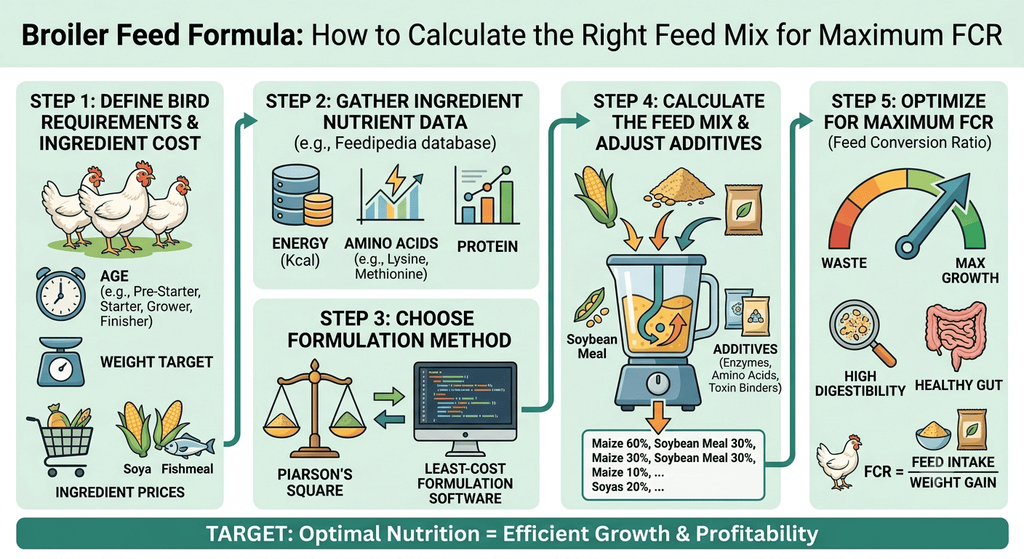
Ask ten feed millers what their biggest headache is and nine will say the same thing. The formula on paper looks perfect, the lab report comes back fine, and yet the FCR the integrator reports back is two points off where it should be.
Usually nothing dramatic has gone wrong. A moisture reading drifted. A maize lot came in lighter than the last one. The oil percentage got trimmed to protect margin during a price spike. Small things, and they add up quickly when you are producing 40 tonnes a day.
So let us walk through how a broiler mix actually gets built, where the FCR leaks happen, and what to check before a consignment goes into the bin.
First, what FCR is really measuring!
Feed conversion ratio is simple arithmetic:
FCR = Total feed consumed (kg) ÷ Total live weight gain (kg)
A flock that eats 3,400 kg of feed and puts on 2,150 kg of body weight is running an FCR of 1.58. Lower is better, because it means less feed is buying the same kilo of bird.
Two things worth adding to that number before you compare anything:
- Adjusted FCR. Birds harvested at 2.2 kg will always show a poorer ratio than birds harvested at 1.8 kg, because maintenance cost climbs with age. Correct to a standard weight before you judge one batch against another.
- Cost per kilo of gain. This is the figure that actually decides profitability. A formula can post a beautiful FCR and still lose money if you bought your way there with expensive oil and synthetic amino acids. Track feed cost per kg of gain alongside the ratio, always.
For millers, that second number is the one to put in front of a customer. It reframes the conversation away from rate per tonne and towards what the ration delivers.
The three phase structure!
Broilers do not eat one feed for 42 days. Their nutrient demand shifts sharply as they grow, and a formula that ignores that will either waste protein early or run out of energy late.
Here is the working range most Indian mills build around. Always cross check against the breed guide your customer is following, since Cobb and Ross specs differ slightly.
| Parameter | Pre starter / Starter (0 to 10 d) | Grower (11 to 24 d) | Finisher (25 d onward) |
| ME (kcal/kg) | 2,950 to 3,000 | 3,050 to 3,100 | 3,150 to 3,200 |
| Crude protein (%) | 22 to 23 | 19.5 to 21 | 18 to 19 |
| Digestible lysine (%) | 1.28 to 1.32 | 1.12 to 1.18 | 1.00 to 1.05 |
| Digestible Met + Cys (%) | 0.94 to 0.98 | 0.84 to 0.88 | 0.76 to 0.80 |
| Calcium (%) | 0.95 to 1.00 | 0.85 to 0.90 | 0.78 to 0.82 |
| Available phosphorus (%) | 0.45 to 0.48 | 0.42 to 0.44 | 0.38 to 0.40 |
The pre starter is where the most expensive nutrients sit, and it is also the phase mills are most tempted to economise on. Resist that. Early frame development sets the trajectory for the whole cycle, and the volume involved is small enough that the saving is barely visible on the cost sheet.
Building the formula, step by step
1. Fix your energy level first
Energy is the anchor. Set metabolisable energy for the phase, then build everything else around it. Maize does most of this work in Indian formulations, typically at 55 to 62% of the mix, supported by vegetable oil to lift the final few hundred kilocalories.
2. Balance on digestible amino acids, not crude protein
This is the single biggest step up a mill can make. Crude protein is a nitrogen estimate. It tells you nothing about whether the bird can actually use what is in there.
Formulate to digestible lysine first, then set methionine, threonine and tryptophan as ratios against it. The ideal protein approach lets you run crude protein one to two points lower while holding performance, and that saved protein is straight margin.
3. Pick your protein carriers
Soya DOC remains the backbone at 25 to 32% depending on phase, mostly because its amino acid profile is hard to match. When soya prices run hot, which they have done repeatedly through 2026, the usual moves are partial substitution with maize DDGS, rice DDGS or mustard DOC, with amino acid top up to close the gaps. We covered the substitution maths in detail in our piece on the soybean meal price surge.
4. Set ceilings on the fibrous co-products
Byproducts earn their place on cost, but every one of them has a point past which FCR starts drifting. Sensible working ceilings for broilers:
- Maize DDGS or rice DDGS: 5 to 8% in grower and finisher, lower in starter
- De oiled rice bran: 3 to 5%, kept modest because of the fibre load
- Mustard DOC: 4 to 5%, watching glucosinolate levels
- Maize gluten: 3 to 5%, useful for pigment and protein together
Push past these and you are diluting energy density faster than you are saving rupees.
5. Close out with minerals, premix and enzymes
DCP and limestone settle calcium and phosphorus. Phytase releases a chunk of the phytate bound phosphorus, which lets you trim DCP. NSP enzymes help when the fibrous inclusions are on the higher side. Salt, sodium bicarbonate, a toxin binder and the vitamin mineral premix finish the sheet.
A worked grower example
Illustrative only, per 100 kg. Run your own numbers in your least cost software against current rates and your actual COA values.
| Ingredient | kg |
| Maize | 58.0 |
| Soya DOC (46% CP) | 28.0 |
| Maize DDGS | 5.0 |
| De oiled rice bran | 3.0 |
| Vegetable oil | 2.5 |
| DCP | 1.3 |
| Limestone | 1.0 |
| Salt | 0.35 |
| DL Methionine | 0.25 |
| L Lysine HCl | 0.15 |
| Vitamin mineral premix | 0.25 |
| Toxin binder | 0.10 |
| Enzyme blend | 0.10 |
| Total | 100.00 |
That lands at roughly 19.6% crude protein and around 3,020 kcal/kg ME. To reach the upper grower energy target, you would lift oil to about 3% and pull maize back to compensate. Which direction you go depends entirely on the oil to maize price ratio that week.
Where does FCR quietly leak?
Most formula failures are not formula failures at all. They are raw material failures. Four decades of loading trucks out of Panipat has made this very clear to us.
- Moisture. A soya DOC lot at 13.5% moisture instead of 11% means you paid for water and shorted the bird on protein. Moisture is a financial KPI, not a lab formality.
- Protein variability. DDGS from different plants can swing several points. If you formulate on a book value rather than the COA in front of you, the ration is wrong before it reaches the mixer.
- Aflatoxin. Maize and its co-products carry the risk, and monsoon lots need tighter scrutiny than summer ones.
- Sand and silica in rice bran. The old adulteration trick, and still the most common one. Ash testing catches it.
- Fat quality. Rancid oil or high free fatty acid levels pull energy value down below what your matrix assumes.
- Mixer performance. A coefficient of variation above 10% means some birds are eating a different formula from the one you designed. Worth a check twice a year.
- Pellet durability. Fines mean selective feeding and wasted feed. A PDI above 90 is a reasonable target.
Every one of these is solvable with routine COA verification and a supplier who sends you the same material twice in a row.
Frequently asked questions!
- What is a good FCR for broilers in India?
Commercial flocks typically run between 1.55 and 1.70 at around 42 days, depending on breed, season and management. Cooler months generally read better than peak summer. - Can I use one formula for the whole cycle?
You can, but it costs you. A single ration either overspends on protein in the finisher phase or underdelivers energy in the starter. Three phases is the practical minimum, and many larger integrators run four. - How much soya DOC goes into broiler feed?
Broadly 25 to 32%, higher in starter and tapering through finisher. The exact figure depends on your other protein sources and your digestible lysine target. - Does switching to DDGS hurt FCR?
Not at sensible inclusion levels with the amino acid profile corrected. The variable that matters is consistency of the DDGS lot, which is why COA-backed supply is worth paying for. - What is the fastest way to improve FCR without raising feed cost?
Move from crude protein balancing to digestible amino acid balancing, and tighten your raw material verification. Both are process changes rather than spending changes.
Where does Brinda Foods fit in?
We do not formulate your rations. Your nutritionist does that and does it better than anyone outside your mill could.
What we do is make sure the inputs behind that formula behave predictably. Brinda Foods has supplied feed raw materials out of Panipat since 1987: Soya DOC, Maize DDGS, Rice DDGS, De Oiled Rice Bran, Mustard DOC, Maize Gluten and Rice Gluten, with a lab tested COA on every batch and pricing that tracks the underlying market rather than hiding behind per shipment markups.
When the material matches the matrix values in your software, the FCR your customer reports back starts matching the one on your sheet. That is the whole job.
Planning your next quarter’s raw material schedule? Talk to our team about specifications, sample review and delivery timelines.

[…] Another change. Buyers don’t just ask for the rate anymore. They ask about consistency. And they should. A slightly wet load here, a protein drop there, and suddenly the integrator is on the phone asking why FCR slipped. It’s almost never one big thing. We’ve written about this in our broiler feed formula guide. […]