Quick answer: Bypass protein is protein that a cow’s rumen can’t quite break down, so it carries on to her small intestine and she digests it there herself. You’ll see it written as RUP, which stands for rumen-undegradable protein. Cows milking around 15 litres and above can’t get by on rumen-made protein alone, and that’s where it comes in. Among everyday ingredients, maize DDGS and maize gluten meal are full of it. Soya DOC, not so much, unless someone has heat treated or formaldehyde treated it first.
A mill owner from Karnal rang us a while back, slightly puzzled. One of his dairy buyers wanted “bypass feed” and he had no clear idea what was meant to go into it. Honestly, we get that call a lot! The word floats around the trade with very little said about what it actually means. So this is our go at explaining it properly.
What is bypass protein in dairy cattle feed?
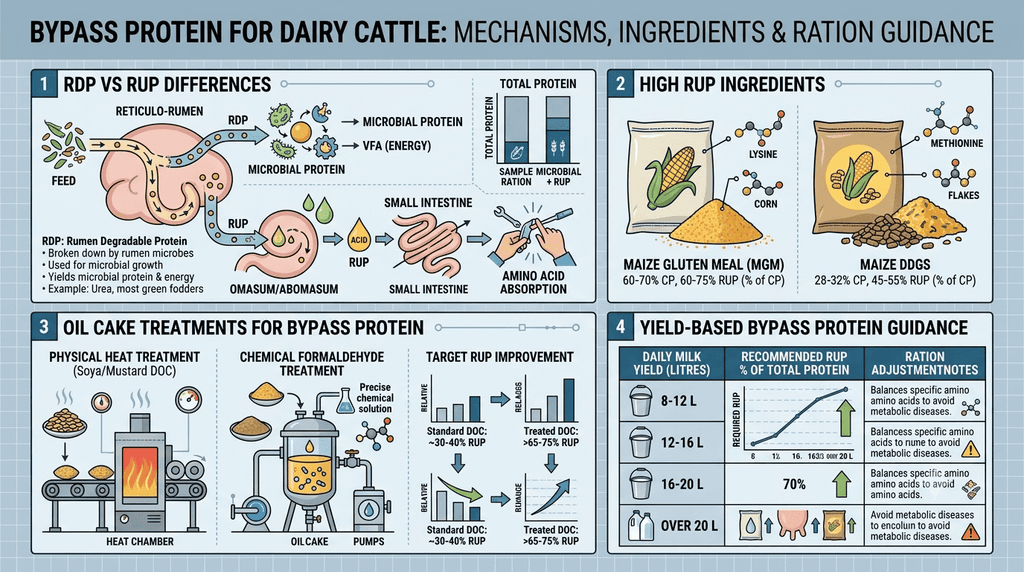
Most people assume the cow digests her own feed. Not quite, or at least not first. Her rumen microbes get there before she does. Whatever goes down her throat lands in that big fermenting vat, and the bacteria and protozoa living in it go straight for the protein. They break a good share of it down into ammonia and peptides and grow on that. Further along, the microbes themselves get washed down the gut, and that’s when the cow finally digests them. She does get the protein back in the end, only secondhand and a little short.
Some protein won’t budge so easily. It’s tucked inside fibre, or folded up tight, or it’s been cooked so hard in a plant dryer that the microbes don’t bother with it. That protein drifts out of the rumen pretty much as it went in. The cow deals with it lower down, in the abomasum and small intestine, the way a pig might. And that, really, is all bypass protein is.
If you want a one-liner to remember: RDP feeds the bugs, RUP feeds the cow. There’s a bit more background on protein in compound feed in our post on the role of protein-rich ingredients in animal feed manufacturing.
What is the difference between RDP and RUP?
You can’t pick one over the other. A dairy ration needs some of each, and the table shows why.
| RDP | RUP (bypass) | |
| Who uses it | The rumen microbes | The cow herself, in her small intestine |
| What it does | Keeps the microbes fed so they can break down fibre | Hands the cow amino acids straight up |
| Overdo it and | You get extra ammonia and lose nitrogen | You spend more than the milk pays back |
| Where you find it | Urea, raw soya DOC, mustard DOC, green fodder | Maize DDGS, maize gluten meal, treated soya DOC |
Go too light on RDP and the microbes starve, which drags fibre digestion down with them. Go too light on RUP in a high yielder and she runs out of amino acids long before she runs out of milk. Getting both right is honestly most of the job.
Why do high-yielding cows need bypass protein?
There’s a cap on what the rumen can produce. Microbial protein depends mostly on how much fermentable energy reaches it, and you can’t just keep piling grain into a ration to push that up. Sooner or later the ration goes out of balance.
Say there are two cows tied up next to each other. One gives about 7 litres, and what her microbes make, plus a bit of RDP, keeps her going fine. Her neighbour calved three weeks ago, an HF cross pushing 18 litres. She needs far more amino acids than her rumen can turn out, and no amount of waiting will fix that.
That gap is where bypass protein comes in. It’s digested exactly where amino acids get absorbed. Mill owners usually like the money side best, though. Less protein disappears as ammonia in the rumen, so more of what you paid for ends up working.
Which common ingredients are naturally high in bypass protein?
RUP usually gets quoted as a percentage of crude protein. Take the figures below as ballpark ranges from published feed tables. A hotter dryer, another plant, even the time of year can nudge them, so if your formulation is tight, get the batch tested.
| Ingredient | Crude protein (%) | RUP share of CP (approx. %) | Our take |
| Maize gluten meal | 55 to 65 | 55 to 65 | The richest natural source, if the price works |
| Maize DDGS | 26 to 32 | 50 to 55 | Best value for most dairy mills |
| Rice DDGS | 40 to 50 | 45 to 55 | Good protein punch, keep an eye on fibre |
| Cottonseed cake (decorticated) | 35 to 42 | 40 to 45 | Decent, where it’s easy to source locally |
| Soya DOC (untreated) | 44 to 48 | 30 to 35 | Great protein, but the rumen gets most of it |
| Mustard DOC | 32 to 38 | 25 to 35 | More useful for RDP than RUP |
| Groundnut cake | 40 to 45 | 20 to 30 | Mostly breaks down in the rumen |
| Soya DOC (heat or formaldehyde treated) | 44 to 48 | 55 to 65 | Treatment turns it into a strong bypass source |
For an Indian mill, our pick would be maize gluten and maize DDGS. Both come out of grain processing, and the drying already shields a fair bit of their protein from the rumen, no extra treatment needed. You can check what our maize gluten for feed manufacturers looks like on spec. Our rice gluten supply is worth a glance too. People don’t talk about rice gluten much, but it’s protein dense, and a few of our customers have quietly started using it in high-yield formulas.
How are oil cakes treated to increase bypass value?
Nobody’s going to argue that soya DOC isn’t a great protein. The trouble, for bypass purposes, is that the rumen chews through most of it. There are two ways around that.
Heat treatment. Extrusion, expeller pressing or toasting reshapes the protein so microbes struggle with it. It all comes down to temperature. Too gentle and the RUP figure hardly budges. Too hot and the Maillard reaction kicks in, binding protein to sugars so tightly that the cow can’t use it in her intestine either. That’s money down the drain.
Formaldehyde treatment. A very small, precisely measured amount of formaldehyde creates cross-links in the protein. They stay put at the near-neutral pH of the rumen and come undone in the acidic abomasum, after which the protein digests as normal. NDDB has been promoting this for oil meals in India for a long time, and a fair share of the commercial bypass feed sold here is made like this. It does need proper dosing equipment, so leave it to a well set up processing plant.
Whichever route is used, consistency in the base meal makes life much easier. When your bulk soya DOC shows up with the same protein and moisture every load, the treated product behaves the same way too.
At what milk yield does bypass protein pay off?
A kilo of bypass protein costs more than a kilo of plain meal. So the cow has to pay you back in milk. For crossbred and buffalo herds in India, this is roughly how we see it.
| Daily milk yield (litres per cow) | Bypass protein guidance |
| Up to 8 | Microbial protein and RDP generally cover it. Put the effort into energy and fodder quality. |
| 8 to 12 | Some benefit. Lean on naturally high-RUP ingredients like maize DDGS in the concentrate. |
| 12 to 20 | Clear benefit. Raise the RUP share of total CP with DDGS, maize gluten or treated meal. |
| Above 20 | Strong benefit. Most nutritionists build in a dedicated bypass protein source. |
And give early lactation some extra thought. In those first few weeks, milk is racing up while intake lags behind, so the amino acid gap is as big as it gets. Herds fed by stage and yield, rather than one rate for everybody, tend to get the best return.
How much bypass protein feed should be fed?
There isn’t one number. Yield matters, the RUP already sitting in your concentrate matters, and so does the fodder. A handful of rules still work well most of the time:
- Think in terms of RUP share, not just crude protein. For high yielders, nutritionists tend to target somewhere near 35 to 40 percent of total dietary CP as RUP.
- High-yielding cows are commonly given about 1 to 2 kg a day of commercial bypass protein feed. That’s within the total concentrate, and a nutritionist should set it.
- Don’t strip out RDP to make space. The rumen still needs it, and fibre digestion drops without it.
- Watch lysine and methionine. They’re usually the first two to run short in dairy rations, so ingredient choice matters at least as much as the amount.
Our post on concentrate feed for dairy cows and how much to feed shows how bypass sources slot into the daily allowance. If you’d rather work through an actual ration, try the cattle feed formulation and ration balancing guide. It has worked numbers you can follow along with.
Is DDGS a good bypass protein source?
Yes. Rupee for rupee, it’s one of the best around. Half or more of the protein in maize DDGS slips past the rumen, and it carries useful energy in its fat and fibre. Put it alongside soya DOC and the two cover each other’s gaps nicely.
What we tell buyers, more or less every time:
- Check the colour first. Golden and even is what you want. Dark brown can mean it got overheated, and digestibility drops.
- Keep track of fat. High DDGS inclusion pushes ration fat up quietly.
- Sort out lysine. DDGS runs a little light here, and soya DOC or a lysine source tops it up.
If DDGS is new to you, begin with what DDGS is and its nutritional value for animal feed. Dairy inclusion rates get their own detailed treatment in our guide on how much DDGS to include in dairy cattle feed. Comparing ingredients? Our comparison of DDGS, soya DOC, mustard DOC and DORB puts protein, energy, fibre and price next to each other.
Bypass protein at a glance
- The cow digests RUP herself, in the small intestine.
- It’s worth adding once cows cross about 12 litres a day, and in early lactation.
- Maize gluten meal and maize DDGS carry plenty of RUP naturally. Untreated soya DOC sits mid-range.
- Treated soya DOC can reach roughly 55 to 65 percent RUP.
- Don’t let RDP slip, and balance on amino acids, not crude protein alone.
Sourcing bypass protein ingredients with Brinda Foods
A great formula falls flat if the raw material keeps changing. Keeping it steady is our job at Brinda Foods. We supply maize DDGS, rice DDGS, maize gluten, rice gluten, soya DOC, mustard DOC and DORB in bulk to feed mills and manufacturers all over India, and we work hard to make every load match the last. Check out our bulk maize DDGS for feed manufacturers, or call our team and we’ll share the latest specs and prices.
Frequently asked questions!
- What is bypass protein in simple words?
Put simply, it’s protein that the rumen bugs leave alone. It moves on to the small intestine, and the cow digests it there herself.
- What is the difference between RDP and RUP?
RDP gets broken down by rumen microbes, who use it to build their own protein. RUP gets past them, and the cow digests it in the small intestine. Dairy cows need a balance of the two.
- Which feed ingredients are naturally high in bypass protein?
Maize gluten meal is the richest, at about 55 to 65 percent of crude protein as RUP. Maize DDGS is close behind at roughly 50 to 55 percent. Rice DDGS and decorticated cottonseed cake help too.
- How is soya DOC converted into bypass protein?
Either by controlled heating or by a small, measured dose of formaldehyde. Both make it harder for rumen microbes to break the protein down, so the bypass share climbs from about 30 to 35 percent to around 55 to 65 percent.
- At what milk yield should bypass protein be added?
You’ll usually start seeing a return around 12 litres per cow per day. Above 20 litres, and in early lactation, most rations include it as a matter of course.
- How much bypass protein feed should a dairy cow get?
For high yielders, 1 to 2 kg a day of commercial bypass protein feed is typical, as part of the total concentrate. Your nutritionist should set the final figure.
- Is DDGS a good source of bypass protein?
Yes, a very good one. Half or more of its protein bypasses the rumen, and it also brings energy from fat and fibre. That’s a lot of value for the price.