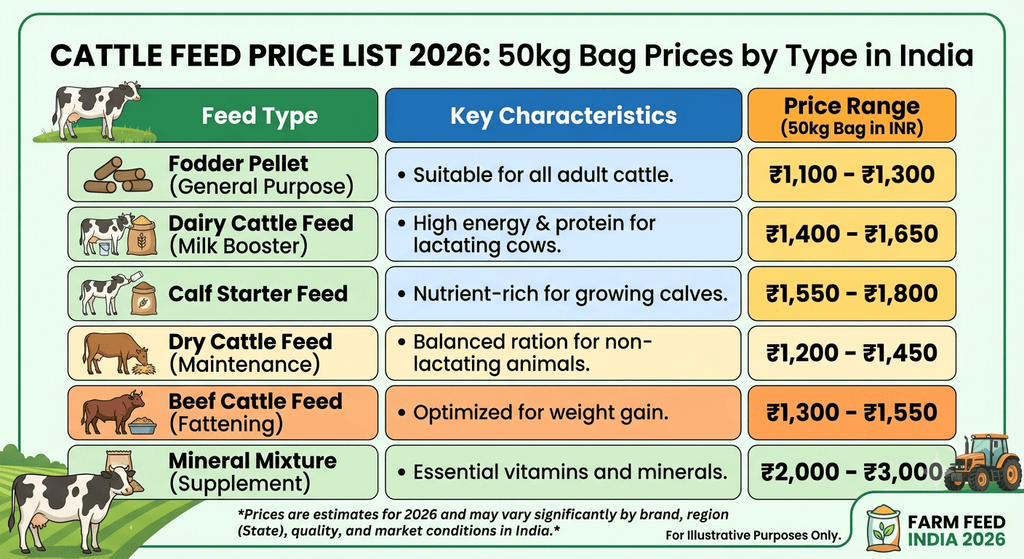
Quick answer: A 50 kg bag of branded compound cattle feed is going for ₹980 to ₹1,650 across India this October, so somewhere around ₹19.6 to ₹33 a kilo. Most of what actually sells sits in a narrower band, ₹1,120 to ₹1,380, Godrej and Amul included. Pellets cost more. Calf starter and bypass protein grades cost more again. The mineral mixture looks eye watering per kg until you notice it goes in at 50 grams a day. All of it is listing and dealer data, all of it moves with maize, DOC and DDGS, and none of it should go into a budget without a phone call first.
Three dealers, three districts, three different answers for the same bag. That is not anyone cheating you.
A cattle feed price list is worth exactly what its date is worth. Two rupees a kilo swings on the week, the road, and the lot size. So take the tables below as a reference point and nothing firmer than that.
Branded Bag Rates
| Brand and product | Bag size | Bag rate | Per kg |
| Godrej Samruddhi (pellet) | 50 kg | ₹1,650 | ₹33.0 |
| Godrej Bypro | 50 kg | ₹1,380 | ₹27.6 |
| Amul Nutri Rich (BIS Type I) | 50 kg | ₹1,180 to ₹1,250 | ₹23.6 to ₹25.0 |
| Godrej Milk More | 50 kg | ₹1,200 | ₹24.0 |
| Godrej Super | 50 kg | ₹1,120 | ₹22.4 |
| Amul Kamdhenu | 50 kg | ₹980 | ₹19.6 |
Dealer listings are off IndiaMART and TradeIndia, October 2026, and they shift by seller and by state.
₹650 between the top and the bottom of that list. Nobody is getting ₹650 more nutrition out of the dearer bag. Form, grade, distance. That is the bulk of it.
Nutri-Rich makes the point on its own. ₹1,180 at a Cooch Behar dealer. ₹1,250 in Moradabad. Same product, same company, and the ₹70 in between is diesel and somebody’s margin.
Rates by Feed Category
Compound feed is one line on the register. The rest do not behave like it at all.
| Category | Typical bag | Indicative rate | How it is fed |
| Compound feed, mash | 50 kg | ₹1,120 to ₹1,380 | Complete ration alongside fodder |
| Compound feed, pellet | 50 kg | ₹1,300 to ₹1,650 | Same role, less wastage, higher processing cost |
| Concentrate | 50 kg | Usually below compound feed per kg | Fed with green and dry fodder |
| Calf starter | 25 kg | ₹1,080 to ₹1,205 (₹43 to ₹48 per kg) | Small daily quantities from about 8 weeks |
| Calf starter | 50 kg | Around ₹1,500 | Same, larger pack |
| Bypass protein feed | 50 kg | Premium over standard compound feed | High-yielding and transition animals |
| Mineral mixture | 1 to 25 kg | Highest per kg of any line | 50 g per animal per day, so low total cost |
Everybody winces at ₹45 a kilo for calf starter. Then you do the intake maths; remember the calf is on a few hundred grams and not eight kilos, and the daily figure turns out to be nothing much. Per kg is simply the wrong way to look at anything that goes in by the handful.
What Sits Behind the Grade on the Label?
IS 2052 is the BIS standard here. The type number on a bag is a floor. It is not a claim about anything above the floor.
| Characteristic | Type I | Type II | Type III |
| Crude protein, minimum | 22% | 20% | 18% |
| Moisture, maximum | 11% | 11% | 11% |
| Crude fibre, maximum | 10% | 12% | 15% |
| Acid insoluble ash, maximum | 3% | 4% | 5% |
| Calcium, minimum | 0.8% | 0.8% | 0.8% |
| Total phosphorus, minimum | 0.5% | 0.5% | 0.5% |
Those are the figures doing the rounds. There was a 2023 revision, so if this is going into a tender, get the current edition rather than trusting a table off the internet, including this one.
At the counter it comes down to something simple. Two bags at the same rate are not the same purchase when one says Type I and the other says Type III. Four points of protein is four points.
And then acid insoluble ash, which hardly anyone asks about. Sand and soil, basically. Type III allows 5%, and at compound feed rates, that is a slightly painful thing to be buying by the tonne.
Why the Same Bag Costs More in Your District?
Brand explains far less of the final price than buyers assume.
Ingredients carry most of it. Maize, DOC, and DDGS are what is in the bag, and when those rates move, the finished feed follows within a few weeks, never the other way round. Freight is next. Godrej mills at Khanna, Baramati, Kharagpur, Bengaluru, and Erode, so the further your dealer sits from one of those, the more road is priced into your bag. After that, form and packaging. A pellet line costs money to run. A printed PP sack is not free either.
Tax, though, is not part of any of this. HSN 2309, Nil GST, so nothing in these tables is a tax difference. The catch is supplements and additives, which often sit outside the exemption at 18%. Classification detail is in the HSN code and GST guide if you need the subcodes.
Reading a Rate Sheet Without Getting Caught Out
Listings are useful for direction. As precision instruments, they are hopeless. A few things worth doing every single time:
- Read the unit before the number. Marketplaces show 50 kg products at “₹1,500 per kg” all day long. A mad number is usually a typo, not a quotation.
- Weigh the assumption. Not every bag is 50 kg. Plenty are 45, some are 39, and calf feed is often 25. Convert to per kg or you are comparing nothing.
- No date, no value.
- No grade attached, also no value.
- Moisture, which is the one people skip. Wetter bag, cheaper per kg, less dry nutrient in the ration, and you find out weeks later.
Water bought at compound feed rates. Quietest loss on the whole sheet.
What the Ingredients Inside the Bag Cost This Month?
Mills and bigger dairies are not really buying bags. They are buying what goes into them, so this is where the comparison actually happens.
| Ingredient | October 2026 range | Role in a cattle ration |
| Maize | ₹22 to ₹26 per kg | Primary energy source |
| Soya DOC | ₹40 to ₹46 per kg | Main protein source, elevated this season |
| Mustard DOC | ₹20 to ₹27 per kg | Protein at lower cost per unit |
| Maize DDGS | ₹22 to ₹25 per kg | Protein and energy together |
| Rice DDGS | ₹28 to ₹30 per kg | Bypass protein for milking animals |
| DORB | ₹9 to ₹15 per kg | Fibre and bulk at low cost |
Hold that against a working formulation and this year’s bag rates stop being mysterious. Soya DOC on its own accounts for a good chunk of the story. Ingredient by ingredient, the cattle feed price breakdown works the cost through, and the ration balancing guide handles the nutrition end.
Where Volume Buyers Actually Save
The cattle feed 50 kg price on a dealer’s board has processing, packing, distribution, and margin sitting on top of the raw material. Four bags a week—that convenience is cheap. Forty tonnes a month, and the arithmetic goes somewhere else entirely.
- Ingredient cost per kg comes in well under finished bag rates once you are buying volume.
- Contracts take the weekly spot movement off your desk. In a year like this one, that is worth more than usual.
- COA on every lot keeps protein steady, which means the formulation is not being reworked every time a truck rolls in.
- Regional hub instead of origin mandi. One less freight layer.
The other side of it deserves saying plainly. Blending in-house wants volume, storage you can genuinely keep dry through a monsoon, and somebody who understands formulation properly. Short on any of the three, and the branded bag is still the better decision.
Frequently Asked Questions!
- What does a 50 kg bag of cattle feed cost in India right now?
Anywhere from about ₹980 to ₹1,650 this October, though most branded product lands between ₹1,120 and ₹1,380. Roughly ₹22.4 to ₹27.6 a kilo. Brand, grade, form and district all pull on it. - Why is pelleted feed dearer than mash?
Extra processing step, plus the power to run it. Farms pay for it because animals cannot sort through pellets, so less of the bag ends up trodden into the floor. - What is the difference between BIS Type I and Type II cattle feed?
22% minimum crude protein against 20%, with tighter fibre and ash limits on Type I as well. High yielders usually justify Type I. - Does GST change the price of cattle feed?
It does not. HSN 2309 is nil rated. Supplements and additives are the exception and often are not. - Is it cheaper to buy raw materials and blend our own feed?
Past a certain volume, yes, provided storage and formulation capability are already there. Below it, no.
How do we get bulk raw material rates?
Brinda Foods supplies Maize, Soya DOC, Mustard DOC, Maize DDGS, Rice DDGS and DORB in bulk from Panipat, Haryana. Submit an enquiry and we will confirm at time of order, since rates move weekly.
About Brinda Foods!
Brinda Foods has supplied animal feed raw materials from Panipat, Haryana since 1987. We supply Soya DOC, Mustard DOC, Maize, Maize DDGS, Rice DDGS and De-Oiled Rice Bran in bulk to feed mills, dairies and farms across India. Every lot is tested and supplied with nutritional specification documentation. ISO 9001:2015 certified.