Quick answer!
Your cow won’t get every mineral she needs from bhusa, grain and khal alone. That’s why mineral mixture goes in daily. NDDB puts it at 20 to 25 g for a calf, 50 g for a heifer or dry animal, and 100 to 200 g for a milking animal, going up with yield. Mixing into dana? Keep it near 2% of the concentrate. Buy an area-specific pack with the BIS mark (IS 1664). Cows repeating after AI? Check minerals before anything expensive.
Here’s the strange thing about minerals. Nothing looks wrong.
The cow eats her dana, stands at the naand, gives her milk. Then the AI doesn’t take. Next month, same story. By the third try you’re counting lost days, and lost days in dairy mean lost money.
A daily scoop of mineral mixture costs very little. Still, a lot of sheds skip it. When ILRI worked with 500 farmers across six Bihar districts, most of them told the team they bought mineral mixture only after an animal fell sick and the doctor wrote it down (ILRI). Those who started feeding 50 g a day in that project reported about half a litre more milk per animal.
Half a litre, every day, from one scoop. Worth reading on.
Why do cereal and oilcake rations need a mineral mixture?
Because a cow can’t make minerals in her body. Full stop. Whatever she has, the trough gave her, and NDDB says plainly that regular feeds and fodders rarely carry enough of all of them (NDDB).
Walk through a normal North Indian ration and the gaps start showing.
Paddy straw first. It holds just 0.2 to 0.3% calcium, and on top of that its oxalates grab part of the calcium she eats from elsewhere. If your herd depends on it, our guide on paddy straw as cattle feed has the workarounds.
Maize and wheat? Great for energy. Not for calcium.
Brans and khal flip it around. Plenty of phosphorus there (a big part of it bound up as phytate), hardly any calcium. So the ratio slides the wrong way. You can see how each bran behaves in our comparison of DORB, rice bran and wheat bran.
And then the soil, which nobody can see from the shed.
Take Haryana. An older ICAR survey from Rewari found zinc low in every usual feed ingredient they tested, berseem being the one exception (Indian Journal of Animal Sciences). More recently, LUVAS researchers checked Murrah buffaloes in Charkhi Dadri in 2022. Serum copper was under the critical level. Hair and milk ran short on zinc and copper both (Indian Journal of Animal Nutrition, 2022).
The funny part? Those same buffaloes had more iron than they needed. So piling on minerals blindly isn’t the answer either. Getting the balance right is.
For calcium and phosphorus, nutritionists usually aim somewhere around 1.5 to 2 parts calcium for each part phosphorus. Minerals come last in ration building, though, after energy, protein and fibre are sorted, which our cattle feed formulation and ration balancing guide walks through step by step.
Some quick maths on the gap
Say you have a 450 kg cow. Just to keep her body going, she needs close to 31 g calcium and 23 g phosphorus each day, and that’s with zero milk counted (Kerala Agricultural University).
Now give her 100 g of a Type 1 mixture that meets the BIS minimum. That alone puts at least 16 g calcium and 9 g phosphorus in front of her. Her chara and dana fill the rest. Pull the mixture out of a straw-heavy ration, though? The sums don’t work anymore.
What about cost? Maize grain is sitting at about ₹28 a kg as we write this. The grain in her dana eats up far more of your budget than the mineral scoop ever will, and the scoop is part of what lets that grain actually turn into milk. Keeping an eye on grain rates? Our maize price and buying guide tracks them.
What daily dose suits calves, heifers and milking cows?
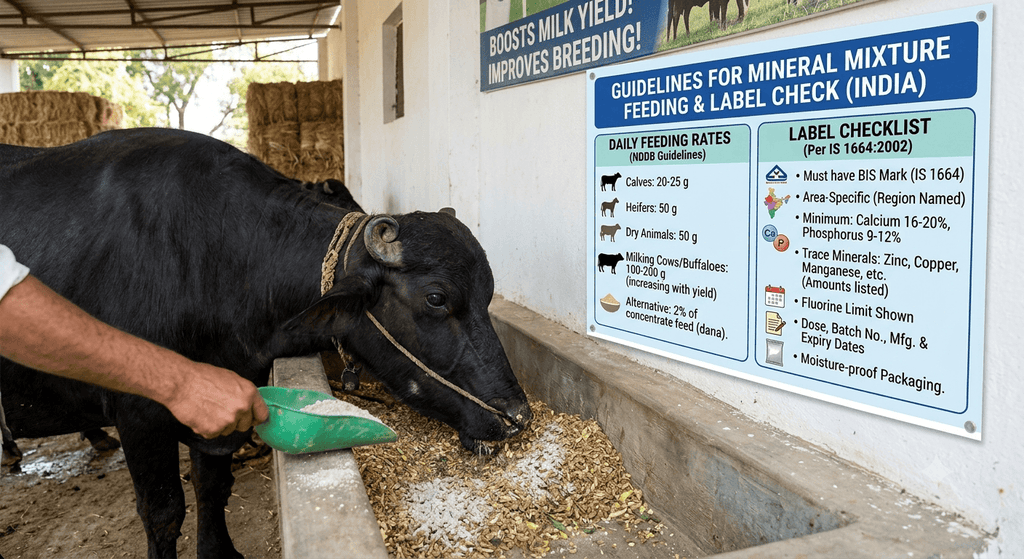
Nearly every milk union goes by NDDB’s numbers (NDDB farmer guide). Treat them as your base and then look at what’s printed on your pack.
| Animal | Mineral mixture per day | Keep in mind |
| Calves | 20 to 25 g | Start when she begins eating calf starter or dana |
| Heifers | 50 g | Keeps growth on track for her first heat |
| Dry and non-producing animals | 50 g | No break in the dry period |
| Milking cows and buffaloes | 100 to 200 g | More milk, move up the range |
Grams per animal or percent in dana?
Ask a farmer and he’ll say grams. Ask a mill and they’ll say percent. It’s the same scoop.
Mills mostly work with 2% mineral mixture and 1% salt in the concentrate. A trial in coastal Odisha did exactly that, 2% in the concentrate, and milk went up 18% in three months. Farm family income rose about 30% (Indian Journal of Animal Nutrition, 2021).
Let’s check that both rules match. A cow milking 12.5 litres gets roughly 5 kg of dana, going by 1 kg for every 2.5 litres. Take 2% of 5 kg. You get 100 g. That’s the bottom of NDDB’s range for milkers, so yes, they line up nicely. The full concentrate rule is in our guide to concentrate feed for dairy cows.
Small warning. A lot of branded cattle feed bags already carry minerals. Check the bag before you add your own scoop, or she ends up getting it twice.
Small habits that make the dose work!
• Put it in the dana. Throw it over dry chara and half stays on the floor.
• Feeding 150 g or more? Give half in the morning, half in the evening.
• Daily. Not when you remember. Minerals need a steady supply.
• Type 1 has salt in it already, Type 2 doesn’t. With Type 2, add salt yourself.
• Buffaloes eating lots of DORB need watching for calcium, because DORB tilts towards phosphorus. Our buffalo vs cow feed requirements guide covers it.
Ordering made easy: 10 milking cows on 150 g each means 1.5 kg a day, so roughly 45 kg in a month. Add up calves, heifers and dry stock the same way and you know what to tell your dealer.
What is an area-specific mineral mixture?
Think of it as a mixture made for your district’s soil, not for all of India. NDDB teamed up with ICAR institutes, mapped minerals state by state, and wrote different formulas for different agro-climatic zones. Plants set up with NDDB support now make about 50,000 tonnes a year (NDDB).
Can one region really be that different from the next? It can.
Inside Haryana alone, soil tests showed zinc running short in about 36% of samples from Bhiwani and Mahendragarh. Karnal had a different problem: manganese, short in almost half its samples (ICAR IISS).
Kashmir looks different again. A 2026 study tested 201 cattle in Shopian and estimated close to 90% were short on zinc and manganese, with copper at 80%. Who was hit hardest? Dry pregnant animals (Indian Journal of Animal Nutrition, 2026).
Keep that one in mind. Lots of farmers ease off feed in the dry period. Minerals are the one thing you shouldn’t ease off.
Does it actually show results?
For breeding, the field numbers look good.
In Odisha, crossbred cows that had breeding problems got 50 g of ASMM daily for 60 days. 55% of them conceived. In the group left on regular farm feeding, only 15% did (Indian Journal of Animal Nutrition).
Buffaloes too. An IVRI field study on 280 buffaloes found 52% of the anoestrus ones came into heat within three months on ASMM, and around 39% of repeat breeders settled within three inseminations (Indian Journal of Animal Sciences, 2012). That study had no control group, so take it as a good sign rather than hard proof.
And Jersey crossbred heifers on 30 g a day hit puberty roughly two months earlier (FAO AGRIS).
The biggest example is NDDB’s own Ration Balancing Programme, which combined balanced rations with ASMM for about 28.65 lakh animals across 33,374 villages. Farmers spent 11.8% less on feed per kg of milk and earned about ₹25 more per animal every day. As a bonus, methane per kg of milk went down 13.7% (NDDB).
So where do you get it? Try your district milk union first. If you’re picking a private brand, just ask the seller which region it’s made for. A good company will tell you.
Chelated vs inorganic minerals: is chelated worth it?
Most packs use inorganic salts like zinc sulphate, copper sulphate and calcium carbonate. Chelated minerals (also called organic) have the trace mineral attached to an amino acid or something similar, so more of it is supposed to get through the gut and into the body.
Does it justify the higher price? Depends on who you ask, honestly.
In Andhra Pradesh, a three-year study across villages saw more milk and better conception with a chelated mix (Plant Archives). Review papers suggest chelated forms can take the place of roughly a quarter to two-fifths of the inorganic trace minerals (Asian Journal of Dairy and Food Research).
Then a Brazilian trial on Holstein cows comes along and finds no difference at all in milk yield or composition (Revista Brasileira de Zootecnia).
How we’d decide
Ordinary herd? Stick with a BIS-marked, area-specific mixture and never miss a day. That covers most of what you need. Spend on chelated for your top milkers, around calving, or if cows keep repeating even though the basics are in order. Tight budget? A part chelated, part regular blend is a fair compromise.
In the organised dairy belts of Maharashtra and Gujarat, chelated products are catching on quickest. We looked at that shift in our piece on animal feed supplement trends in India for 2026.
What changes in the weeks before calving?
Those final two or three weeks are their own little season.
The moment milk comes in, she needs a lot more calcium, very fast. Some cows just can’t draw it out of their bones quickly enough. That’s milk fever.
This is where anionic mineral mixtures come in. Cooperative brands generally suggest around 100 g a day for the last 14 to 21 days before the due date. And the Haryana numbers are hard to ignore. In a randomised trial across 200 farms, milk fever dropped from 21% of cases to 2%. Milk went up 14%. Profit, 35% (Agricultural Economics Research Review).
Plan it with your vet, more so for older cows and heavy milkers. Also, don’t give an anionic pack on top of the regular one unless the vet asks you to.
Which deficiency signs point to poor mineral supply?
Breeding usually tells you first. The coat and skin come much later.
| What you see | Minerals often linked |
| Repeat breeding, no heat after calving, poor conception | Phosphorus, copper, zinc, manganese, cobalt |
| Licking walls, chewing bones, cloth or mud | Phosphorus, salt |
| Dull, rough coat; greying hair around the eyes | Copper |
| Swollen throat in a newborn calf | Iodine |
| Watery eyes, thick or cracked skin | Zinc |
| Cow down after calving, cold ears, can’t get up | Calcium (milk fever, call the vet now) |
| Heifer growing slowly, first heat late | Overall minerals and energy |
One caution before you act on this. Worms, too little energy and infections can all look like the list above. Minerals are a suspect here, not the final answer. Let your vet do blood tests and go over the full ration. NDDB’s farmer material ties copper to coat colour changes, iodine to an enlarged thyroid and zinc to watery eyes (NDDB).
What should the label and BIS specification show?
The standard to look for is IS 1664:2002. Two types sit under it. Type 1 has salt. Type 2 doesn’t (BIS).
What changed in 2026?
A fair bit. Back in April, the Delhi High Court said FSSAI has no power to regulate cattle feed under food safety law, and it struck down FSSAI’s BIS certification directives (Verdictum).
Six months later, on 7 October, the Department of Animal Husbandry and Dairying brought in a new Quality Control Order, this time under the BIS Act. Cattle mineral mixtures are covered, along with feed grade dicalcium phosphate and salt and cattle licks (S.O. 5576(E)).
The dates to remember: the BIS mark becomes compulsory on mineral mixtures from 1 April 2027 for most manufacturers. Small units get until 1 July 2027 and micro units until 1 October 2027.
If you’re already buying BIS-marked packs, nothing changes for you. You’re ahead. For tax questions on feed and supplements, see our cattle feed HSN code and GST guide.
IS 1664 numbers at a glance!
| Parameter (moisture-free basis) | Type 1 (with salt) | Type 2 (without salt) |
| Moisture, max | 5% | 5% |
| Calcium, min | 16% | 20% |
| Phosphorus, min | 9% | 12% |
| Magnesium, min | 4% | 5% |
| Salt (as NaCl), min | 22% | Not required |
| Zinc, min | 0.64% | 0.80% |
| Manganese, min | 0.10% | 0.12% |
| Copper, min | 0.078% | 0.100% |
| Iron, min | 0.3% | 0.4% |
| Iodine (as KI), min | 0.020% | 0.026% |
| Cobalt, min | 0.009% | 0.012% |
| Fluorine, max | 0.05% | 0.07% |
| Lead, max | 16 mg/kg | 20 mg/kg |
Before you pay at the counter!
Flip the pack and read the back. Check that it has:
• the BIS mark, plus IS 1664 and Type 1 or Type 2 in clear print
• calcium and phosphorus matching or beating the table
• amounts next to every trace mineral, not just names
• fluorine shown and within limit (some phosphate sources carry too much)
• a region named, if the front says area-specific
• the chelated minerals named one by one, if it claims to be chelated
• a dose for each type of animal, a batch number, date of manufacture and a best before date
• a moisture-proof bag, with powder that pours freely
No BIS mark? Pass. Only “all essential minerals” written, no numbers? Pass. Price far below the rest? Ask why, then probably pass. Honestly, every bag in your feed store deserves the same check, and our cattle feed raw materials and quality standards guide shows what that looks like.
Storing it!
Seal the bag after every use. Keep it raised off the floor and away from damp walls; monsoon is when most stock goes bad. Hard lumps mean moisture has got in. Buy only what you’ll use before the best before date, and open the older bag first.
Where Brinda Foods fits in?
A mineral scoop can’t fix a ration that’s wrong underneath.
That underneath part is our job. Brinda Foods has been supplying Maize, Soya DOC, Mustard DOC, Maize DDGS, Rice DDGS, DORB, Maize Gluten and Rice Gluten from Panipat, Haryana, since 1987, and every batch leaves with lab-tested specification documents. Steady raw material means your mineral calculation stays right from one lot to the next.
If you use our feed concentrates, remember the 5% concentrate already carries vitamins, minerals and enzymes. Count that before adding more. Mills, cooperatives and bigger dairies can get a current bulk quote from our team whenever they need one.
Frequently asked questions!
- How many grams of mineral mixture should a cow get per day?
For a milking cow, NDDB says 100 to 200 g a day, more as her yield rises. Dry cows and heifers do well on about 50 g, calves on 20 to 25 g. Using a chelated or concentrated pack? Then the label dose wins.
- How much mineral mixture should go into cattle concentrate?
Roughly 2%, and about 1% common salt with it. That way, a cow eating 5 kg of dana picks up close to 100 g of mineral mixture each day.
- Is the dose the same for buffaloes?
Yes, it is. NDDB’s 100 to 200 g range is for milking animals in general, buffaloes included. If your buffaloes eat a lot of DORB, just keep a closer eye on their calcium.
- Can I give mineral mixture to a pregnant cow?
You should. Around 50 g a day through pregnancy is right. In the last two to three weeks before she calves, talk to your vet about switching to an anionic mixture, which helps keep milk fever away.
- What is the difference between Type 1 and Type 2 mineral mixture?
Type 1 under IS 1664 has at least 22% salt mixed in. Type 2 skips the salt but packs more calcium, phosphorus and trace minerals, so you give salt on the side.
- Is a chelated mineral mixture better than a normal mineral mixture?
Her body usually absorbs it better, though studies don’t all agree on the benefit. It earns its price mostly in high yielders, around calving and in herds where repeat breeding won’t go away. For everyone else, a daily BIS-marked area-specific mixture is the place to start.
- Is BIS certification compulsory for cattle mineral mixture?
Not yet, but it’s coming. Under the Quality Control Order of 7 October 2026, the BIS mark under IS 1664 is compulsory from 1 April 2027 for most makers. Small and micro units get a few extra months.
Key takeaways!
• Bhusa, grain and khal can’t cover minerals by themselves. Feed the mixture every day.
• Calves get 20 to 25 g, heifers and dry cows 50 g, milkers 100 to 200 g (or keep it near 2% of dana).
• Soil gaps change from district to district, even inside Haryana, which is why area-specific packs make sense.
• Talk to your vet before the last few weeks of pregnancy.
• Chelated is a top-up for high yielders. The basics come first.
• From April 2027, the BIS mark under IS 1664 is a must.