
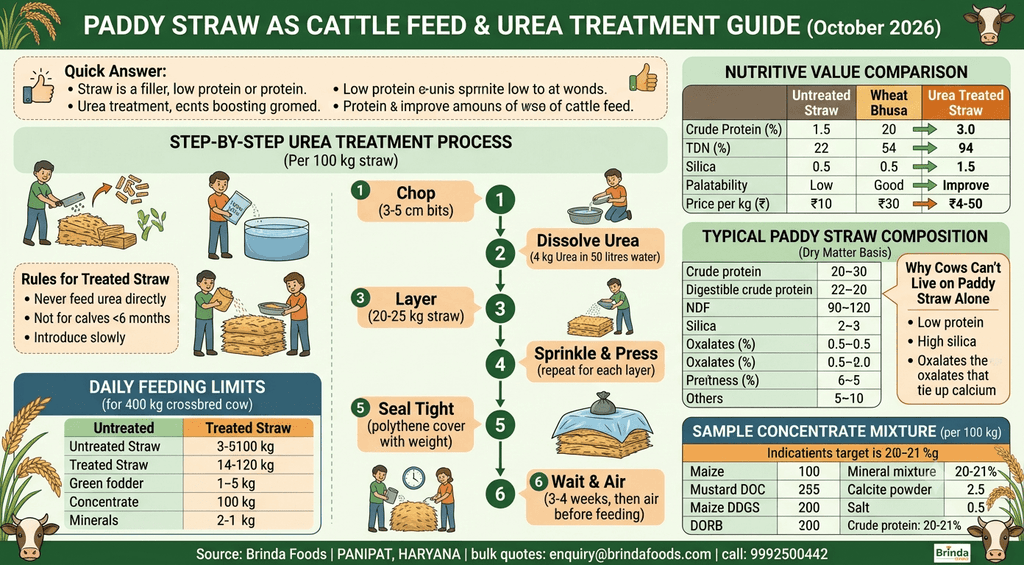
Quick answer: Paddy straw fills the stomach but doesn’t feed the cow much. It has 3 to 5% crude protein and 40 to 45% TDN, a lot of silica, and oxalates that tie up calcium. Use it with green fodder, a good concentrate and a mineral mixture. If you treat it with urea (4 kg urea in 50 litres water per 100 kg straw, kept sealed for around three weeks), the protein nearly doubles and cows eat it better.
Why Does Everyone Ask About Paddy Straw in October?
Dhaan katai is done. Parali is lying in every field from Ambala to Saharanpur. And bhusa? Getting costlier by the week, because last season’s stock is almost gone.
So my phone rings. Dairy owners, gaushala people, the odd feed adviser who wants a second opinion. They all want to know one thing. Can the straw go to the animals instead of going up in smoke?
Yes, it can. I’m happy every time someone asks, actually. But it needs some help, and that’s what this whole post is about.
What Is Actually Inside a Bale of Paddy Straw?
Mostly fibre. Quite a bit of ash. Very little protein.
These are usual figures on dry matter basis. Straw from your area could be a little better or worse, depending on variety and whether it caught rain before baling.
| Parameter | Typical range |
| Crude protein | 3 to 5% |
| Digestible crude protein | Below 1% |
| TDN | 40 to 45% |
| NDF | 70 to 78% |
| Lignin | 5 to 7% |
| Total ash | 15 to 20% |
| Silica | 10 to 14% |
| Calcium | 0.2 to 0.3% |
| Oxalates | 1 to 2% |
That second row is the one that matters. Under 1% digestible protein means the straw gives nearly nothing towards milk.
What Do Silica, Lignin and Oxalates Do Inside the Cow?
Rice plants soak up silica from the soil. A lot of it. It sits on the straw like a thin glassy layer, and the rumen bugs can’t chew through it easily, so a good share of the fibre just comes out in the gobar. That’s the main reason paddy straw loses to wheat bhusa on nutrition.
Lignin adds to the problem by binding the cellulose tight.
Oxalates are sneakier. They hold on to calcium in the gut. You feed the calcium, the cow doesn’t get all of it. For a milking animal that’s not a small thing, which is why I keep telling people: on a straw ration, mineral mixture goes in every batch, no skipping. Some nutritionists put in a little calcite powder too.
Why Can’t a Cow Live on Paddy Straw Alone?
Simple. A crossbred cow milking 10 litres needs about a kilo of digestible protein daily, and paddy straw gives her almost none of it.
She also can’t eat much of it. Coarse straw stays in the rumen a long time, so she feels full early. Full stomach, empty tank.
What the straw does well is keep the rumen working. The rest (energy, protein, calcium) has to come from green chara, concentrate and minerals. Our cattle feed formulation and ration balancing guide shows how that roughage and concentrate split is worked out.
How Do You Urea Treat Paddy Straw at Home?
If you do only one thing with paddy straw, do this. It’s cheap. Inside a sealed heap the urea becomes ammonia, which softens the fibre and leaves nitrogen behind for the rumen microbes.
Per 100 kg of straw you need 4 kg fertiliser urea, 50 litres water, a drum, a thick polythene sheet or a pucca pit with a cover, and a watering can.
1. Chop the straw into 3 to 5 cm bits. Long straw doesn’t soak well and leaves air gaps.
2. Dissolve the urea in the water. Keep stirring. No granules should be left at the bottom.
3. Spread a layer of 20 to 25 kg straw on the sheet. About a hand span thick is fine.
4. Sprinkle a quarter of the solution on it, turn it once, then walk on it to press it down.
5. Repeat until the straw and the solution are both finished. Press every layer, don’t get lazy on the top ones.
6. Cover it completely with polythene. Put soil or bricks on the edges. If ammonia escapes, the treatment fails.
7. Wait. Three weeks if it’s warm. When the nights turn cold in November, give it four.
8. Air it out before feeding. Pull one day’s straw from one side only, spread it for 15 to 20 minutes till the smell eases, and close the heap again.
Protein usually goes up to 7 to 9%. The straw comes out softer and animals stop picking through it.
Now the rules. Never give urea directly, not dry, not mixed in water. Keep urea bags locked up. Treated straw isn’t for calves below six months. And go slow in the first week, a little more each day.
How Much Paddy Straw Can a Dairy Cow Eat in a Day?
For a 400 kg crossbred cow, I’d start here:
| Straw | Per day | Along with |
| Untreated | 3 to 4 kg | 15 to 20 kg green fodder, concentrate, minerals |
| Urea treated | 5 to 7 kg | Same, concentrate set as per milk |
Buffaloes deal with coarse straw slightly better, so you can push them a bit. Dry cows and low yielders can take more straw. High yielders get less, and better fodder.
Your feed adviser should fine tune this. Every herd is a little different.
Paddy Straw or Wheat Bhusa: Which Gives More for Your Money?
Bhusa is better feed. No argument. Less silica, softer, cows prefer it.
But look at what you pay. Rough North India rates for October 2026 below. Mandi rates change every week, so put in your own.
| Paddy straw | Wheat bhusa | Urea treated paddy straw | |
| Crude protein | 3 to 5% | 3 to 4% | 7 to 9% |
| TDN | 40 to 45% | 42 to 48% | 50 to 55% |
| Silica | High | Low | High, softer fibre |
| Palatability | Fair | Good | Good |
| Price per kg (indicative) | ₹2 to ₹4 | ₹7 to ₹11 | About 50 paise over raw straw |
| Cost per kg TDN (approx.) | ₹7 | ₹20 | ₹7 |
Paddy straw at ₹3 and 42% TDN works out to about ₹7 per kg of digestible energy. Bhusa at ₹9 and 45% TDN? Around ₹20. Nearly three times. Treatment adds maybe 50 paise a kilo and you get more protein and energy for it, so cost per kg of nutrients barely moves.
Most dairies I know that do this well keep some bhusa for taste and the rest is treated parali.
Which Concentrate Ingredients Balance a Paddy Straw Ration?
Straw-heavy roughage means the concentrate has to bring more protein than normal, and minerals have to be there daily. Grades and quantities are covered in our piece on concentrate feed for dairy cows.
Up here in the paddy belt, three ingredients make the most sense.
Mustard khal first. 34 to 38% protein, priced right for Haryana and Punjab dairies. If you’re thinking of raising its share, go through our complete guide to mustard DOC in animal feed before you do.
Then DDGS. Protein, fat and bypass protein from one bag, which helps a lot when the straw is giving so little. Maize DDGS runs 26 to 30% protein and works well next to mustard DOC.
And DORB, which comes off the same paddy crop as the straw. Funny how that works out. Cheap bulk, some protein, useful fibre. Our de-oiled rice bran goes into a lot of straw-based formulas.
What Could a Sample Concentrate Look Like? (per 100 kg)
| Ingredient | kg |
| Maize, crushed | 24 |
| Mustard DOC | 25 |
| Maize DDGS | 20 |
| DORB | 27 |
| Mineral mixture | 2 |
| Calcite powder | 1 |
| Salt | 1 |
| Total | 100 |
Crude protein lands somewhere around 20 to 21%. That’s enough room to make up for the straw. The calcite covers what oxalates take away.
A 10 litre crossbred cow could get 5 to 6 kg treated straw, 15 to 20 kg green jowar or maize or bajra, 5.5 to 6 kg of this concentrate, and water whenever she wants it.
It’s an example, nothing more. Lab reports on your own raw material, this month’s prices and your nutritionist decide the real numbers. For silage and green fodder planning alongside this, see the best feed for dairy cows to increase milk production.
What Should You Check Before Stocking Paddy Straw?
Look at the colour. Golden and bright is good. Black patches, dust or a musty smell mean rain got to it, so don’t buy.
Keep bales off the floor and under a shed where air can move. Chop before feeding, or half of it ends up under the animals’ feet. Get the urea pits going now and your first lot opens early November. Minerals in every batch. I’ll keep repeating that one.
Frequently Asked Questions
Is paddy straw good for cattle?
As filler roughage, yes. As the only feed, no.
How much protein does paddy straw have?
Around 3 to 5% crude protein, almost none of it digestible. Urea treatment takes it to 7 to 9%.
Can a cow be fed only paddy straw?
No. She won’t get enough protein, energy or calcium, and she can’t physically eat enough straw to make up for it.
How long should urea treated straw stay sealed?
About three weeks in warm weather and four when it’s cold. Air out each day’s portion before feeding.
Which is better, paddy straw or wheat bhusa?
Bhusa is better feed. Treated paddy straw is better value.
Can buffaloes eat more paddy straw than cows?
A little more, usually. They still need their concentrate and minerals.
What concentrate works best with paddy straw?
In North India, a mix built on mustard DOC, DDGS and DORB, with mineral mixture every time.
Brinda Foods
Brinda Foods is a family business supplying animal feed raw materials from Panipat, Haryana since 1987. We work with cattle feed manufacturers, dairy cooperatives, gaushalas and compound feed producers across North India. Our range covers Maize DDGS, Rice DDGS, Soya DOC, Mustard DOC, De-Oiled Rice Bran, Maize, Maize Gluten and Rice Gluten, and every batch comes with lab tested specification documents.
See our feed concentrates range, or give us a call to plan this season’s straw rations around tested, consistent raw materials.
For a bulk quote: Send us an enquiry | Call: 9992500442 | Email: sales1@brindafoods.com


[…] oxalates grab part of the calcium she eats from elsewhere. If your herd depends on it, our guide on paddy straw as cattle feed has the […]