Quick Answer:
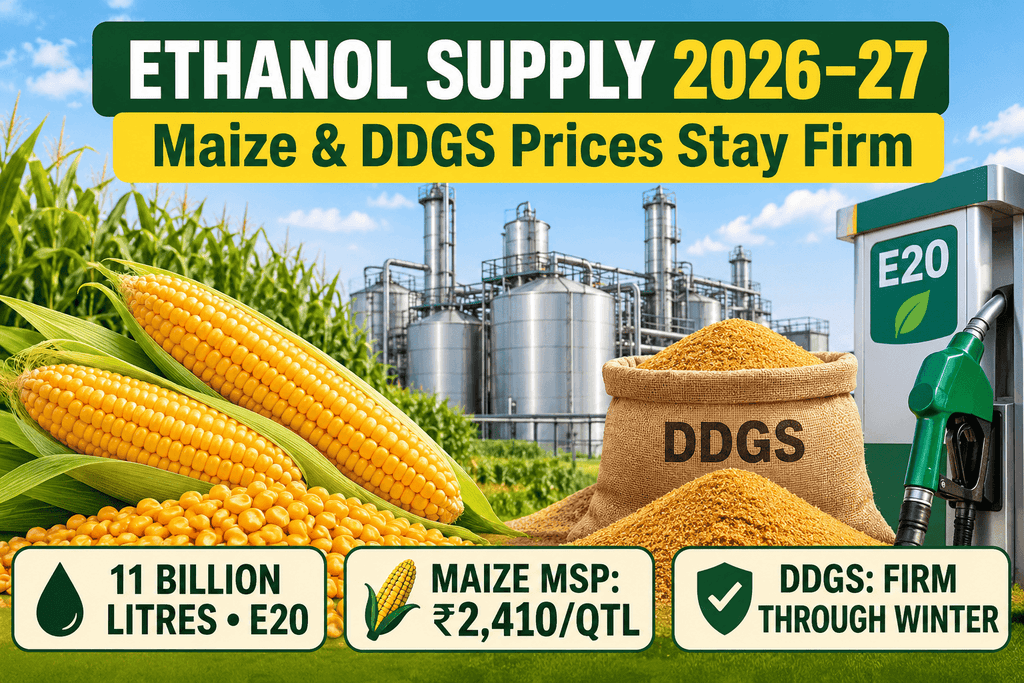
The 2026-27 ethanol supply year began on 1 November 2026 and will run until 31 October 2027. For this year, the oil marketing companies (OMCs) have tendered for about 11 billion litres of ethanol to keep petrol at a 20% blend (E20), and they have accepted no ethanol made from sugarcane juice, sugar syrup or B-heavy molasses. Since rice-based supply is also capped, maize is expected to carry the largest share of the programme, which has kept maize well above its minimum support price of ₹2,410 per quintal.
DDGS supply should rise as distilleries grind more maize, although costlier grain and a lower ethanol price for maize distillers are likely to keep DDGS rates firm through the winter.
Since the 2026-27 ethanol tender was issued in October, maize and DDGS rates have been the most common subject in our calls with feed mills. This guide explains what the tender changed and how those changes reach the price of both ingredients. Separate Brinda Foods posts cover new-crop maize prices for November 2026 and the wider maize price shock, so this one stays with the ethanol side of the market.
What is the ethanol supply year?
The ethanol supply year (ESY) is the twelve-month period over which the OMCs buy ethanol for blending into petrol. It runs from November to October, in line with the sugar season, and each year opens with a tender that sets the volume required, the feedstocks accepted and the price paid for each. Distilleries plan their grain purchases around that tender, so a change in its terms usually shows up in maize mandis within a few weeks.
India began blending ethanol into petrol in January 2003, when a 5% blend was introduced in nine states. A 20% blend was first set as a target for 2030, but the deadline was brought forward to 2025, and E20 has since become the standard grade of petrol across the country. At that level, distillery buying is large enough to move the price of feed grains.
What changed in the 2026-27 ethanol tender?
Bharat Petroleum Corporation Limited (BPCL) issued the tender on 16 October 2026 on behalf of all the OMCs, and revised conditions followed on 3 November. The tender asks for about 11 billion litres of ethanol. Because the Government wants sugar diversion for ethanol cut to zero after poor rainfall in Maharashtra and Karnataka, it seeks nothing from sugarcane juice, sugar, sugar syrup or B-heavy molasses.
Grain-based routes face limits of their own. Ethanol from surplus Food Corporation of India (FCI) rice is capped at 3.24 billion litres over the first three quarters, equal to about 7.2 million tonnes of rice, and no producer may offer more than roughly 30% of its quarterly quantity from rice. Ethanol from damaged foodgrain is capped at 1.6 billion litres for the year, at 400 million litres per quarter. Taken together, the two sources can supply at most 4.84 billion litres, representing about 44% of the tender, while C-heavy molasses can add only around 500 million litres. The rest has to come mainly from maize.
The price paid for maize ethanol has also come down. The OMCs cut the maize incentive from ₹5.79 to ₹2.79 per litre, which lowers the maize ethanol price from ₹71.86 to ₹68.86 per litre.
| Feedstock | Status in ESY 2026-27 | Price or limit |
| Sugarcane juice, sugar syrup, B-heavy molasses | Not accepted | Not applicable |
| Maize | Accepted | ₹68.86 per litre (₹71.86 last year) |
| Surplus FCI rice | Accepted, capped | ₹60.32 per litre; 3.24 billion litres over Q1 to Q3 |
| Damaged foodgrain | Accepted, capped | ₹64 per litre; 1.6 billion litres a year |
| C-heavy molasses | Accepted | About 500 million litres available |
Bids received by early November showed how far maize now leads. The OMCs received offers for 1,934.5 crore litres against the 1,100 crore litres tendered; maize accounted for 1,140.4 crore litres of these, compared with 457.8 crore litres from FCI rice and 239.6 crore litres from damaged foodgrain.
How the ethanol year affects maize prices?
Distilleries now compete directly with poultry, dairy feed and starch makers for maize. Ethanol-related maize demand is estimated at about 16 million tonnes for 2026-27, compared with roughly 13 million tonnes in the year before, and total demand from all users could reach about 55.7 million tonnes in 2027, up from an estimated 49 to 50 million tonnes in 2026. Feed remains the largest user, at 55 to 60% of the maize India consumes.
This extra demand has arrived in a weak crop year. The Compound Livestock Feed Manufacturers Association (CLFMA) estimates kharif maize output at 23.2 million tonnes, 16.8% lower than last year, after drought cut production by 33% in Karnataka and 24% in Maharashtra. The Agriculture Ministry had not released its own kharif estimate by mid-November, so the CLFMA figure remains an industry number.
| Maize price point | ₹ per quintal | Date |
| MSP, Kharif Marketing Season 2026-27 | 2,410 | Notified for 2026-27 |
| Warangal mandi (a local record) | 3,255 | 29 October 2026 |
| Maharashtra state average | 2,660 | 9 November 2026 |
| All-India average mandi rate | 2,629 | 20 November 2026 |
Mandi prices rose 30 to 40% in the five weeks to early November. Maharashtra’s November average of ₹2,674 per quintal is the highest in that state series since 2001 and 67% above November 2025, and CLFMA chairman Sumit Sureka said he had not seen maize prices at this level in over 30 years. Importers have also contracted about 104,000 tonnes of maize from Myanmar for November and December shipment, roughly 1.8 times India’s total maize imports in the previous financial year.
For feed mills, the effect is direct. In a broiler ration with 60% maize, every ₹1 per kg rise in maize adds about 60 paise to the cost of a kilo of feed, a calculation set out in our maize price shock article.
Ethanol impact on DDGS price
Dried distillers grains with solubles (DDGS) is the material left after a distillery ferments the starch in grain into ethanol and dries the remaining mash together with the concentrated thin stillage. Since the starch goes into the fuel, the protein, fibre and fat of the grain stay behind in the DDGS. Any change in how much grain distilleries use therefore changes how much DDGS reaches the feed market.
More maize ethanol means more maize DDGS
A tonne of maize yields about 378 litres of ethanol and 309 kg of DDGS, based on standard conversion rates. If distillery use of maize rises by around 3 million tonnes in 2026-27, as current estimates suggest, close to 0.9 million tonnes of additional maize DDGS would be produced over the supply year. Indian plants vary in yield, particularly where corn oil is extracted, so this figure is an estimate rather than a forecast.
Why DDGS prices are unlikely to fall with the extra supply?
Extra supply would normally soften prices, but two factors work against that this winter. The first is grain cost. The All India Distillers’ Association has said that maize now costs distilleries ₹26 to ₹27 per kg, compared with ₹18 to ₹19 a year ago, and it asked for ₹75 per litre for maize ethanol; the OMCs set ₹68.86 instead. With ethanol paying less and grain costing more, DDGS income matters more to each distillery’s margin, which leaves sellers little room to discount.
The second factor is protein value. DDGS competes for the same place in a formula as soya DOC and other oilmeals, and while soya DOC stays costly (see our Soya DOC price outlook), feed mills keep buying DDGS as a cheaper protein source. That steady demand has so far absorbed the new supply.
Maize DDGS and rice DDGS may move differently
The split between maize and rice is still unsettled. The Grain Ethanol Manufacturers Association (GEMA) has warned that the tender’s pricing could favour rice over maize and has asked the Government and the OMCs to review it. If more distilleries use their full FCI rice quota, the market will see relatively more Rice DDGS and less Maize DDGS than the maize bids imply. Rice DDGS usually carries more protein, so the two products are priced apart and do not always move together.
The Brinda Foods view
At Brinda Foods, we expect maize DDGS to follow the firmness in maize until the rabi crop arrives between March and May 2027, rather than fall with the extra volume. Short dips are still likely near distillery clusters when plants clear stock, and these are usually good points to book. Current rates are listed on our DDGS price in India page, which we update every month.
Quality is the second thing we are watching. More plants running more grain means more lots in the market, and crude protein, fat and moisture can differ widely between them. A lower price is only a saving when the lab report supports it.
Buying maize and DDGS this winter
Most of the cost risk this season can be handled through buying and quality habits rather than large changes to formulas. These are the practices we see working best with our customers:
• Forward booking of 30 to 50% of winter volume during the November to January harvest window, when supply is widest. Our feed raw material buying calendar lists the better months for each ingredient.
• Formula costing on price per kg of protein, not price per kg, which often favours rice DDGS despite its higher list price. Our cost per kg of protein comparison has November figures.
• A certificate of analysis with every load, checked against your own tests for crude protein, fat, moisture and aflatoxin (how to read a COA, how to sample a truckload).
• Dry storage and first-in, first-out use, since winter fog and condensation can raise moisture in stacked bags (DDGS storage guide).
• Imported DDGS as a fallback if domestic prices stay high (importing US DDGS into India).
Dairy plants can apply the same approach. Our guide to cattle feed cost per litre of milk shows how a change in maize or DDGS rates reaches the cost of each litre.
What to watch for the rest of ESY 2026-27?
Several decisions will shape maize and DDGS prices over the coming months. The 11 billion litre tender may fall short of what E20 requires, and the OMCs are expected to float an additional tender of about 1 billion litres, which would add to maize demand. Rice and damaged grain allocations are made quarter by quarter, so the February and May rounds will show whether distilleries are shifting between grains.
The surplus FCI rice allocation is valid until 30 June 2027, after which more of the load could return to maize. Imports are also under discussion, as the starch industry has asked for temporary duty-free maize imports. For feed mills, though, the rabi maize harvest from March to May remains the most likely trigger for lower maize and DDGS rates.
Frequently asked questions
- When does the ethanol supply year 2026-27 start and end?
The 2026-27 ethanol supply year started on 1 November 2026 and ends on 31 October 2027. The OMC tender for the year was issued on 16 October 2026.
- Will DDGS get cheaper because more ethanol is made from maize?
DDGS is unlikely to get much cheaper this winter. More maize ethanol does mean more DDGS, but distilleries are paying far more for maize while receiving less per litre of ethanol, so they depend on DDGS income and hold prices firm. Rabi maize arrivals from March are a more likely trigger for lower rates.
- How much maize will ethanol use in 2026-27?
Ethanol-related maize demand is estimated at about 16 million tonnes in 2026-27, compared with roughly 13 million tonnes in the previous year.
- Why is maize trading above MSP in November 2026?
Maize is trading above MSP because the kharif crop is smaller after drought in Karnataka and Maharashtra, while ethanol, feed and starch demand have all grown. Mandi rates of about ₹2,600 to ₹3,250 per quintal compare with an MSP of ₹2,410.
- Does excluding sugarcane juice from ethanol affect feed mills?
It affects them indirectly. With the sugar route closed and rice capped, more of the 11 billion litre target has to come from maize, which increases competition for the grain that feed mills also buy.
- Is rice DDGS or maize DDGS better value right now?
The answer depends on what your formula is short of. Rice DDGS usually has more protein, so it is worth comparing cost per kg of protein rather than price per kg before choosing.
Buy maize and DDGS with Brinda Foods
Brinda Foods has supplied feed raw materials from Panipat since 1987, to feed manufacturers across Punjab, Haryana and Uttar Pradesh and to export buyers in Vietnam, the UAE and Thailand. We stock Maize, Maize DDGS and Rice DDGS with a COA for every lot. Call us on 9992500442 for this week’s rates and bulk availability.