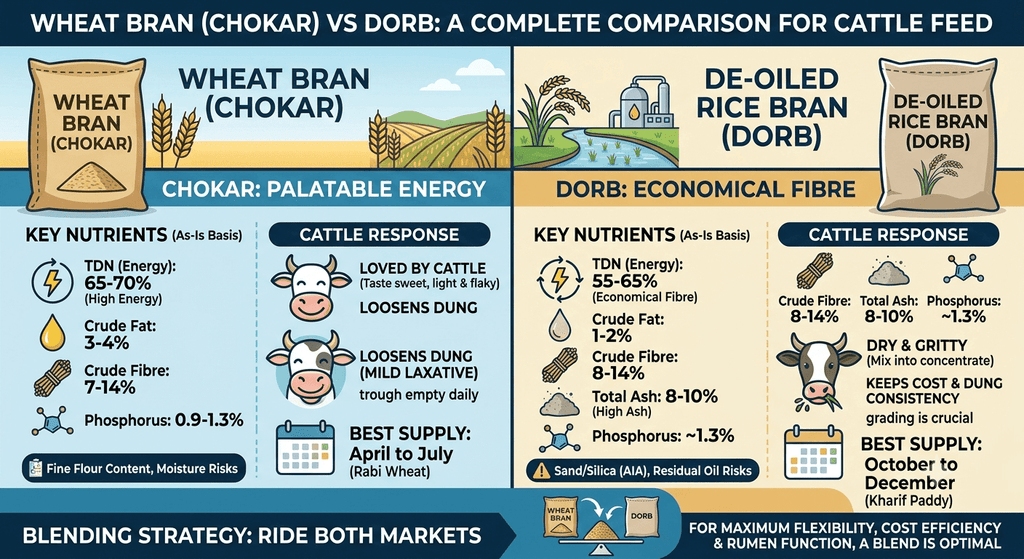
Quick answer: Honestly, you’ll probably want both. Protein wise there’s nothing between them (13 to 16% in each), so neither is what you buy for protein. Chokar has more energy, around 65 to 70% TDN against 55 to 65% for DORB, cattle eat it happily, and it loosens the dung a bit. DORB is cheaper per kilo and keeps longer in the godown. Per kg of TDN this October, they’re about even. Blend them, and tilt towards whichever one the market is giving you cheaper.
Hardly a week goes by without a mill owner calling to ask me this. Chokar or DORB? Most people in Haryana and Punjab already use both, so that’s not really the question. The question is how much of each. And that keeps shifting with whatever the mandi is doing that month.
So let’s put wheat bran and de-oiled rice bran next to each other. Nutrients first, then taste, cost per unit of energy, storage and the months when each one gets cheap. At the end you’ll find a blend ratio you can start with.
How do protein, fibre and phosphorus compare?
Protein is basically a draw. Where they really differ is energy, fat, ash, and how much sand turns up in the bag.
| Parameter | Wheat bran (chokar) | DORB |
| Crude protein | 13 to 16% | 13 to 16% |
| TDN (energy for cattle) | 65 to 70% | 55 to 65% |
| Crude fibre | 7 to 14% | 8 to 14% |
| Crude fat (ether extract) | About 3 to 4% | 1 to 2% |
| Total ash | 4 to 7% | 8 to 10% |
| Phosphorus | 0.9 to 1.3% | About 1.3% |
| Calcium | 0.07 to 0.2% | Low |
| Main quality risk | Fine flour content, moisture | Sand and silica (AIA), residual oil |
Where do these numbers come from? Mostly the NDDB Dairy Knowledge Portal (wheat bran, de-oiled rice bran), the Feedipedia wheat bran page and our own DORB nutrition guide. Small warning though. A few of them quote dry matter values and a few quote as fed, so if you’re holding two lab reports side by side, convert them first or you’ll be comparing apples with oranges.
For cattle, I’d read that table for three things.
First, energy. Chokar holds on to some flour and a little oil, and that’s what lifts its TDN. DORB goes through solvent extraction, which takes out nearly all the oil, and a good chunk of the energy leaves with it.
Second, the phosphorus and calcium mismatch. Both brans have plenty of phosphorus and hardly any calcium. Yes, a lot of the phosphorus is phytate, but rumen microbes break that down without much trouble, so in cattle it counts. What you have to watch is the ratio. Use a lot of either bran and you’ll want limestone powder or a proper mineral mixture in there.
Third, ash. DORB runs higher, and some of that isn’t mineral at all. It’s silica from the rice hulls. I’d ask for AIA (acid insoluble ash) on every single lot. Our note on reading a feed lab report explains which numbers deserve your attention first.
Which is more palatable?
Chokar, easily. It’s light and flaky, a little sweet from the flour stuck to it, and cattle go for it without any coaxing. NDDB calls it quite palatable. Every dairy buyer I’ve spoken to says the same.
DORB is a different animal. Dry, a bit gritty. Mix a fresh lot into concentrate and nobody complains. Send an old one, or one with high free fatty acids (FFA), or one that’s half sand, and you’ll hear about it from the dairy because the cattle start leaving feed behind. Which is exactly why grading DORB matters so much more than grading chokar. If DORB is new to you, our short piece on what DORB is and where it’s used is a good place to begin.
One thing I always suggest. Even if DORB makes up most of your bran, leave some chokar in. The trough looks emptier at the end of the day.
Does wheat bran have a laxative effect?
A little, yes. The fibre in bran drinks up water and swells, so there’s more bulk moving through. Both NDDB and Feedipedia point this out. Ask any older dairy farmer and they’ll tell you chokar was what their family fed around calving.
Should a formulator worry? Not really. It’s about how much you use.
At the levels most concentrates use, you’ll barely notice it. In a dry, straw heavy ration it can even help a bit. It’s when you push wheat bran really high that dung goes loose and the whole diet digests a little worse. One study on milking Holstein cows raised wheat bran from 0 to 30% of the diet’s dry matter, and digestibility dropped with every increase. DORB doesn’t do this at all, so mixing the two sorts it out on its own.
Which is cheaper per unit of TDN?
Right now, it’s almost a tie. DORB wins on the price tag. Chokar wins on energy per kilo. Put the two together at October 2026 rates and the gap per kg of TDN is under a rupee.
| October 2026 | Wheat bran (chokar) | DORB |
| Price used (₹/kg) | 21.50 | 19.50 |
| TDN used | 67.5% | 60% |
| Cost per kg TDN (₹) | 31.90 | 32.50 |
| Crude protein used | 14.5% | 14.5% |
| Cost per kg crude protein (₹) | 148 | 134 |
The prices in that table are midpoints. Mid October, sellers in Indore were asking ₹20 to ₹23 a kilo for cattle feed wheat bran (IndiaMART). Feed grade DORB sits at ₹19 to ₹20 (we update this in our DORB price guide for 2026). Buying truckloads direct from a flour mill or solvent plant? Your rate is probably better. Swap in your own numbers.
You don’t need a spreadsheet for this. Price per kilo divided by TDN (written as a fraction, so 0.6 not 60) gives you cost per kg of TDN. Do that with the figures above and a rule of thumb drops out: DORB is only cheaper on energy when it’s at least 11% below chokar per kilo. So with wheat bran at ₹21.50, DORB needs to be under roughly ₹19.
Protein’s simpler. Same protein in both, so the cheaper bag is the cheaper protein. That’s DORB at the moment, about ₹14 less per kg of crude protein.
Can DORB fully replace wheat bran?
Technically, yes. But in a commercial cattle concentrate, I’d swap part of it rather than all of it.
There’s research on this. In one trial with crossbred milking cows, the grain in the concentrate was taken out completely and replaced with DORB and molasses. TDN stayed about where it was. Milk protein, fat and total solids didn’t move either. A few other ruminant studies swapping wheat bran for DORB have come out positive as well.
Go all the way, though, and you’ll have three gaps to cover.
Energy is the first one. Pull 200 kg of chokar out of a tonne of concentrate and put 200 kg of DORB in its place, and your TDN slips. Usually a little extra maize, some molasses or a bypass fat gets it back.
Then there’s taste. With no wheat bran in the mix, the whole feed depends on how good your DORB is, so you can’t compromise on fresh, low FFA lots anymore.
And minerals. More DORB brings more ash and pushes phosphorus even further ahead of calcium. Check your calcium source again, and keep an eye on the AIA of the finished feed.
We’ve written about where brans sit in a full ration in our guide to concentrate feed for dairy cows. Buffalo feed makers, take the energy point seriously. A Murrah’s milk is much richer in fat, so she needs more energy per litre (more on that in our buffalo vs cow feed comparison).
How do seasonal prices of the two move?
Wheat is a rabi crop, paddy is kharif. So the two brans hit their cheap months at different times of year, and if you blend, you get to ride both.
| Factor | Wheat bran (chokar) | DORB |
| Parent crop | Rabi wheat, harvested March to May | Kharif paddy, harvested October to December |
| Easiest supply | Typically April to July, when flour mills run fresh wheat | October to December, plus April to May in some regions |
| Tighter months | Typically late in the year, as mill wheat stocks thin out before the next harvest | Monsoon months, when paddy stocks run low and storage risk rises |
| Wild cards | Government open market wheat sales, which let flour mills run harder | Export demand since the DORB export ban was lifted in October 2025 |
October to December is when DORB is easiest to get, and we’re just stepping into it. No surprise, then, that the energy cost gap is this narrow. Our feed raw material buying calendar does the same month by month view for maize, oilcakes and DDGS.
Thinking of buying DORB now and holding it till summer? Fine, but count storage in the cost. Keep moisture below 10 to 12%, keep bags off the floor, and use the old stock first. There’s more in our guide on storing DDGS, Soya DOC and DORB without spoilage. With the oil gone, DORB lasts far longer than full fat rice bran, which makes forward buying realistic. Chokar doesn’t give you that luxury.
A practical blend: how to split the bran share?
In the dairy concentrates I come across, total bran usually lands near 30%. The split inside that 30% is where price comes in. Use the table as a first draft, not gospel, and run the final formula against your own energy and protein targets.
| Price situation | DORB (% of concentrate) | Wheat bran (% of concentrate) |
| DORB at least 11% cheaper per kg | 20 to 25% | 5 to 10% |
| Both close in price (October 2026) | About 15% | About 15% |
| Wheat bran level with or cheaper than DORB | 5 to 10% | 20 to 25% |
“Why not just buy the cheaper one?” I hear this a lot. Because some chokar keeps cattle eating, some DORB keeps the laxative effect and the cost in check, and if one crop has a bad year you’re not stuck.
What to check before you accept a lot?
| Check | Wheat bran (chokar) | DORB |
| Moisture | Below about 12% | Below 10 to 12% |
| Acid insoluble ash (AIA) | Should be low | Above 3 to 4% is a red flag for sand |
| Free fatty acids (FFA) | Not a key test | Under 3% for feed grade |
| Residual oil | Not a key test | 1 to 2% after extraction |
| Common adulteration | Rice husk, sawdust, sand | Sand, silica, husk |
Sand in rice bran. Husk in wheat bran. Those two turn up at mill gates more than anything else. You can catch most of it with simple tests right when the truck pulls in, and we’ve put them together in our guide to common feed raw material adulteration.
Frequently asked questions!
- Is wheat bran or DORB better for cattle feed?
There’s no outright winner. Chokar brings more energy and cattle like it better. DORB costs less, stores longer and gives you cheaper protein. Most concentrates do best with a mix of the two, adjusted to price. - Which has more protein, chokar or DORB?
Pretty much the same, 13 to 16% crude protein in both. Don’t rely on either for protein. Oilcakes like Soya DOC or Mustard DOC do that job. - Does wheat bran cause loose dung in cattle?
It can, mildly. Its fibre holds water and adds bulk. At normal concentrate levels you’ll hardly see it, and blending in DORB keeps it in check. - When is DORB cheaper than wheat bran per unit of energy?
When it’s about 11% cheaper per kilo, going by typical TDN values. In October 2026 the two are almost level. - Can I replace wheat bran completely with DORB?
You can, and research backs it on nutrients. But you lose some energy, and everything then depends on DORB quality and mineral balance. Partial replacement is the safer bet for commercial feed. - Why do both brans need extra calcium in the ration?
Because both have lots of phosphorus and very little calcium. If either bran makes up a big share, add limestone powder or a good mineral mixture to fix the ratio.
Source the right bran for your formula!
Brinda Foods has been sending feed raw materials out of Panipat since 1987. Each DORB lot gets tested for FFA, residual oil, moisture and AIA before it leaves, so the batch you get next month behaves like this one. Tell us how much you need and where, through our bulk enquiry form, or just call 9992500442 and ask for today’s