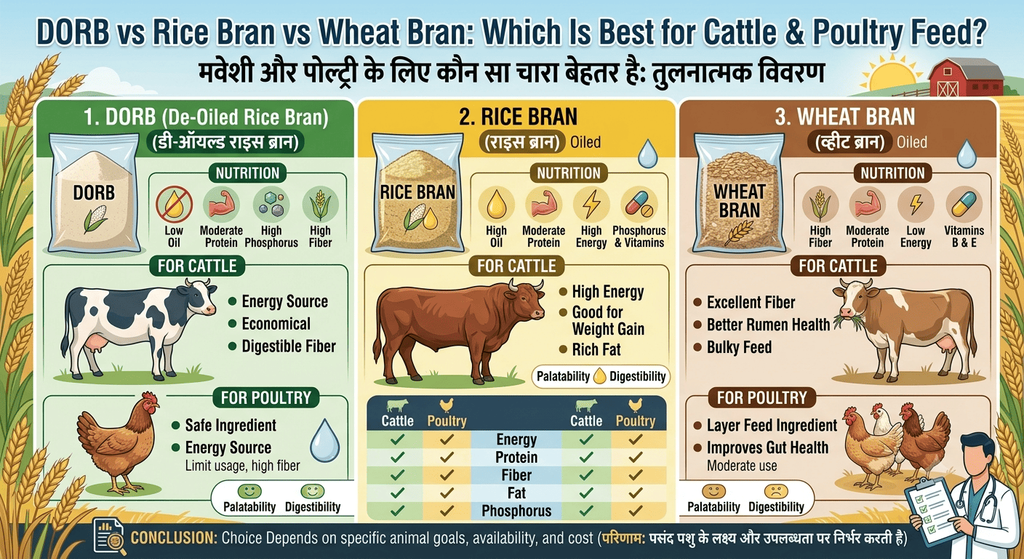
Quick answer: It depends on what the formulation needs. DORB is usually the cheapest and easiest to store, so it’s a natural base bran for dairy concentrates and works well at moderate levels in poultry feed. Full-fat rice bran has much more energy, but the oil in it goes rancid fast, so it’s only worth buying fresh or stabilised. Wheat bran has about the same protein as DORB and dairy buyers like it, though for birds it has the lowest energy of the three. In practice, most mills pick one as the base and use a second bran to fine tune cost or energy.
Put this question to a room full of feed millers and you’ll get a proper debate. One swears by DORB. Another won’t make a dairy concentrate without chokar. Someone else buys rice bran every time a nearby sheller has fresh stock.
They’re all right, for their own mills.
In the bag, the three brans look much alike. Inside a formulation, they don’t behave alike at all. Fat, energy, shelf life and price each move differently, and that’s what decides which one belongs in your next batch.
Haven’t worked with DORB before? Start with our guide on what DORB is and how it is used in livestock feed. Here, we’ll put all three side by side.
Three Brans, Three Very Different Stories!
- DORB (de-oiled rice bran) is what’s left once a solvent plant has taken the oil out of rice bran. No oil means nothing to go rancid, so it stores for months and blends without trouble. Protein is moderate, fibre is on the higher side.
- Full-fat rice bran is the same brown layer polished off the rice grain, just with the oil still in it. That oil is where its energy comes from. The catch is lipase, an enzyme in the bran that starts breaking the oil down almost as soon as the rice is milled. Fresh rice bran is a good buy. Week-old bran from a warm godown often isn’t.
- Wheat bran, or chokar as most of the trade calls it, comes out of flour mills. It’s bulky, has fair protein and very little fat. Because its supply follows flour milling and not rice milling, it’s a handy fallback when rice-based brans get tight.
Side by Side: What Each Bran Brings to the Spec Sheet!
These are typical ranges for Indian material. Always formulate on the Certificate of Analysis for your actual batch.
| Parameter | DORB | Rice Bran (full-fat) | Wheat Bran |
| Crude protein | 14 to 17% | 12 to 14% | 14 to 17% |
| Crude fat | Under 1% | 14 to 20% | 3 to 5% |
| Crude fibre | 12 to 16% | 8 to 12% | 9 to 12% |
| Total ash | 10 to 14% | 8 to 11% | 5 to 7% |
| Energy for poultry (ME) | 1,800 to 2,000 kcal/kg | 2,600 to 3,000 kcal/kg | 1,300 to 1,600 kcal/kg |
| Energy for cattle (TDN) | 55 to 60% | 70 to 75% | 65 to 70% |
| Total phosphorus | 1.2 to 1.6% (mostly phytate) | 1.3 to 1.8% (mostly phytate) | 1.0 to 1.2% |
| Storage stability | High | Low | Medium |
Look at the protein row first. DORB and wheat bran are almost level. Then look at energy, where rice bran pulls well ahead. The gap is far bigger in the poultry row than the cattle row, since a cow’s rumen gets a lot more out of fibre than a bird’s gut does.
Quick Compare: Cattle View vs Poultry View!
Same bran, different job, depending on who’s eating it.
| Bran | In a Cattle Ration | In a Poultry Diet |
| DORB | The dependable base bran. Low fat means easy blending at higher inclusion. | A cost-efficient filler at moderate inclusion. Phytase helps unlock its phosphorus. |
| Rice bran | The energy leader, with inclusion capped by its oil content. | The only one of the three that adds real energy, as long as it is fresh. |
| Wheat bran | Valued for bulk and palatability, with protein close to DORB. | The lowest energy for birds, most useful in pullet and layer grower diets. |
Where Does Each Bran Fits in a Cattle Ration?
Dairy concentrates can use all three, and plenty of good ones do.
DORB usually carries the load. You can push it fairly high without worrying about total ration fat, and it won’t spoil if a consignment sits for a few weeks.
Rice bran is what nutritionists reach for when they want more TDN. Its oil sets a limit, though, so it tends to stay a smaller share of the mix.
Then there’s chokar. A lot of dairy buyers simply expect it in a concentrate, and its protein is close enough to DORB that the two swap in and out easily. Just remember it’s very low in calcium compared to its phosphorus, so the mineral mix has to make up for that.
Across North India, a DORB and wheat bran blend is probably the most common starting point, with rice bran added whenever fresh stock comes in at a sensible price. Our cattle feed formulation and ration balancing guide walks through how to balance these step by step.
Where Does Each Bran Fit in Poultry Feed?
Birds are a different story. They handle fibre poorly and need dense energy, so every bran comes in at lower levels.
DORB is mostly about saving money here. Used at moderate levels in grower, finisher and layer feeds, it takes the place of pricier ingredients, as long as you make up the energy from maize or oil.
Rice bran is the one bran of the three that actually adds energy to a bird’s diet. Buy it fresh, buy it close to the mill, and check for free fatty acids if it’s been sitting around.
Wheat bran has the least energy for poultry. It makes most sense in pullet and layer grower feeds, where some bulk is actually welcome.
For targets by phase, see our broiler feed guide covering starter to finisher nutrition.
Practical Inclusion Rates at a Glance!
Treat these as working ranges. Mills formulating on digestible amino acids with enzyme support often sit at the top end or a bit beyond.
| Feed Type | DORB | Rice Bran (fresh or stabilised) | Wheat Bran |
| Dairy cattle concentrate | 15 to 30% | 10 to 15% | 10 to 25% |
| Broiler starter | 0 to 3% | 0 to 5% | 0 to 3% |
| Broiler grower and finisher | 3 to 8% | 5 to 10% | 2 to 5% |
| Commercial layers | 5 to 12% | 5 to 10% | 5 to 10% |
| Growing pullets | Up to 10% | 5 to 8% | 5 to 15% |
Which Bran Fits Your Formulation?
Pick your species on the left, then find what matters most for this batch. Use it as a starting point before you run the numbers in your formulation software.
| Species | More Energy per kg | Lowest Cost per Nutrient | Safe Monsoon Storage | Fibre and Bulk Targets |
| Dairy cattle | Rice bran on a DORB base, with total fat kept in check | DORB, with wheat bran when its price dips | DORB | Wheat bran blended with DORB |
| Broilers | Fresh rice bran at modest inclusion | DORB at 3 to 8% in grower and finisher | DORB | DORB, with wheat bran only at low levels |
| Layers and pullets | Fresh rice bran at 5 to 10% | DORB at 5 to 12%, paired with phytase | DORB | Wheat bran, with DORB sharing the load |
You’ll notice DORB turns up almost everywhere. It’s simply the easiest bran to build a formulation around. Rice bran and wheat bran come in when you’re chasing something specific.
The Cost Question: Price per Bag vs Price per Nutrient!
We see this one a lot. A buyer picks the brand with the lowest price per kg and assumes that’s the saving. Sometimes it is. Often it isn’t.
What you’re really paying for is protein and energy, so price them that way:
- Price per kg of protein = price per kg ÷ (crude protein % ÷ 100)
- Price per kg of TDN (cattle) = price per kg ÷ (TDN % ÷ 100)
Here’s a quick worked example with illustrative prices:
| Bran | Example Price | Crude Protein | ₹ per kg Protein | TDN | ₹ per kg TDN |
| DORB | ₹15/kg | 15.5% | ₹96.77 | 57.5% | ₹26.09 |
| Rice bran | ₹20/kg | 13% | ₹153.85 | 72.5% | ₹27.59 |
| Wheat bran | ₹22/kg | 15.5% | ₹141.94 | 67.5% | ₹32.59 |
Example prices only. Use today’s delivered rates and your batch COA values for a real comparison.
Per bag, rice bran looks a third dearer than DORB. Per kg of TDN, there’s barely ₹1.50 between them. That’s why it pays to do the sum. DORB tends to come out ahead on protein, fresh rice bran can hold its own on energy, and wheat bran has its good weeks when flour mills are running flat out.
There’s also a supply angle this season. India reopened DORB exports in late 2025, so domestic mills now compete with export buyers for the same material. A contracted supplier is worth more than it used to be. For current rates across the main ingredients, see our raw material price comparison for 2026.
Storage and Monsoon: The Factor Buyers Underrate!
Great specs don’t count for much if the bran spoils in a damp godown.
DORB is the forgiving one. Keep it dry, and it holds for months, so buying ahead of the rains is realistic.
Wheat bran stores fairly well but draws insects, which means regular pest control and first-in, first-out stock rotation.
Full-fat rice bran is the tricky one. Free fatty acids start climbing within days of milling, and monsoon humidity only speeds that up. Plan to use it quickly.
What to Check Before You Accept a Load?
- Moisture on your batch, ideally under 11 to 12% for all three
- For DORB: acid insoluble ash (sand and silica), residual oil, and crude fibre to catch husk mixing
- For rice bran: free fatty acids and smell. A sharp, soapy odour means it’s already turning
- For wheat bran: live insects, lumps, or a musty smell
- Aflatoxin test results on every load, and more so through the monsoon
- Consistency from one delivery to the next, so your formulation doesn’t need weekly tweaks
The full list of parameters worth tracking is in our guide on cattle feed ingredients and quality standards.
From the mill floor: [ADD: one or two lines from Dr. Rishabh Chugh from real experience, such as the DORB and wheat bran split he most often sees in North Indian dairy concentrates, or how buyers switch brans during the monsoon.]
Frequently Asked Questions!
- Is DORB better than rice bran for cattle feed?
For most dairy concentrates, yes, as the base bran. It’s low in fat, keeps well and usually costs less per kg of protein. Rice bran has more energy, so use it as a smaller top up when you can get it fresh.
- Can wheat bran replace DORB in poultry feed?
Partly. The protein is about the same, but wheat bran has less energy for birds, so a straight swap drops the energy of the diet. It suits pullet and layer grower feeds best.
- How much DORB can go into poultry feed?
Most mills use 3 to 8% in broiler grower and finisher feeds and 5 to 12% in layer feeds, with starters kept low. If you buy layer feed, our layer feed price guide for a 50 kg bag shows how ingredient choices affect bag price.
- Why does rice bran go rancid so fast?
It’s full of oil and also contains lipase, an enzyme that breaks that oil down once the rice is milled. Within days to a few weeks, it can turn rancid. Taking the oil out, as with DORB, or heat stabilising the bran largely fixes this.
- How does DORB compare with DDGS and Soya DOC?
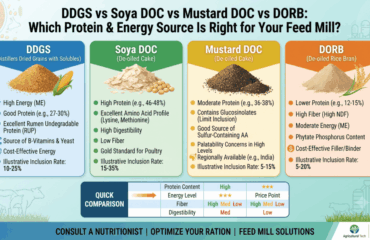
They do different jobs. DORB is a moderate protein, high fibre ingredient, while DDGS and the DOCs are there mainly for protein. Our DDGS vs Soya DOC vs Mustard DOC vs DORB comparison shows how they fit together.
About Brinda Foods!
Brinda Foods has supplied animal feed raw materials from Panipat, Haryana, since 1987. We supply bulk De-Oiled Rice Bran (DORB), along with Maize DDGS, Rice DDGS, Soya DOC and Mustard DOC, to cattle and poultry feed manufacturers across India, with lab verified specification documentation on every batch. ISO 9001:2015 certified.
Consistent specs, clear documentation and a supply you can plan your formulation around.
Get today’s bulk quote: Submit an enquiry or contact our team.