
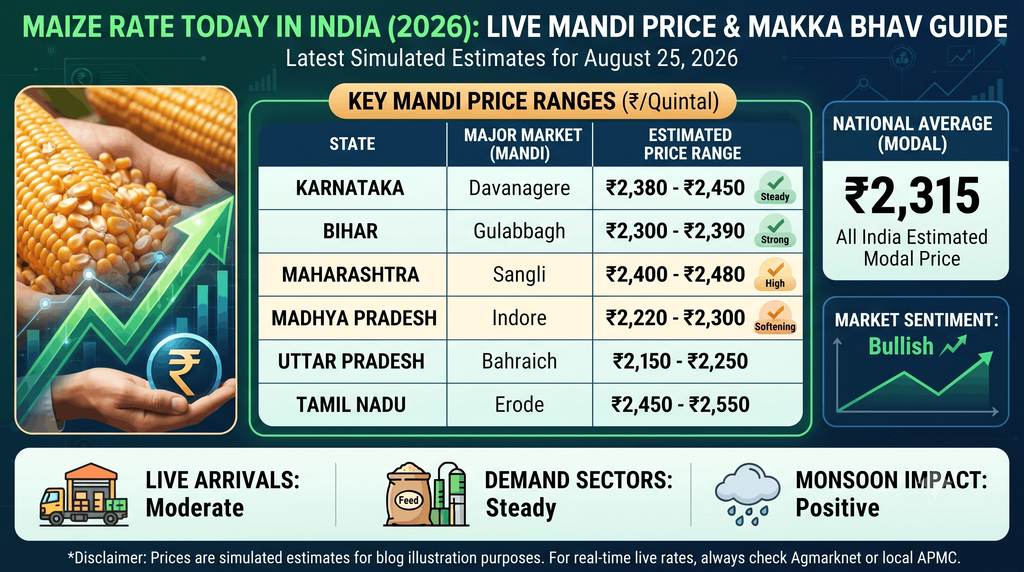
Quick answer: As of September, 2026, maize (makka) is trading at a national average of roughly ₹2,250–2,450/quintal (₹22.50–24.50/kg) across major mandis, with a wider min–max spread of ₹1,850–2,550/quintal (₹18.50–25.50/kg) depending on mandi and quality. That’s still running below the Kharif 2026-27 MSP of ₹2,410/quintal (₹24.10/kg) in most markets, which means government procurement centres are currently the better sale option for farmers in many regions. Mandi rates change every trading day — this page is a directional snapshot, not a live feed, so confirm today’s exact figure with your local mandi board or with Brinda Foods before booking a bulk order.
Today’s Maize Rate: Quick Snapshot
| Metric | Per Quintal | Per Kg |
|---|---|---|
| National average (mandi, Aug 25, 2026) | ₹2,250–2,450 | ₹22.50–24.50 |
| National min–max range | ₹1,850–2,550 | ₹18.50–25.50 |
| MSP (Kharif 2026-27) | ₹2,410 | ₹24.10 |
| Feed-grade delivered (bulk, North India) | ₹2,200–2,600 | ₹22–26 |
Most mandis are currently pricing maize at or slightly below MSP, which is typical for the lean pre-harvest window (July–September) before fresh kharif stock starts arriving from October. Where a mandi is quoting meaningfully below MSP, farmers selling in volume are generally better served checking their nearest government procurement centre first.
Makka Bhav Today: Sample Mandi-Wise Rates
“Makka bhav” (मक्का भाव) is simply the Hindi-language way traders and farmers search for the same information — today’s maize rate by mandi. Rates vary significantly by state, arrival volume, and moisture content on any given day. A representative sample from major mandis:
| State | Mandi | Min (₹/quintal) | Max (₹/quintal) | Avg (₹/quintal) |
|---|---|---|---|---|
| Andhra Pradesh | Rayadurg | 2,200 | 2,650 | 2,400 |
| Andhra Pradesh | Addanki | 2,400 | 2,430 | 2,420 |
| Bihar | Kishanganj | 2,350 | 2,550 | 2,450 |
| Uttar Pradesh | Kanpur (Grain) | Higher-end outlier — verify locally | — | — |
| Madhya Pradesh | Manawar | 1,510 (low outlier) | — | — |
These figures move daily and vary mandi-to-mandi based on arrivals, moisture, and grading — treat any single mandi’s number as a local reference point, not the national rate. Extremely high or low single-mandi prints (well outside the ₹1,850–2,550 range) are usually data-entry outliers rather than genuine market moves, so cross-check against the national average before acting on them.
Quick Read : Cattle Feed Price in India
Quick Read : Soya DOC Price in India
Quick Read : Mustard DOC Price in India
Quick Read : DORB Price in India
Quick Read : Broiler Feed Price in India
Why “Today’s” Maize Rate Moves So Much
Unlike formulated feed products, whose prices shift gradually, raw maize is a live commodity — which is exactly why “rate today” and “bhav” searches spike daily among traders and farmers. Five factors drive the day-to-day movement:
1. Daily arrivals. A heavy arrival day at a major mandi (more farmers bringing grain to sell) typically softens that day’s price; thin arrivals firm it up.
2. Lean-season stock tightness (current period). September sits in the July–November lean season, when the previous kharif crop’s stock is at its tightest before the new harvest — historically the firmest pricing window of the year, and the reason today’s rate is running close to MSP rather than well below it.
3. Ethanol blending demand. A growing share of India’s maize crop is now diverted into fuel-grade ethanol production, a structural demand pull that shows up as firmer day-to-day pricing versus a few years ago — the same dynamic covered in our Maize DDGS price guide, since DDGS is the co-product of that process.
4. MSP procurement activity. On days when government procurement centres are actively buying in a region, it puts a same-day floor under nearby mandi rates.
5. Moisture and grading at arrival. Freshly harvested or monsoon-affected lots with higher moisture typically clear at a discount to dry, well-graded maize on the same day, in the same mandi.
Seasonal Pattern: When “Today’s Rate” Tends to Be Lowest and Highest
| Period | Typical rate behaviour |
|---|---|
| October–December (post-harvest) | Lowest rates of the year as fresh kharif crop floods mandis |
| January–March | Gradual firming as post-harvest stock gets absorbed |
| April–June | Continued firming; pre-monsoon buying activity |
| July–September (lean season — current) | Firmest rates of the year, typically closest to or above MSP |
If you’re checking “maize rate today” purely to time a large purchase, the October–December window (right after this lean season ends) has historically offered the most favourable buying rates — worth weighing against storage cost if you have the capacity to hold stock.
Maize Rate Today vs. Maize Price Per Kg vs. Maize MSP — Not the Same Question
This page tracks the live, day-to-day mandi rate — the number that changes daily and is what “maize rate today,” “maize price today,” and “makka bhav” searches are really asking for. It’s a companion to, not a replacement for, our Maize Price Per Kg guide, which is anchored on the annual MSP figure and the quintal-to-kg conversion buyers need when comparing quotes. Use that page for the MSP baseline and unit conversion; use this page for what maize is actually trading at on a given day. For the nutrition and inclusion-rate side of maize buying — how much to use in poultry and cattle rations — see our maize for animal feed guide.
Frequently Asked Questions
What is the maize rate today in India? As of September, 2026, maize is trading at a national average of roughly ₹2,250–2,450/quintal (₹22.50–24.50/kg), with individual mandis ranging ₹1,850–2,550/quintal depending on quality and location. Rates change daily — confirm with your local mandi or with Brinda Foods for the current figure before booking.
What is makka bhav today? “Makka bhav” is the Hindi term for today’s maize price. It follows the same national range as “maize rate today” — currently averaging ₹2,250–2,450/quintal — but always varies mandi to mandi based on daily arrivals and grading.
Is maize trading above or below MSP right now? Below, in most mandis. The Kharif 2026-27 MSP is ₹2,410/quintal (₹24.10/kg), and current mandi averages of ₹2,250–2,450/quintal sit at or just under that floor in many markets — meaning government procurement centres are currently the better sale option for farmers with access to one.
Why does the maize rate change every day? Daily arrival volumes, moisture and grading of that day’s lots, MSP procurement activity in the region, and structural demand from the ethanol and feed industries all move the price day to day — which is why “today’s rate” genuinely differs from yesterday’s, unlike more stable formulated feed prices.
When is maize rate typically lowest during the year? Rates are typically lowest in the October–December window right after the kharif harvest floods mandis with fresh supply, and firmest in the July–September lean season — the period this page is currently published in.
Where can I book bulk feed-grade maize at today’s rate? Brinda Foods supplies feed-grade maize in bulk to compound feed mills and integrators from Panipat, Haryana. Request today’s bulk quote — pricing is confirmed at time of order given daily rate movement.
About Brinda Foods
Brinda Foods has supplied animal feed raw materials from Panipat, Haryana since 1987. We provide bulk supply of Maize, Maize DDGS, Soya DOC, Mustard DOC, and other feed ingredients to mills and farms across India. ISO 9001:2015 certified.
Get today’s bulk quote: Submit an enquiry or contact our team.




[…] Quick Read: Maize Rate Today in India (2026) […]
[…] useful conclusion is where your leverage is. Maize and Soya DOC are 80% of the ingredient cost, and a one-rupee move in maize shifts the bag by ₹27. […]