
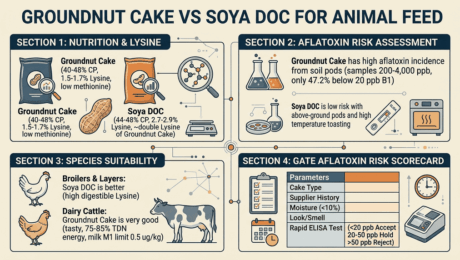
Groundnut Cake vs Soya DOC: Which Protein Source Makes Sense for Your Feed?
Quick answer: For most mills, Soya DOC. It has nearly double the lysine of groundnut cake (around 2.8% against 1.6%) and far less aflatoxin trouble. Groundnut cake isn’t a bad ingredient, though. Protein is about the same, 40 to 48%, and cattle eat it happily. At October 2026 prices it even works out roughly ₹13
- Published in Uncategorized
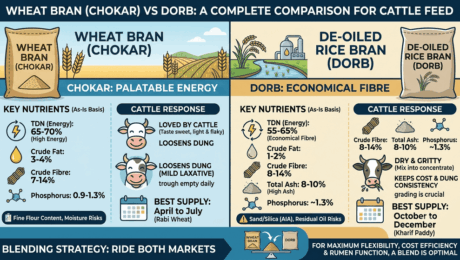
Wheat Bran (Chokar) vs DORB: Which Is Better for Cattle Feed?
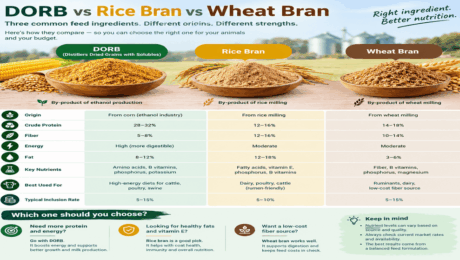
Quick answer: Honestly, you’ll probably want both. Protein wise there’s nothing between them (13 to 16% in each), so neither is what you buy for protein. Chokar has more energy, around 65 to 70% TDN against 55 to 65% for DORB, cattle eat it happily, and it loosens the dung a bit. DORB is cheaper
- Published in Uncategorized
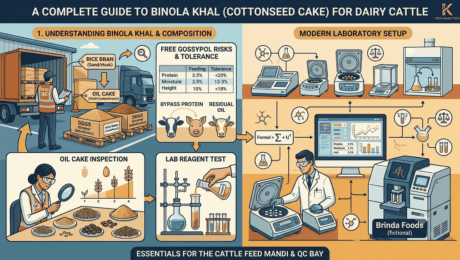
Cottonseed Cake (Binola Khal) for Cattle: Protein, Gossypol and Safe Feeding Limits
Quick answer: For a grown cow or buffalo, binola khal is a perfectly good protein. The undecorticated cake that most mandis in the north sell has somewhere around 20 to 24% crude protein with a lot of fibre in it, and the decorticated kind (made after the hull is removed) can go to 34 to
- Published in Uncategorized
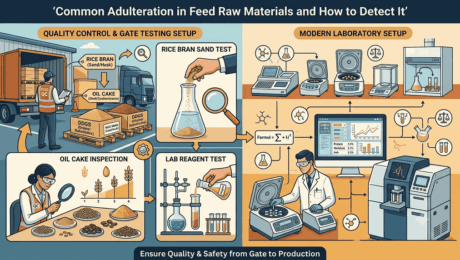
Common Adulteration in Feed Raw Materials and How to Detect It
Quick answer: Sand in rice bran, urea in oil cake, husk in bran and cheap cake mixed into good cake are the four I run into most at Indian feed mill gates. Sand gives itself away through acid insoluble ash (AIA). Urea makes protein look better than it is, and a DMAB or urease test
- Published in Uncategorized
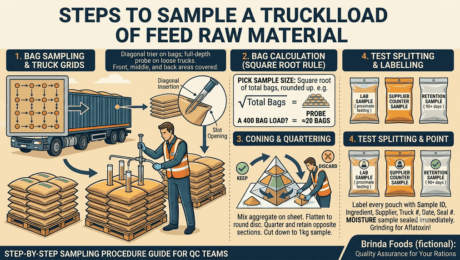
How to Sample a Truckload of Feed Raw Material: A Step-by-Step Sampling Procedure!
Quick answer: Count the bags on the truck. Take the square root. Probe that many bags, picked from all over the load, not just the back. A 400 bag truck? About 20 bags. Tip everything onto one sheet, mix it properly, and cut it down by coning and quartering till you’re left with roughly a
- Published in Uncategorized
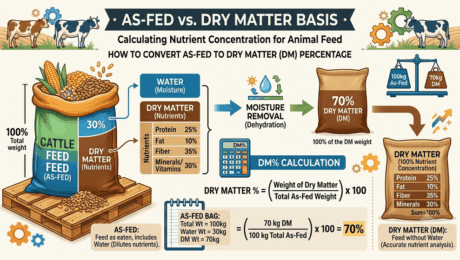
As-Fed vs Dry Matter Basis: How to Convert Feed Nutrient Values (With Examples)
Quick answer: Knock the moisture off 100 to get dry matter. Then divide your as-fed number by that dry matter (as a fraction). DDGS at 10% moisture has 90% DM, so its 27% as-fed protein becomes 27 ÷ 0.90, which is 30% on DM. To come back, multiply by the same 0.90. Say two Soya
- Published in Uncategorized
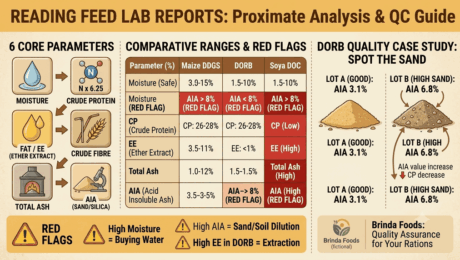
How to Read a Feed Lab Report: Proximate Analysis Explained (CP, EE, CF, Ash, AIA, NFE)?
Quick answer: Proximate analysis breaks a feed sample into six parts. These are moisture, crude protein (nitrogen × 6.25), ether extract or fat, crude fibre, ash, and nitrogen free extract, which the lab works out by subtraction. If you only learn one extra number, make it acid insoluble ash (AIA). It’s mostly sand and silica,
- Published in Uncategorized
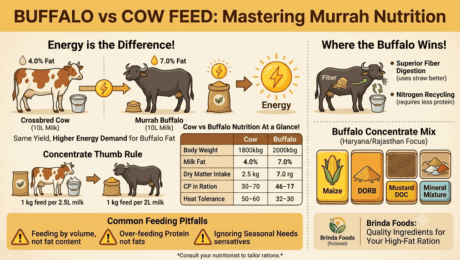
Buffalo Feed vs Cow Feed: How Murrah Buffalo Nutrition Differs
Quick answer: A buffalo can eat everything a cow eats. The difference is in how much. Buffaloes do brilliantly on straw, but their milk has close to double the fat of cow milk, and fat needs a lot of energy. So don’t feed a Murrah by litres. Feed her by fat-corrected milk, and give her
- Published in Uncategorized
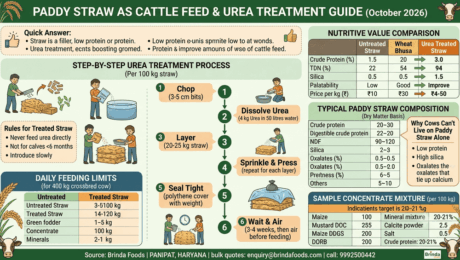
Paddy Straw as Cattle Feed: Nutritive Value, Feeding Limits & Urea Treatment Guide (October 2026)
Quick answer: Paddy straw fills the stomach but doesn’t feed the cow much. It has 3 to 5% crude protein and 40 to 45% TDN, a lot of silica, and oxalates that tie up calcium. Use it with green fodder, a good concentrate and a mineral mixture. If you treat it with urea (4 kg
- Published in Uncategorized
Feed Raw Material Buying Calendar for India: Best Months to Buy Maize, Soya DOC, Mustard DOC, DORB & DDGS
Quick answer: Feed ingredient rates in India go up and down with the crops they come from. New kharif maize and soybean hit the mandis from October, so October through January is when maize and Soya DOC are easiest on the pocket. DORB picks up in winter, once the rice mills are in full swing.
- Published in Uncategorized