Quick answer: For a grown cow or buffalo, binola khal is a perfectly good protein. The undecorticated cake that most mandis in the north sell has somewhere around 20 to 24% crude protein with a lot of fibre in it, and the decorticated kind (made after the hull is removed) can go to 34 to 40%. Both have gossypol in them. Adult cattle don’t really mind it at normal amounts, but calves below four months, pigs and poultry do, so keep them off it. A milking cow usually does well on 1 to 2.5 kg a day mixed into a proper concentrate.
Why Is Binola Khal Still on Every Dairy’s Shopping List?
If you walk into a khal bhandar anywhere between Sirsa and Jind, chances are the binola khal bags are kept right near the door, because that’s what moves fastest. Pick up a piece and your fingers come away slightly oily.
Dairy owners here have trusted it for generations, and when you ask them why, the answer hardly ever changes: “fat badhata hai.”
With ginning in full swing this month and fresh cake reaching the mandis, I keep getting the same set of questions from buyers. Is it safe, how many kilos should a cow get, and is it any better than sarson khal? So here are my answers, one by one.
What Exactly Is Cottonseed Cake?
After cotton is ginned, the lint goes to the textile side and the seed, which we call binola, goes to an oil mill. Whatever is left after the oil is pressed out is the cake.
Most of our cottonseed is still crushed whole in expellers, hull and all, and an expeller never gets all the oil out, so the cake usually keeps 6 to 10% of it. People like binola khal largely because of this oil, though the same oil is what makes it tricky to store (I’ve covered that further down).
What Is the Protein Content of Decorticated vs Undecorticated Cottonseed Cake?
In decorticated cake the hull has been taken off before crushing, while undecorticated cake is made from the whole seed. The hull is basically fibre, so keeping it in brings the protein down.
BIS lays down limits for both in IS 1712:2022:
| Parameter (dry matter basis) | Decorticated cake | Undecorticated cake |
| Moisture, max | 8% | 8% |
| Crude protein, min | 40% | 24% |
| Crude fat, min | 7% | 7% |
| Crude fibre, max | 12% | 22% |
| Acid insoluble ash, max | 2% | 2% |
| Aflatoxin B1, max | 20 ppb | 20 ppb |
| Castor husk, mahua cake | Absent | Absent |
| Free gossypol | As agreed with buyer | As agreed with buyer |
Keep in mind these limits are on dry matter, so a bag at 8% moisture that only just meets the 24% mark will show about 22% protein as fed. Our note on converting as-fed and dry matter values explains the conversion if you need it.
What actually sells in the mandi doesn’t always match the standard. Some loose binola khal is sold with about 22% protein and fibre near 27%, which is more fibre than BIS allows, and in that case a good part of what you’re paying for is husk. That’s why I always say compare cakes on protein and not on the price of the bag.
Is Binola Khal a Good Protein for the Rumen?
Yes, and this is something people rarely talk about. Research on undecorticated cake shows roughly half of its protein is bypass protein, which means it isn’t broken down in the rumen and gets digested later in the intestine, and a good milker can make real use of that.
Its weak point is lysine. The heat in pressing makes some of the gossypol bind with lysine, so the cake ends up short of it. For cattle that’s not a big worry since the rumen microbes make up much of it, but hens and pigs can’t do that, and it’s one of the reasons cottonseed cake isn’t used much for them.
What Is Gossypol and Which Animals Are Most Sensitive?
Gossypol is a yellowish pigment the cotton plant keeps in small glands inside its seed, mainly to keep insects away. It shows up in the cake in two forms:
• Bound gossypol, which is stuck to the protein. Very little of it gets absorbed, so it’s mostly harmless.
• Free gossypol, the active form that can cause harm, and the one you should ask your supplier about.
The heat inside an expeller binds a good share of the free gossypol, so normal expeller cake doesn’t carry much. A Punjab Agricultural University study measured about 0.06% free gossypol in undecorticated expeller cake, whereas cake pressed with very little heat can have several times more, so do ask your supplier how the cake is made.
Which Animals Need the Most Care?
• Young calves, up to 3 or 4 months. Their rumen hasn’t started working yet, so gossypol goes straight into the blood. A trial on Holstein calves found feed with 200 ppm free gossypol was safe but 400 ppm was toxic, and on farms the trouble usually starts when a calf eats from its mother’s trough.
• Pigs. They are very sensitive, so it’s better not to give it to them at all.
• Poultry. Also sensitive, and in laying hens it can change the yolk colour, so leave it out unless the meal has been specially treated.
• Breeding bulls. Gossypol can affect sperm quality, which is why most vets either keep it very low for bulls or don’t give it.
• Grown cows and buffaloes. These handle it best, because the rumen binds a lot of the free gossypol before it can be absorbed.
How Much Gossypol Is Too Much for a Grown Cow?
Research from Auburn University found toxic signs in mature cows at around 24 g of free gossypol a day, which comes to about 0.1% of the ration dry matter, and most nutritionists keep total gossypol for adult cattle below roughly 1,000 ppm.
Compare that with what a cow really eats. Even 2.5 kg of binola khal at 0.06% free gossypol gives her only about 1.5 g a day, which is far below that level. So for adult animals, the things that actually limit how much binola khal you use are its fibre, its oil and its price, not gossypol.
If you’re buying a large lot from a mill you haven’t dealt with before, get free gossypol tested separately along with the usual protein, fibre and AIA. Our guide on reading a feed lab report tells you how to make sense of those numbers.
How Much Binola Khal Can a Milking Cow Eat Per Day?
For a 400 kg crossbred cow, I would start with the ranges below, and remember they are part of her concentrate and not something you add over and above it.
| Animal | Binola khal per day | Keep in mind |
| Calf under 4 months | None | Keep calves away from the cows’ trough |
| Growing heifer, 6 to 12 months | Up to 0.5 kg | Inside the concentrate |
| Dry cow | 0.5 to 1 kg | Watch body condition |
| Milking cow, 8 to 10 litres | 1 to 1.5 kg | Balance with other proteins |
| Milking cow, 15 to 20 litres | 1.5 to 2.5 kg | Ration set by your nutritionist |
| Milking buffalo | 1.5 to 2.5 kg | Go by fat corrected milk |
| Breeding bull | Avoid, or under 0.5 kg | Fertility comes first |
In compound concentrate, most formulators don’t take binola khal beyond 20 to 25% of the mix, because after that the fibre starts lowering the energy. For how much concentrate a cow needs per litre of milk, see our guide to concentrate feed for dairy cows.
Buffaloes handle binola khal just as well, although their concentrate is worked out slightly differently, and you can read about how Murrah buffalo nutrition differs from a cow’s.
Does Cottonseed Cake Raise Milk Fat?
To some extent, yes, so the old “fat badhata hai” saying isn’t wrong. There are two reasons for it:
• The oil left in the cake adds fat to the diet, and part of that fat passes into the milk.
• The fibre from the hull keeps the cow chewing cud, and good rumination helps her keep up fat %.
That said, the effect is small. Fat % depends far more on breed, the stage of lactation and the quality of roughage, and no amount of binola khal is going to take a 3.5% cow up to 5%.
Feeding too much of it can actually have the opposite effect, since excess unsaturated oil slows down the fibre digesting microbes in the rumen and fat % falls. Sticking to moderate amounts gets you the benefit without this.
Cottonseed Cake vs Mustard DOC: Which Is Better Value?
A lot of buyers just look at the rate per kg, but the figure that matters more is how much you pay for each kg of protein.
| Binola khal (undecorticated) | Mustard DOC | |
| Crude protein, as fed | 20 to 24% | 35 to 40% |
| Crude fibre | 20 to 27% | 8 to 12% |
| Residual oil | 6 to 10% | 1 to 3% |
| Bypass protein | About half | Lower |
| Main caution | Gossypol, high fibre | Glucosinolates |
| Price per kg (indicative, Oct 2026) | ₹27 to ₹45 | ₹24 to ₹30 |
| Cost per kg of protein (approx.) | ₹125 to ₹190 | ₹65 to ₹85 |
Rates move weekly, and loose and branded binola khal are priced quite differently, so use your own quotes here.
For example, binola khal at ₹32 with 22% protein means you pay around ₹145 for every kg of protein, while mustard DOC at ₹26 with 36% protein comes to roughly ₹72, about half.
But binola khal gives you things mustard DOC doesn’t, like oil that counts as energy and bypass protein that high yielders benefit from. So my suggestion is to use both, with mustard DOC supplying most of the protein and a moderate share of binola khal for the oil, the bypass protein and the taste cows like.
If you plan to raise the mustard DOC share, read our complete guide to mustard DOC in animal feed before you do that, as it explains the glucosinolate limits. And if you’re also comparing DDGS, soya and DORB, this side by side comparison of DDGS, Soya DOC, Mustard DOC and DORB puts all four together in one table.
What Could a Concentrate With Binola Khal Look Like? (per 100 kg)
| Ingredient | kg |
| Maize, crushed | 30 |
| Binola khal | 20 |
| Mustard DOC | 15 |
| Maize DDGS | 10 |
| De-oiled rice bran | 22 |
| Mineral mixture | 2 |
| Salt | 1 |
| Total | 100 |
This mix gives about 18 to 19% crude protein, and with the cake at 0.06% free gossypol the whole mix carries around 120 ppm, which is well within what adult cattle can take. Calves should still get a separate calf starter.
A cow giving 10 litres could start on 4 to 5 kg of this along with green fodder, dry roughage and plenty of clean water. Please take it only as an example, since the final numbers should come from your lab reports, current rates and your nutritionist. Our cattle feed formulation and ration balancing guide explains how that balance is worked out.
What Storage Risks Does Binola Khal Carry?
The leftover oil that makes binola khal popular is also what makes it harder to store.
• Rancidity. In hot weather the oil goes stale, the cake starts smelling sharp and cows eat less of it, so in summer buy fresh stock and use it up within 6 to 8 weeks.
• Aflatoxin. Cottonseed gets mouldy easily and BIS allows a maximum of 20 ppb aflatoxin B1, so be extra careful with stock bought during the monsoon.
• Moisture. It should stay under 8%, because damp cake heats up inside the stack.
• Adulteration. The common ones are sand, extra husk and urea added to show higher protein, and the standard says castor husk and mahua cake must not be present at all. You’ll find simple tests in our guide on spotting adulteration in feed raw materials.
• Stacking. Stack on pallets, leave space from the walls and keep air moving. The points in our guide to storing DDGS, Soya DOC and DORB without spoilage apply to binola khal as well.
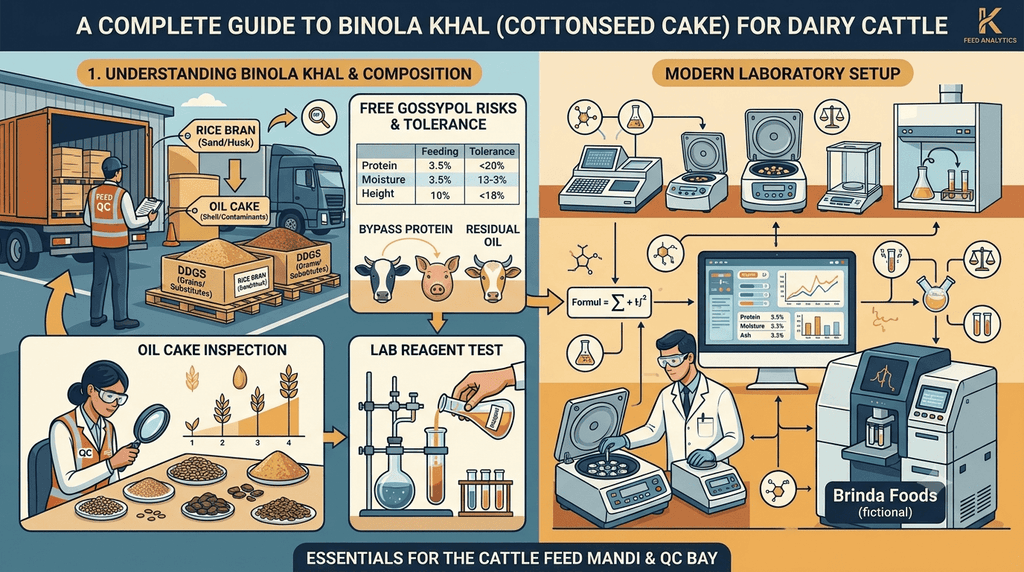
Before accepting any lot, check it with your own eyes and nose. Good cake has an even brown colour and a nutty smell, feels oily but not wet, and has no grey or green patches on it. Then ask the supplier to give protein, fibre, AIA, aflatoxin and free gossypol in writing.
Frequently Asked Questions!
- What is the protein content of binola khal? The regular undecorticated binola khal you get in most mandis has about 20 to 24% crude protein as fed, and decorticated cake, where the hull is taken off first, has around 34 to 40%.
- Is cottonseed cake safe for calves? Not until they are 3 to 4 months old, because their rumen isn’t working yet and gossypol goes directly into the blood. Heifers above six months can be given a small amount in their concentrate.
- How much binola khal can a milking cow eat per day? A 400 kg crossbred cow can usually be given 1 to 2.5 kg a day, depending on how much milk she gives, as long as it’s part of a balanced concentrate.
- Does binola khal increase milk fat? It helps a little because of the oil and fibre in it, but breed, stage of lactation and good roughage make a much bigger difference.
- Is binola khal better than mustard khal? Mustard DOC gives you protein at a lower cost, while binola khal brings oil, bypass protein and taste, so most good rations use some of both.
- Can poultry or pigs eat cottonseed cake? It’s better to avoid it for them, since both are sensitive to gossypol and cottonseed protein is low in the lysine they need.
- Can buffaloes eat binola khal? Yes, a milking buffalo can be given about as much as a high yielding cow, which is roughly 1.5 to 2.5 kg a day.
- How long can binola khal be stored? It’s best used fresh, ideally within 6 to 8 weeks in summer and a little longer in dry winter weather, stacked off the floor in a godown with good airflow.
Brinda Foods!
Brinda Foods is a family business from Panipat, Haryana, and we have been supplying animal feed raw materials since 1987 to cattle feed makers, dairy cooperatives, gaushalas and compound feed units all over North India.
When binola khal is part of your concentrate, you need the other protein and energy sources to be consistent too. We deal in Mustard DOC, Soya DOC, Maize DDGS, Rice DDGS, De-Oiled Rice Bran, Maize, Maize Gluten and Rice Gluten, and each batch is sent with its lab tested specs. You can check our feed concentrates range, or just call us and we’ll be happy to help you plan rations for this season.
For a bulk quote: Send us an enquiry | Call: 9992500442 | Email: sales1@brindafoods.com