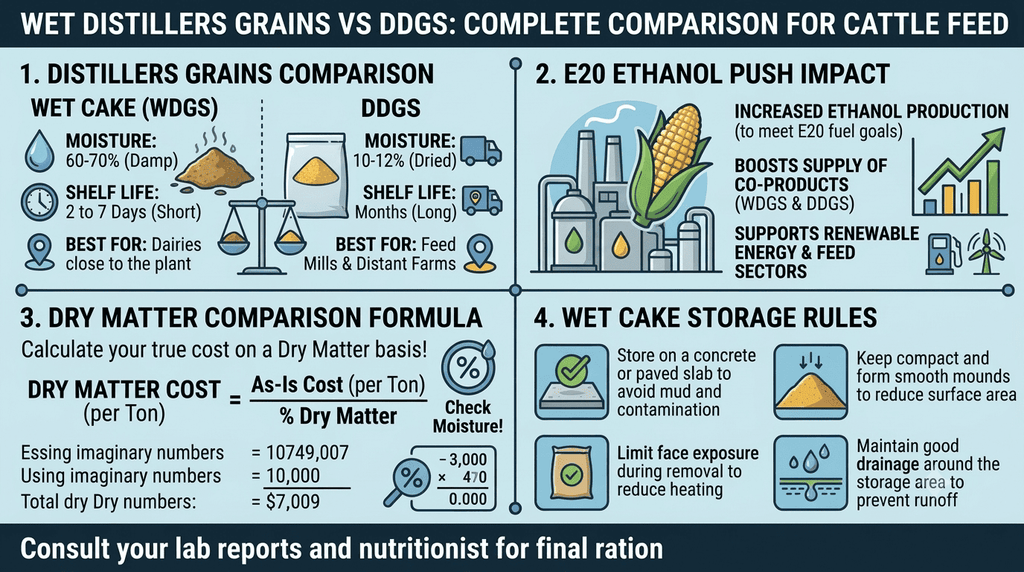
Quick answer: Wet distillers grains, or wet cake, is the leftover from a grain distillery that nobody bothered to dry. Cheap by the tonne. Trouble is, two thirds of that tonne is water, it starts going off in a few days, and you’re paying freight on the water too. DDGS is the same residue dried to around 10 to 12% moisture, so it keeps for months and travels fine. Close to the plant with a big herd? Wet cake can work out cheaper. Anyone else, and any feed mill, is better off with DDGS.
Anyone running a dairy near a grain distillery knows the pitch. “Wet cake, very cheap, take a truck.” And next to that number, DDGS looks expensive.
Is it actually cheaper, though? Sometimes yes. Quite often, no. Because what you’re mostly buying is water, and water’s heavy and it doesn’t keep.
We’ll start with the names (there are a lot of them), then do the price maths properly, then get to who should buy which. If DDGS itself is new to you, read our piece on what DDGS is and why feed mills use it first.
What are WDGS, DWGS, DDGS and HP-DDGS?
Same starting point for all of them. Maize or rice goes in, gets ground and fermented, and the ethanol is distilled off. The sloppy hot stuff left behind is called whole stillage.
Next the plant spins it in a centrifuge. Out come wet solids on one side and thin liquid on the other, and the liquid gets cooked down into a syrup. Then it’s just a question of how much drying the plant wants to pay for. That one call is behind nearly every name you’ll see on a quote.
| Type | What it is | Moisture | Keeps for | Best fit |
| Wet cake (WDGS / DWGS) | Grain solids plus syrup, not dried | 60 to 70% | 2 to 7 days | Dairies close to the plant |
| Modified wet (MWDGS) | Wet cake partly dried | About 45 to 60% | A little longer than wet cake | Nearby farms; rare in India |
| Condensed solubles (CDS, syrup) | Evaporated thin stillage | About 70% | Days | Usually blended back in at the plant |
| DDG | Grain solids dried without syrup | About 10% | Months | Less common in Indian trade |
| DDGS | Wet cake plus syrup, dried | 10 to 12% | Months, if kept dry | Feed mills, distant farms, exporters |
| HP-DDGS | Fibre removed during processing, then dried | About 10% | Months | Poultry and swine formulators |
WDGS, DWGS. Don’t let these two confuse you, they’re one product. Wet distillers grains with solubles versus distillers wet grains with solubles. Somebody just flipped the words. In the market it’s all “wet cake” anyway. The abbreviations are explained in our DDGS full form and FAQ guide if you want them in one place.
HP-DDGS is the high protein version. Some plants pull the fibre out of the grain either before or after fermenting it, and what’s left comes in at 36 to 48% crude protein or so. Normal maize DDGS? Closer to 27. Most of those plants are in America. Over here, Rice DDGS usually ends up filling that gap, because rice gives you somewhere around 40 to 45% protein without any special process at all. How millers choose between the two is in our Rice DDGS vs Maize DDGS guide.
How long do wet distillers grains keep?
A few days. Fewer here than in most places.
Larry Chase at Cornell, who’s spent a career on dairy nutrition, says five to ten days if it’s cool and two to four if it’s hot and humid. Purdue came up with much the same thing (three or four days in a warm summer, five to seven in winter). Untreated wet cake sitting out in humid weather can turn in three days flat.
Now think about our calendar.
• April to June: two, maybe three days from the gate to the trough.
• Monsoon months, plan for two. Honestly.
• North Indian winter is kinder. Cover the pile, feed from the face, and a week isn’t unrealistic.
DDGS plays by different rules. It leaves the dryer at 10 to 12% moisture and, kept dry and off the floor, it’ll sit happily in a godown for months. Drying isn’t free, mind you. Iowa State reckons it’s about 40% of what an ethanol plant spends on energy. So part of the DDGS price is that drying bill. You get shelf life and cheaper haulage in return.
How do you compare wet cake and DDGS prices fairly?
Forget the per tonne price. That’s where most people go wrong.
Take one tonne of each. Wet cake at 32% dry matter gives you 320 kg of feed. DDGS at 89% gives you 890. So you need to compare on dry matter (DM), and then load in what wet cake doesn’t show on the invoice: freight on all that water, plus whatever spoils or gets refused.
The sum we use with buyers looks like this:
Cost per kg of dry matter = (price per kg + freight per kg) ÷ DM fraction ÷ (1 − spoilage loss)
Here it is with some numbers. They’re made up, just to show how it works. Put your own quote, freight and lab DM in their place.
| Item | Wet cake, 75 km, cool weather | Wet cake, 250 km, summer | Maize DDGS, delivered |
| Price at gate (₹/kg) | 4.00 | 4.00 | 14.00 |
| Freight (₹/kg) | 0.30 | 1.00 | 0.50 |
| Dry matter | 32% | 32% | 89% |
| Spoilage and refusal loss | 8% | 12% | Negligible |
| Cost per kg of dry matter | ₹14.6 | ₹17.8 | ₹16.3 |
Look at the first column. Wet cake hauled 75 km in cool weather lands at ₹14.6 per kg of DM, under DDGS at ₹16.3. Fine. Now move the plant 250 km away and make it summer. Same wet cake, ₹17.8. DDGS wins now. Change any one input and the answer can flip, so we’d always run the sum rather than go on gut feel.
A couple of checks before you trust it.
• Test DM on every load you get. Wet cake from one plant won’t match the next, and even one plant’s moisture drifts shift to shift. Say you assumed 32% DM and the load is really 28%. You’ve just paid about 14% more than you thought. Our guide on how to read a feed lab report tells you what to ask the lab for.
• Don’t use an old DDGS rate. Maize DDGS prices have jumped around this year, so check our DDGS price in India tracker before you plug a number in.
Which suits a small dairy and which suits a feed mill?
Distance and herd size. That’s really it. One decides your freight, the other decides how fast the pile disappears.
The truckload test. Ten tonnes of wet cake arrive at 32% DM, so 3.2 tonnes of actual feed. Your ration uses maybe 2.5 kg of distillers grains DM per cow a day (about 12% of a 20 kg intake, well inside the 10 to 15% nutritionists usually suggest for the wet stuff). That truck covers around 1,280 cow days. You’d need roughly 320 cows to finish it in four summer days. With 25 cows, it’d take you the best part of two months. The pile won’t last one week, let alone eight.
Smaller loads on a tractor trolley? Possible. Freight per kilo shoots up though, and there goes your discount. Inclusion levels by animal class are in how much DDGS to include in dairy cattle feed.
Wet cake usually makes sense when!
• The plant’s near. Do the sum, but somewhere under 100 km is a fair place to begin.
• Your animals can get through a load in three or four summer days.
• There’s a walled concrete pad, a cover, and somebody feeding from the face daily without fail.
• The plant runs steadily, and you’ve thought about what happens when it doesn’t.
DDGS usually makes sense when!
• You’re a longer drive away, or you’ve got fewer than a few hundred head.
• You run a mill. Mash and pellet lines want something dry that flows, and wet cake simply can’t be stored, batched or pelleted at mill volumes.
• You need a CoA to formulate against for every lot.
• It’s monsoon, or you need stock to last more than a week.
If you’re reworking a ration around either one, our cattle feed formulation guide walks through a Pearson Square with DDGS and other Indian ingredients.
How is E20 changing wet cake availability?
E20 (20% ethanol in petrol) arrived in June 2025, earlier than planned, and by January 2026 the country was blending a little over 20%. Grain has become a big part of that. Maize on its own is behind roughly 35% of India’s ethanol now, and we’ve written up what that means in India’s E20 ethanol push and what it means for Maize DDGS supply.
For a dairy owner, a few things follow.
• More wet cake within reach. DDGS output in India went up something like thirteen times in two years, hitting an estimated 5.5 million tonnes by 2025. With new grain distilleries in Bihar, UP, Gujarat, MP, Punjab and Haryana, farms that never had a plant nearby suddenly do.
• Grain keeps getting pulled into ethanol. Sugar was left out of the oil companies’ latest tender entirely, which puts maize, broken rice and FCI rice on the hook. Industry people expect ethanol to need about 16 million tonnes of maize in 2026 to 2027. Before, it was about 13.
• Wet cake comes and goes with the plant. According to USDA, close to half of India’s installed ethanol capacity is idle. A plant stops, the wet cake stops the same day. DDGS that’s already out in the market keeps moving. Lean on wet cake and you’ll want dried feed on standby.
So E20 cuts both ways. More farms can get wet cake, but supply is more local and less dependable. Think of DDGS as the base and wet cake as a top up when you’re close enough.
What are the storage and mould risks of wet cake?
It’s warm, it’s wet and it’s full of nutrients, which makes it ideal for moulds and yeasts. Trouble starts on the surface and creeps in. On top of that, any mycotoxin in the original grain is already concentrated around threefold (DM basis) in distillers co-products. Good yard habits protect what you’ve paid for.
• Concrete floor, side walls, cover on top. Never straight onto soil.
• Slice off the front every day. Don’t dig into the top or scatter the pile around.
• Old pile first. A fresh load never goes on top of yesterday’s.
• Walk past it each morning. If it’s hot, smells sour or musty, or has blue, green or white patches, that portion is waste.
• For longer storage, farms have tried salt, acid based preservatives, airtight bags, or ensiling it with dry fodder. One Iowa State trial bagged wet grains and still found mould by a badly sealed vent. Get the seal right and the method matters less.
And DDGS? Safer, not invincible. Leave it in a damp godown through the rains and it’ll draw moisture. The checks are in our monsoon mycotoxin and aflatoxin guide.
Where Brinda Foods fits
We only sell the dried forms, Maize DDGS and Rice DDGS, sent out from Panipat to mills and dairies across the country. No wet cake, because it won’t survive the journey or the wait. Right next to a distillery? Do the sum and buy whatever comes out cheaper. Further away, or want something dried in reserve for shutdown weeks? We’d be glad to quote.
Frequently Asked Questions!
- Is wet cake the same as DDGS?
Basically yes, minus the drying. Wet cake is 60 to 70% moisture and lasts days. DDGS is dried to 10 to 12% and lasts months. Protein and fat look broadly alike once you compare on dry matter.
- What does DWGS stand for?
Distillers wet grains with solubles. Same product as WDGS. In Indian markets it just gets called wet cake.
- How long can wet distillers grains be stored?
Two to four days when it’s hot or humid, five to ten when it’s cool. That’s on a covered concrete pad, fed from the face.
- Is wet cake cheaper than DDGS?
By the tonne, almost always. By the kilo of dry matter that actually gets eaten, only if the plant’s close and your herd finishes each load in time. Divide the delivered price by the DM fraction, allow for spoilage, then decide.
- Can feed mills use wet distillers grains?
Not in any practical way. A mill needs something dry that stores, flows and tests consistently, and that’s DDGS.
- What is HP-DDGS?
High protein DDGS. Fibre and oil are pulled out during processing, leaving roughly 36 to 48% crude protein. In India, Rice DDGS (around 40 to 45% protein) usually plays that part.
- Does E20 mean more wet cake near me?
Maybe. Grain distilleries are opening in several states, but wet cake only flows on the days a plant runs. Keep dried feed as a backup.
About Brinda Foods!
Brinda Foods has been supplying animal feed raw materials out of Panipat, Haryana, since 1987. Maize DDGS, Rice DDGS, De-Oiled Rice Bran, Soya DOC and Mustard DOC, in bulk, to mills and farms all over India. ISO 9001:2015 certified.
Want a DDGS quote, or a backup supply plan?
Drop us an enquiry or ring 9992500442.